Quick answer
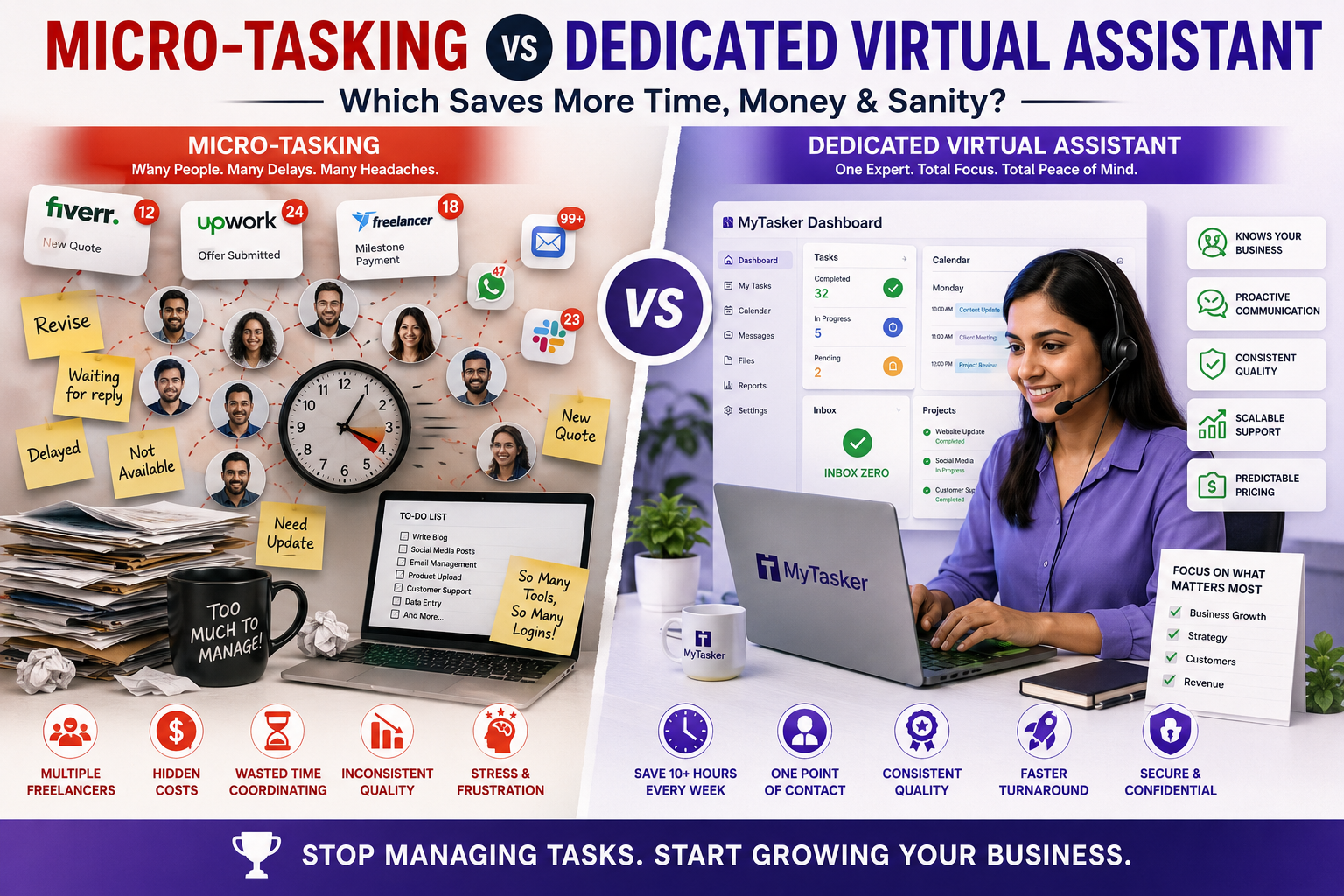
Micro-tasking hides its true cost because the invoice only captures the freelancer's time, not yours. The seven costs that never appear on a gig platform invoice are: repeated briefing, freelancer selection, revision review time, lost context between jobs, coordination across multiple providers, security cleanup, and availability risk. For most small businesses, the real cost of a micro-task is two to three times the invoice amount. The break-even point where a dedicated virtual assistant becomes cheaper is roughly when a task recurs more than twice a month, or when you're managing more than three freelancers at once.
You know what's fascinating?
People will spend three hours trying to save £20.
You'll hire someone for a £15 task because it feels like a win. Cheap. Efficient. Smart. Then you'll spend your afternoon explaining the task, reviewing it, requesting revisions, chasing replies, and wondering where your day went.
The invoice says £15.
Your calendar says something very different.
What is micro-tasking?
Micro-tasking is outsourcing work in single, disconnected units — one task, one freelancer, one payment — rather than assigning ongoing work to a consistent person. It's the model behind gig platforms like Fiverr and Upwork. Each job is bought separately, with no continuity between them.
Think of it like ordering takeaway every night.
Each meal isn't expensive. But nobody counts the delivery fees, the deciding, the waiting, or the fact your kitchen never gets organised.
Micro-tasking works the same way. Every task starts from scratch. Different freelancer, different process, different expectations, every single time.
That's the core of the micro-tasking vs dedicated virtual assistant question. One model resets to zero repeatedly. The other compounds.
What are the hidden costs of micro-tasking?
The seven costs that never appear on the invoice are re-briefing, selection, revision review, lost context, coordination overhead, security cleanup, and availability risk. Here's what each one actually looks like.
| Hidden cost | What it looks like | Typical time per task |
|---|---|---|
| Re-briefing | Explaining context, brand voice, file locations to someone new | 30–45 min |
| Finding the freelancer | Posting, reading proposals, comparing, vetting | 30–60 min |
| Revision review | Reading, feeding back, waiting, re-checking | 25–40 min |
| Lost context | Same mistakes, same questions, month after month | Compounds annually |
| Coordination | Five providers, five inboxes, five invoices | 15 min per provider, per task |
| Security cleanup | Revoking access nobody remembers granting | Usually skipped entirely |
| Availability risk | Your good freelancer is booked, pricier, or gone | Discovered at the worst moment |
Why do I keep repeating myself to new freelancers?
Because context doesn't transfer between people who never meet.
Every new freelancer asks the same questions. Where are the files? What's the brand voice? Do you have examples?
None of those questions is wrong. You've just answered them twenty times already.
It's like explaining the rules of cricket to a new friend every weekend. Eventually you're teaching more than you're playing.
Why does hiring freelancers take longer than the task?
Reading proposals. Checking reviews. Comparing prices. Working out why one person charges £15 and another £150.
On small jobs, selection routinely costs more time than delivery. This is the largest uncounted piece of the cost of outsourcing small tasks.
Are freelancer revisions actually free?
No. Revisions are free for the freelancer, not for you. Every round means reopening the file, rereading it, writing feedback, waiting, and reviewing again. Your time has value whether anyone invoices it or not.
What does "context doesn't compound" mean?
It means the work never gets faster, because nobody accumulates knowledge of your business.
Imagine your barber forgot you every visit. What haircut do you get? What number on the sides? Every month. Forever.
You'd lose your mind. Yet business owners accept exactly this from freelancers.
A dedicated assistant remembers your folders, your customers, your tone, your tools. By month six, they're catching problems before you notice them.
That's structurally impossible with micro-tasking. This is the single largest hidden cost, and the hardest to see, because it shows up as an absence — improvement that never happens.
How much time does coordinating freelancers cost?
Five freelancers means five conversations, five invoices, five deadlines, five follow-ups, five working styles.
The freelancer coordination cost is enormous precisely because it's invisible. It's spread across dozens of tiny interactions. Death by a thousand notifications.
What's the security risk of using many freelancers?
Micro-tasking creates repeated temporary access that never gets revoked, because there's no offboarding process for someone who was never formally onboarded.
Quick question: how many people still have access to your Google Drive? Your website? Your CRM?
Most small businesses can't answer immediately. Not through carelessness — through accumulation.
Is Fiverr worth it for small business?
Yes, for genuinely one-off and specialist work. No, for anything recurring.
Gig platforms are the right tool when you need:
- A one-time logo or brand asset
- A translation or voice-over
- A legal or contract template
- A specialist skill you'll use a few hours a year
- A trial run before committing to a retainer
It would make no sense to hire permanently for four hours of annual work.
The trap is drift. The one-off becomes weekly. Weekly becomes daily. Before long you're running a company through strangers you've never met.
That's when the maths changes.
When does a dedicated virtual assistant become cheaper than freelancers?
A dedicated assistant becomes the cheaper option when a task recurs more than twice a month, or when you're coordinating more than three freelancers simultaneously.
Two questions settle it:
- Do I need this task done every week?
- Am I juggling more than three providers?
If either answer is yes, you're paying the micro-tasking tax. You're no longer outsourcing work — you're managing outsourcing. Those are different jobs, and only one of them is yours to do.
How do I calculate the true cost of a micro-task?
Take a £30 task and add the time around it:
- 30 min — finding the freelancer
- 30 min — writing the brief
- 20 min — answering their questions
- 20 min — reviewing the delivery
- 15 min — requesting changes
- 10 min — checking the revision
That's roughly two hours of owner attention on a £30 invoice. Multiply by fifty tasks a year.
This is where the dedicated virtual assistant cost comparison finally makes sense. A monthly plan isn't competing against a £30 invoice. It's competing against everything surrounding it.
Completely different calculation.
Why do businesses underestimate this?
Because visible costs register and invisible ones don't.
It's why subscriptions feel harmless. It's why credit cards work. It's why owners celebrate a small freelancer invoice while burning founder hours managing it.
Our brains count money. They don't count attention.
Key takeaways
- The invoice captures roughly a third of what a micro-task actually costs you.
- The highest hidden cost isn't fees — it's that nothing compounds. Month six looks like month one.
- Micro-tasking is genuinely the right call for one-offs, specialisms, and trial runs.
- The break-even is twice-monthly recurrence, or three-plus concurrent freelancers.
- Most businesses should run both models: gig platforms for specialists, dedicated support for anything recurring.
Frequently asked questions
Is micro-tasking always the wrong choice?
No. For occasional, specialised work it's one of the smartest ways to outsource. The problem starts when occasional quietly becomes routine.
How do I know if my time is expensive enough to delegate?
Ask what you'd charge someone to buy one hour of your day tomorrow. Most owners answer far more than they pay freelancers. That gap is your answer.
Doesn't a dedicated assistant cost more?
On paper, usually. In practice, often not. The briefing disappears, the learning compounds, the coordination shrinks, and your attention returns to growing the business.
Can I use both freelancers and a dedicated assistant?
Yes, and most well-run operations do. Specialists via gig platforms, recurring work via a dedicated assistant. That combination is usually the sweet spot.
How long before a dedicated assistant pays back the setup time?
Typically four to eight weeks. There's an initial period where you invest more time than you save, then it inverts — and unlike micro-tasking, it keeps improving after that.
What tasks are best suited to a dedicated virtual assistant?
Anything recurring and context-heavy: inbox and calendar management, bookkeeping support, CRM updates, customer service, reporting, research, and content scheduling. The more your business context matters, the worse micro-tasking performs.
The real lesson
Micro-tasking isn't the problem.
Measuring it badly is.
The invoice tells you what left your bank account. It doesn't tell you what left your day. And in business, your attention is usually worth more than your money.
So before posting your next £15 job, ask one question.
Will I need this done again?
If the answer is yes, you're not buying a task. You're renting the same problem, repeatedly, forever.
Stop paying the micro-tasking tax
At MyTasker, you work with a dedicated virtual assistant who learns your business, your systems, and your preferences instead of starting from scratch every week. One accountable point of contact, structured onboarding, secure processes, and flexible plans that scale with you.
Book a free consultation and find out what your time is really worth.