When invoices are organized, vendors are paid on time, and records stay accurate, operations become much easier and less stressful. Yet many businesses overlook a critical hire that makes this possible: a skilled Accounts Payable professional.
Hiring an AP specialist is one of those decisions that truly get appreciated when everything runs smoothly behind the scenes.
Why Accounts Payable Matters More Than You Think
Accounts Payable is not just about paying bills. It's the backbone of financial operations that helps businesses stay organized, manage cash flow strategically, and maintain strong vendor relationships. When AP functions run smoothly, your entire organization benefits.
Key Benefits of Having a Strong AP Team:
On-time payments: Build reliability and trust with suppliers
Strong vendor relationships: Negotiate better terms and pricing
Better cash flow management: Strategically time payments to optimize liquidity
Accurate financial records: Support decision-making with clean data
Smooth day-to-day operations: Reduce stress and prevent costly errors
The Seven Core Responsibilities of Accounts Payable
1. Invoice Processing
The foundation of AP operations starts here. A qualified AP professional will:
-
Receive, review, and verify all incoming invoices
-
Ensure accuracy in amounts, vendor details, and coding
-
Prevent duplicate submissions and catch discrepancies early
2. Vendor Management
Strong supplier relationships begin with organized record-keeping:
-
Maintain accurate vendor databases with contact information
-
Update payment details, terms, and account information
-
Serve as the primary contact for vendor inquiries and issues
3. Payment Processing
Timely payments are critical to business operations:
-
Schedule and process payments according to agreed-upon terms
-
Ensure payments are made on time to avoid late fees and relationship damage
-
Select the most cost-effective payment methods (check, ACH, wire transfer, etc.)
4. Record Keeping
Documentation is essential for compliance and audits:
-
Maintain accurate and organized AP records
-
Keep all supporting documents easily accessible
-
Ensure compliance with retention requirements
5. Account Reconciliation
Regular reconciliation prevents errors from compounding:
-
Reconcile vendor statements to internal records
-
Investigate and resolve discrepancies promptly
-
Catch fraud and errors before they impact financial reporting
6. Expense Tracking
Accurate categorization drives financial insights:
-
Track all expenses and categorize them correctly
-
Support month-end and year-end closing processes
-
Provide detailed data for financial analysis
7. Reporting
AP professionals support strategic decision-making:
-
Prepare comprehensive AP reports for management
-
Provide data that informs cash flow planning
-
Give visibility into spending patterns and vendor performance
The AP Workflow: Four Essential Steps
Effective Accounts Payable operations follow a structured process:
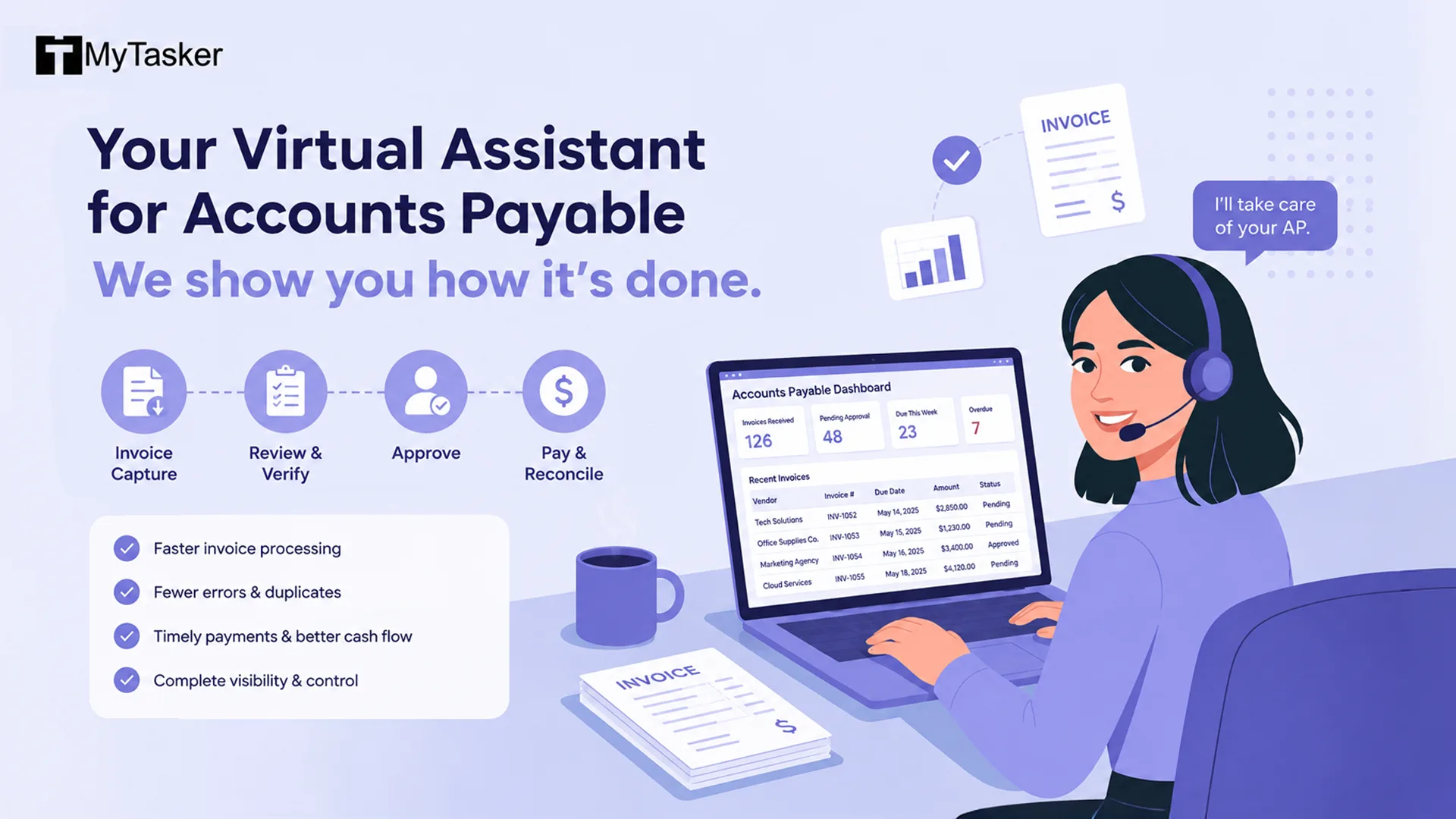
1. Receive Invoice: Collect and log all vendor invoices
2. Review & Approve: Verify accuracy and get appropriate authorization
3. Process Payment: Schedule and execute the payment
4. Record & Reconcile: Document the transaction and reconcile records
This workflow ensures nothing falls through the cracks and creates an audit trail for compliance.
Understanding AP Accounting: Debit vs. Credit
To hire the right AP professional, you should understand the accounting mechanics:
When you incur an expense from a vendor, Accounts Payable increases (credit). When you pay the vendor, cash decreases (credit) and AP decreases (debit). A knowledgeable AP professional will understand these relationships intuitively.
Best Practices for AP Operations
Implement these practices to maximize efficiency and accuracy:
Verify invoices before payment: Catch errors and fraud early
Keep vendor records up to date: Prevent misdirected payments
Pay on time to avoid late fees: Protect cash and relationships
Reconcile accounts regularly: Monthly or quarterly, not just annually
Maintain organized documentation: Support audits and dispute resolution
Common Mistakes to Avoid
Even well-intentioned AP departments can stumble. Watch out for these pitfalls:
-
Paying without proper approval: Create a documented authorization process
-
Duplicate payments: Implement system checks and reconciliation controls
-
Missing invoices: Use a centralized system for invoice capture and tracking
-
Incorrect coding: Train your team on account coding requirements
-
Poor communication with vendors: Set clear expectations and respond promptly
What to Look for in an AP Professional
When hiring, prioritize candidates who demonstrate:
-
Attention to detail: Accuracy is non-negotiable in AP
-
Organizational skills: Multiple invoices, vendors, and deadlines require systematic thinking
-
Communication ability: They'll interact with vendors, internal teams, and leadership
-
Technical proficiency: Familiarity with accounting software and Excel
-
Understanding of accounting fundamentals: At minimum, basic knowledge of debits, credits, and general ledger entries
-
Integrity: They'll handle company payments and sensitive vendor information
Frequently Asked Questions
Do I really need a dedicated AP person, or can I combine this with accounting duties?
Depends on volume. If you process 50-100 invoices monthly, a dedicated person makes sense. Below that, someone can do AP as part of broader accounting work. But understand the trade-off: hybrid roles mean AP gets deprioritized during busy periods, which is when accuracy matters most. The moment AP work backs up—invoices pile up, vendor calls increase, reconciliation lags—you've created the problem you were trying to avoid. A dedicated hire, even part-time, eliminates that conflict.
What experience level should I look for—entry-level or someone with years in the role?
Entry-level candidates (0-2 years) are cheaper and often hungry to prove themselves, but you'll spend time training and catching their mistakes. Mid-level (3-5 years) typically have seen enough problems to anticipate them. They're worth the extra cost. Senior candidates (5+ years) are pricier but bring systems thinking and vendor management experience that prevents issues before they arise. For a growing company that's hit AP chaos, a mid-to-senior hire pays for itself in avoided problems.
How much of an AP person's time should I expect to be "busy work" versus strategic?
If your processes are manual-heavy and paper-based, expect 70-80% routine work. If you've invested in AP software and decent workflows, that drops to 40-50%. The gap matters: bored AP professionals burn out and leave. Investing in tools that reduce manual work actually keeps your hire longer and makes the role more attractive. It's not an expense—it's retention investment.
4. Should I hire based on accounting software experience or general competence?
General competence. AP software changes, but the underlying logic doesn't. Someone who understands invoices, reconciliation, vendor relationships, and cash implications can learn any AP system in a few weeks. Someone technically proficient but conceptually lost in four different systems remains lost. Prioritize judgment and communication skills—software fluency is secondary.
Conclusion
Great AP professionals keep everything running smoothly behind the scenes. Investing in the right hire means fewer headaches, better financial visibility, and stronger vendor relationships. When you empower your AP team with clear processes, good tools, and ongoing support, you create a foundation for operational excellence that benefits your entire organization.
The next time an invoice is processed on time, a vendor relationship is strengthened, or a discrepancy is caught before it becomes a problem, remember: that's the impact of a skilled Accounts Payable professional at work.