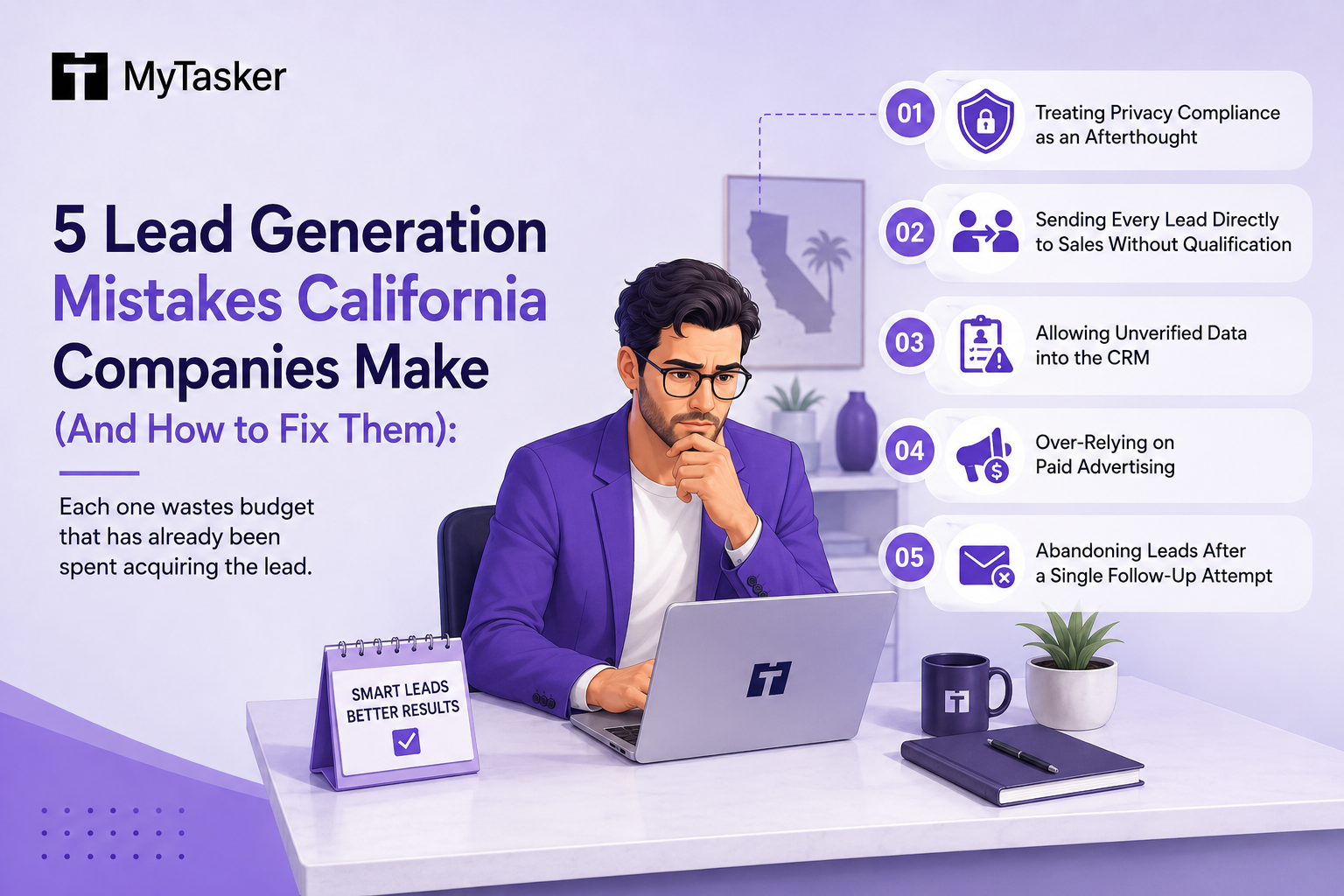
Quick answer: The five most common lead generation mistakes California companies make are
(1) treating privacy compliance as an afterthought,
(2) sending every lead directly to sales without qualification,
(3) allowing unverified data into the CRM,
(4) over-relying on paid advertising, and
(5) abandoning leads after a single follow-up attempt.
Each one wastes budget that has already been spent acquiring the lead.
Over the years, we have worked with California businesses at every stage of growth, from fast-moving Silicon Valley startups to established statewide companies. Every lead generation audit tells a slightly different story, but the underlying problems repeat. Companies invest heavily in attracting leads, then lose the return to small operational gaps.
California has never been an easy place to acquire customers. Advertising costs climb, competition is relentless, and privacy regulations are stricter than in most other states. Winning new business requires more than good campaigns. It depends on what happens after someone clicks your ad, submits your form, or joins your mailing list.
That is usually where things fall apart.
A company might spend tens of thousands of dollars a month driving traffic, then lose qualified prospects because leads are not verified, not routed correctly, or not followed up in time. In other cases, weak privacy practices create compliance exposure that better processes would have prevented.
The encouraging part: none of these is a hard problem. They are systems problems, and systems can be built and maintained.
Mistake #1: Treating Privacy Compliance as an Afterthought
The short version: Under the CCPA as amended by the CPRA, California businesses must honour Global Privacy Control signals and document valid consent for every lead source, including purchased lists. Treating this as an annual review item rather than an operational process creates real regulatory exposure.
For many businesses, compliance only gets attention when regulations change, or a legal question comes up. That is an increasingly risky posture.
California's privacy landscape has shifted significantly. The California Privacy Protection Agency (CPPA) has expanded its enforcement capabilities, and regulators are paying closer attention to how businesses collect, share, and process customer data. Public-facing websites can be reviewed for missing Global Privacy Control support, confusing consent flows, or opt-out mechanisms that do not function as described.
Enforcement actions have made one point clear: regulators are not focused only on the world's largest technology companies. For instance, in 2022, the California Attorney General secured a $1.2 million settlement against Sephora for sharing customer data with third-party analytics and advertising trackers without notifying consumers or honoring opt-out signals. Businesses of every size are expected to demonstrate that they respect consumer privacy and obtain valid consent before sharing personal information with advertising platforms or marketing partners.
For growing companies, the financial penalty is only part of the cost. Regulatory reviews consume time, legal fees accumulate quickly, and even a minor public investigation damages customer trust.
What is Global Privacy Control (GPC)?
Global Privacy Control is a browser-level signal that automatically communicates a visitor's opt-out preference to every website they visit. Under California law, a valid GPC signal must be treated as a legitimate request to opt out of the sale or sharing of personal information. The visitor does not need to interact with your cookie banner for the signal to count.
How to fix it
Make privacy compliance part of everyday operations rather than an annual checklist.
- Honour Global Privacy Control signals automatically. If a visitor opts out through their browser, your website and tracking tools should recognise that preference without any further action from the user.
- Audit every lead source. Whether you generate leads internally or purchase them from a third party, confirm you can verify when and how consent was obtained. If a vendor cannot produce clear documentation, reconsider the relationship.
- Keep consent choices symmetrical. Visitors should not have to hunt for an opt-out button while the opt-in is visually emphasised. Equal prominence reduces regulatory risk and builds trust.
- Log consent at the record level. Store timestamp, source, and consent language against each contact in your CRM so you can evidence compliance without a manual investigation.
Privacy compliance is not only about avoiding penalties. Businesses that are transparent about data handling tend to earn longer-term trust.
Mistake #2: Sending Every Lead Straight to Sales
The short version: Passing unqualified leads to sales wastes your most expensive resource. A lead scoring model that combines explicit firmographic data with behavioural signals, plus an agreed handoff threshold, protects sales capacity for buyers who are actually ready.
One of the most expensive mistakes we see is assuming every new lead deserves immediate attention from a salesperson.
Consider paying $25 to $40 for a click on Google, then routing every form submission to a sales representative regardless of buying intent.
For instance, according to recent search advertising benchmarks from Cactus Marketing and LocaliQ, high-intent commercial search terms in competitive B2B verticals—such as enterprise SaaS, cybersecurity, and legal tech in major markets like California—frequently average $25 to $50+ per click.
Before long, salespeople spend more time chasing casual researchers than talking to serious buyers.
The result is predictable. Sales loses confidence in lead quality, marketing questions campaign performance, and genuinely promising opportunities sit in a queue alongside low-intent enquiries.
Lead scoring solves exactly this problem, yet many companies either skip it or rely on rules nobody has revisited in years.
What is lead scoring?
Lead scoring is a system that assigns a numeric value to each lead based on how closely they match your ideal customer profile and how much buying intent their behaviour demonstrates. Leads above an agreed threshold are passed to sales as sales-qualified leads. Leads below it stay in automated nurture.
How to fix it
Build a scoring framework around two categories of signal:
| Signal type | What it measures | Examples |
|---|---|---|
| Explicit | Fit with your ideal customer profile | Company size, industry, job title, location, budget range |
| Behavioural | Demonstrated buying intent | Pricing page visits, repeat sessions, email opens, resource downloads, demo requests |
The strongest buying intent appears when both signals align. A marketing manager in your target industry who has visited your pricing page three times is a materially stronger opportunity than someone who downloaded one guide six months ago.
Most importantly, agree on the handoff threshold before you launch the model, and get sales and marketing to sign off on it together. Prospects below the threshold stay in automated nurture until they show stronger intent.
Your sales team's time is one of the most valuable resources in the business. Protecting it often moves revenue more than generating additional leads.
Mistake #3: Letting Bad Data Into Your CRM
The short version: Spam submissions, bots, disposable email addresses, and fake phone numbers corrupt reporting, waste sales time, and trigger automations for people who were never prospects. Real-time verification at the point of form submission is the fix.
Not every lead is a real person.
If your website attracts meaningful traffic, you are also collecting spam submissions, bot traffic, disposable email addresses, and invalid phone numbers. This affects businesses of every size, particularly those investing heavily in paid advertising. According to industry benchmarks from HubSpot, B2B contact data naturally decays at an average rate of 22.5% to 30% per year, while poor data quality costs organizations an average of $12.9 million annually.
The damage extends well beyond an untidy database. Sales representatives waste time dialling numbers that do not exist. Marketing reports become unreliable. Automation workflows fire for people who were never genuine prospects. Over time, these small leaks quietly reduce the return on every marketing dollar.
How to fix it
Stop bad data before it reaches the CRM, not after.
- Add real-time verification at form submission. Services such as ZeroBounce, NeverBounce, and Clearout validate email addresses before a record is created. Phone validation APIs do the same for numbers.
- Design forms that prevent errors rather than catching them later. Inline validation that guides a visitor to correct a mistyped email feels helpful; a rejection after submission feels punitive.
- Quarantine rather than auto-delete. Route suspicious submissions to a review queue instead of your primary pipeline. This prevents hours of wasted follow-up without discarding legitimate enquiries that happened to trip a rule.
- Run a quarterly hygiene pass. Deduplicate records, standardise field formats, and re-verify contacts that have gone dormant.
A clean CRM does more than simplify reporting. It gives your sales team confidence that every new lead is worth their attention.
Mistake #4: Depending Too Much on Paid Advertising
The short version: Paid advertising should accelerate a pipeline, not be the only thing sustaining it. Measuring cost per lead instead of true customer acquisition cost hides the moment when rising CPCs make a channel unprofitable.
Paid advertising deserves a place in a growth strategy. It should not be the only engine driving your pipeline.
Many California companies become heavily dependent on Google Ads or paid social because those channels produce results quickly. As long as budgets keep increasing, the leads keep arriving.
The problem is that advertising costs rarely hold still. In competitive verticals, cost per click can rise sharply in a short window. For instance, according to search advertising benchmark reports from LocaliQ and WordStream, average cost per click increased across 87% of industries year-over-year—with high-intent verticals such as Personal Services, Health & Fitness, and commercial real estate experiencing year-over-year CPC spikes ranging from 23% to over 40%.
When that happens, businesses relying almost entirely on paid traffic discover that acquisition costs have outpaced revenue. If conversion rates slip or follow-up slows at the same time, profitability disappears quickly.
This is why cost per lead is a misleading headline metric. A campaign producing cheap leads is not necessarily producing profitable customers. A campaign with a higher cost per lead may generate substantially more revenue if those prospects are genuinely qualified.
How to calculate true customer acquisition cost
CAC = (Ad spend + Marketing software + Sales salaries and commission + Content and creative costs + Operational overhead) ÷ Number of new customers acquired
Cost per lead measures the top of the funnel. CAC measures the whole business. Compare CAC against customer lifetime value (LTV) to see whether a channel is actually creating profit — a healthy B2B benchmark is commonly cited as an LTV: CAC ratio of 3:1 or better.
How to fix it
- Measure CAC and LTV: CAC by channel, not cost per lead.
- Build compounding assets. Educational articles, local SEO content, comparison guides, industry resources, and well-optimised service pages attract qualified visitors month after month without continuous spend. They take time to mature, but unlike paid campaigns, their value compounds.
- Diversify acquisition channels. Email marketing, referrals, partnerships, and organic search each play a different role. Companies with several working channels absorb CPC increases and algorithm changes far better than single-channel businesses.
Mistake #5: Giving Up After the First Follow-Up
The short version: B2B buying cycles frequently run for months. A lead marked unresponsive after one call and one email is usually not uninterested — the timing is wrong. Automated long-term nurture keeps the relationship alive until it is right.
Many businesses lose customers not because the lead was uninterested, but because the conversation stopped too early.
A prospect downloads a guide, requests a consultation, or completes a contact form. A salesperson makes one call, sends one email, waits. No immediate response, so the lead is marked "unresponsive" and attention moves elsewhere.
That is not how considered purchases work.
For B2B services, enterprise software, and professional consulting, decision cycles routinely stretch across several months. Priorities shift, budgets need approval, and additional stakeholders join the evaluation. According to research from RAIN Group and Gartner, it takes an average of 8 touchpoints to generate a qualified opportunity—with B2B sales cycles spanning anywhere from 3 to 10 months—yet industry benchmarks from Invesp show that 48% of salespeople never follow up after their initial attempt. Silence rarely means the opportunity is gone. It usually means the timing is not right yet.
Companies that stay visible through that period tend to be the ones who get the conversation when the buyer is finally ready.
How to fix it
- Treat nurture as relationship-building, not repeated selling. Deliver useful information at a comfortable cadence rather than recurring "are you ready to buy?" reminders.
- Publish content that answers real questions. For California businesses, that might include privacy regulation updates, operational best practice, or case studies from comparable industries.
- Automate the handback. When a salesperson pauses active outreach, your CRM should automatically move that lead into a long-term nurture sequence rather than letting the relationship end.
- Set a re-engagement trigger. If a nurtured lead revisits your pricing page or opens three consecutive emails, alert sales. Intent has returned.
Consistency outperforms persistence. Buyers remember the company that stayed genuinely helpful over months, not the one that called twice and disappeared.
The Real Challenge Is Not Knowing What to Do
None of these ideas is new.
Most marketing leaders already understand lead scoring, data quality, privacy compliance, and consistent follow-up. The difficult part is keeping all of those systems running well while simultaneously managing campaigns, supporting sales, and handling daily business priorities.
That is where organisations struggle. Processes drift. Automations break silently. Forms stop behaving as expected. CRM fields become inconsistent. Small operational issues compound into measurable losses in lead quality and campaign performance.
A healthy lead generation system requires ongoing maintenance, not a one-time setup.
How Companies Solve the Resource Problem
When businesses recognise they need stronger operational support, they generally choose one of three models.
| Model | What it gives you | The trade-off |
|---|---|---|
| In-house hire | Dedicated expertise, deep business context, close collaboration | Salary, benefits, training, recruitment time, and overhead |
| Agency or contractor | Access to experienced specialists, fast to start | Coordinating multiple vendors, fragmented ownership, variable continuity |
| Hybrid/outsourced operations | Strategy stays in-house while execution runs consistently at lower cost | Requires clear briefs, defined ownership, and good communication rhythm |
Under the hybrid model, companies keep strategy and decision-making internal while outsourcing implementation: CRM maintenance, workflow automation, lead scoring upkeep, reporting, and data management.
The right choice depends on your size, budget, and internal capability. What matters most is unambiguous ownership of the systems that move leads through your pipeline.
A Practical 60-Day Lead Generation Fix
Resist the temptation to change everything simultaneously. Fix the biggest weakness first.
Days 1–15 — Diagnose. Audit where leads enter, how they are scored, and where they stall. Pull a list of every form on your site and every third-party lead source.
Days 16–30 — Stop the leaks. Add real-time email and phone verification to your highest-traffic forms. Review what actually reaches your CRM against what was submitted.
Days 31–45 — Fix qualification. Rebuild or update your lead scoring model. Get written agreement from sales and marketing on what qualifies as sales-ready.
Days 46–60 — Measure properly. Calculate true CAC by channel, not cost per lead. Identify which channels produce customers rather than enquiries, and reallocate.
Ongoing — Compliance. Review consent mechanisms, privacy notices, and Global Privacy Control implementation against current California requirements. Schedule this quarterly.
A single meaningful improvement can produce measurable results within a few weeks.
Frequently Asked Questions
What is the most common lead generation mistake companies make?
Sending every lead directly to sales without qualification is the most common and most expensive mistake. It consumes sales capacity on prospects who are not ready to buy, erodes trust between sales and marketing, and delays follow-up on genuinely qualified opportunities. A lead scoring model with an agreed handoff threshold resolves it.
Why are my leads not converting into customers?
Low conversion usually points to one of four causes: leads are unqualified at the point of handoff, contact data is invalid so follow-up never reaches them, follow-up stops after one or two attempts, or the offer and audience are mismatched. Audit lead quality and data validity before increasing ad spend, because more traffic multiplies an existing conversion problem rather than solving it.
Do California businesses have to honour Global Privacy Control signals?
Yes. Under the CCPA as amended by the CPRA, a Global Privacy Control signal must be treated as a valid request to opt out of the sale or sharing of personal information. The signal must be honoured automatically, without requiring the visitor to interact with your cookie banner or preference centre. Businesses should confirm their consent management platform is configured to detect and act on GPC.
What is a good lead scoring threshold?
There is no universal number, because scores are relative to your own model. A practical approach is to score your last 50 closed-won customers retrospectively, identify the score band most of them fell into at the point they became sales-ready, and set your threshold at the lower boundary of that band. Review it quarterly as your product and market shift.
How many times should you follow up with a lead before giving up?
For B2B and considered purchases, stopping after one or two attempts is almost always premature. A more effective approach is to move leads out of active outreach after a defined number of attempts and into an automated long-term nurture sequence, rather than closing them entirely. Set a behavioural trigger — such as a return visit to your pricing page — to hand the lead back to sales when intent reappears.
How do you stop spam and fake form submissions?
Add real-time email and phone verification at the point of submission using a service such as ZeroBounce, NeverBounce, or Clearout. Combine this with inline field validation, a honeypot field or invisible CAPTCHA, and a quarantine queue for suspicious submissions rather than automatic deletion. Blocking bad data before it enters the CRM is far cheaper than cleaning it afterwards.
What is the difference between cost per lead and customer acquisition cost?
Cost per lead measures only what you spend to generate an enquiry. Customer acquisition cost includes advertising spend, marketing software, sales salaries and commission, content production, and operational overhead, divided by the number of customers actually won. A channel can produce cheap leads and expensive customers simultaneously, which is why CAC is the more reliable decision metric.
Should I outsource lead generation operations or hire in-house?
It depends on whether your constraint is strategy or execution. If you need someone to set direction and own the commercial relationship with sales, hire in-house. If your strategy is clear but recurring execution work — CRM maintenance, automation upkeep, reporting, data hygiene — keeps slipping, a hybrid model where strategy stays internal and execution is outsourced is usually more cost-effective than a full-time hire.
Conclusion
California remains one of the most competitive places in the country to generate new business. When acquisition is expensive, every qualified lead matters.
In our experience, the biggest gains rarely come from spending more on advertising. They come from improving the systems that support every lead after it arrives: how it is verified, routed, nurtured, and measured.
Those improvements seldom require major technology investment. More often they require disciplined process, regular maintenance, and a willingness to review what is working rather than assuming last year's approach still delivers.
At MyTasker, we have seen how relatively small operational improvements produce noticeable differences in lead quality, sales efficiency, and marketing performance. If you are unsure where your biggest opportunities lie, an independent review of your lead generation process often surfaces issues that are difficult to see from inside the business.
Whether you address those challenges internally or with external support, the goal is identical: make sure the leads you have already paid to acquire have the best possible chance of becoming long-term customers.
Talk to MyTasker about a lead generation operations review