TL;DR (bulleted):
-
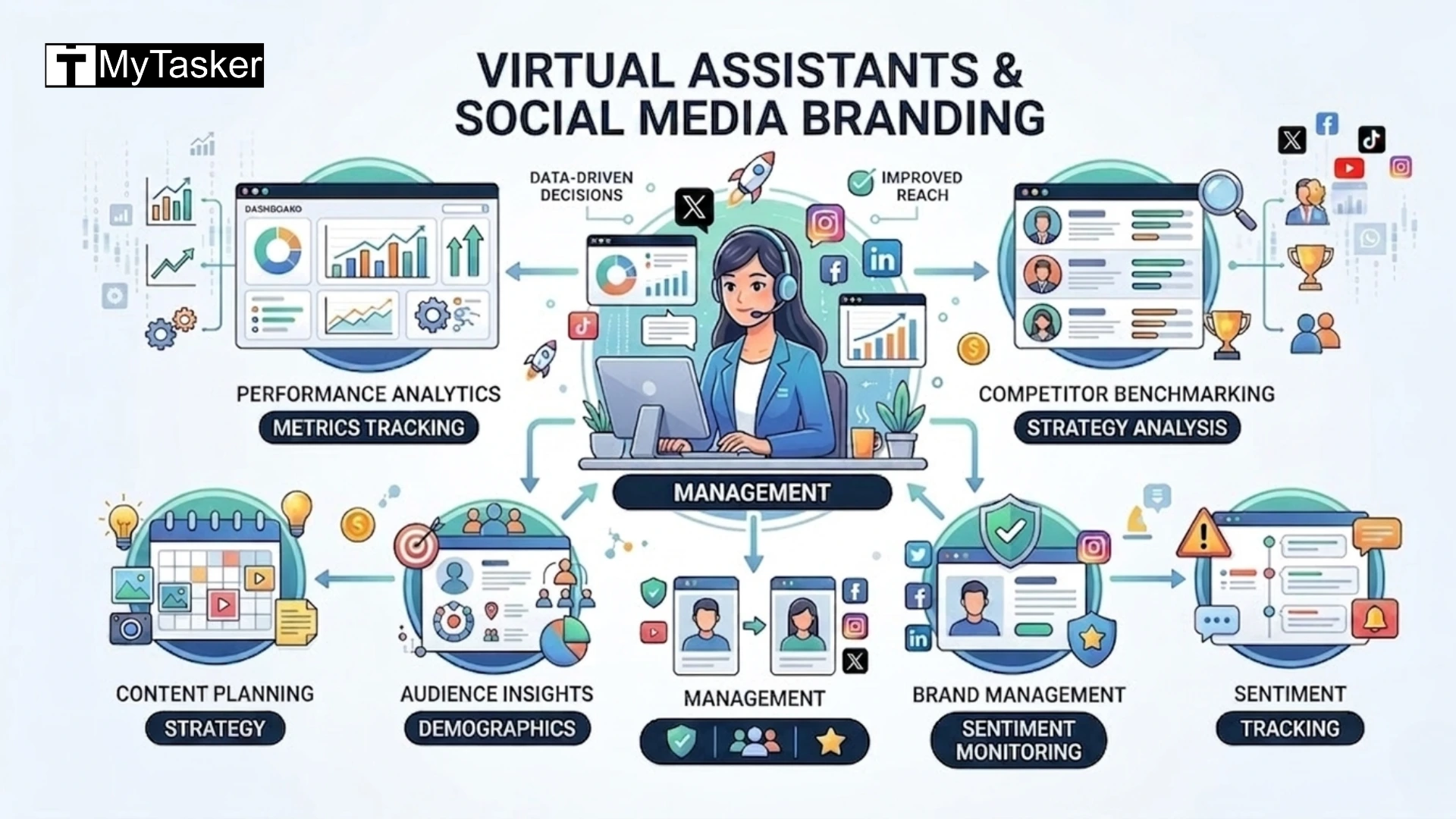
A VA tracks reach, engagement, clicks, conversions, comment quality, response speed, dark social shares, and untagged mentions.
-
They use native analytics plus free tools (Google Alerts, Brand24 free tier, Buffer).
-
Improvement comes from testing one variable at a time and reporting qualitative insights, not just numbers.
-
Key takeaway: A great VA turns raw data into brand trust – by listening to what people really say and how fast you reply.
Why Social Media Metrics Matter for Branding
The most important thing to remember: Branding is how people feel about your business after seeing your posts. Metrics tell you if they feel engaged, ignored, or inspired.
MyTasker has a dedicated team of social media virtual assistants who support businesses and individuals with marketing and brand promotion.
What truly drives meaningful results is a consistent focus on data, carefully analyzing performance and continuously refining the strategy, whether that means adjusting content themes, layouts, or topics.
In social media marketing, due diligence, regular analytics review, and ongoing course correction are essential. The key is to adapt to what’s working while shaping your approach accordingly, without ever losing your brand voice.
I have seen that if you have fewer followers, it is better to create meaningful reels to spread awareness and expand reach, as we live in the era of reels.
Most common mistake: Tracking only likes and followers. A post with 500 likes but zero meaningful comments builds no real brand loyalty.
In summary: Good metrics answer: “Are we reaching the right people, and are they talking about us in a way that builds trust?”
The 5 Core Metric Categories a VA Should Track (Updated)
To compare categories at a glance:
| Category | What It Measures | Example Metric |
| Reach | How many people see your content | Impressions, unique reach |
| Engagement | How people interact | Likes, comments, shares, saves |
| Clicks | How many leave the platform | Link clicks, profile clicks |
| Conversions | Valuable actions | Form fills, email sign-ups |
| Brand sentiment & trust | Quality of interaction | Comment sentiment, response time, dark social shares, untagged mentions |
Key takeaway: The fifth category is what separates basic tracking from better branding. A VA must report on how people engage – not just how many.
Step-by-Step – How a VA Sets Up Social Media Tracking
Step 1: Connect native analytics on every platform
-
Instagram & Facebook → Meta Business Suite.
-
LinkedIn → LinkedIn Analytics (Company Page) plus Profile Views for personal brand (founder/CEO).
-
X (Twitter) → X Analytics.
-
TikTok → TikTok Analytics.
Step 2: Add free listening and reporting tools
|
Tool |
Best For | Free Tier |
| Google Alerts | Untagged brand mentions | Yes |
| Brand24 (free trial / limited) | Sentiment and mention volume | Limited |
| AnswerThePublic | What people ask about your industry | Free (limited searches) |
| Buffer / Later | Scheduling + basic analytics | Yes |
Step 3: Set up a weekly reporting spreadsheet with qualitative columns
Example headers:
Date | Platform | Post type | Reach | Likes | Comments | Shares (public) | Shares (DM/private) | Clicks | Avg response time (hrs) | Sentiment (pos/neu/neg) | Qualitative insight
Step 4: Establish a baseline (2 weeks of data before making changes)
Most common mistake: Changing three things at once. A good VA tests one variable at a time – and listens to what people actually say.
Beyond Numbers – Qualitative Metrics That Build Brand Trust
The most important thing to remember: A comment that says “this changed my perspective” is worth 1,000 likes.
Comment Quality & Sentiment
What a VA tracks:
-
Low value: Emojis only.
-
Medium value: “Great post!” (no elaboration).
-
High value: Questions, personal stories, disagreements (“Actually, I think X because…”).
Actionable metric: Sentiment tagging – Positive / Neutral / Inquiry / Complaint.
VA task: Each week, tag 50–100 comments (random sample) and report the percentage that are inquiries – these are content ideas for next week.
Common mistake: Ignoring negative comments. A brand that responds gracefully to criticism builds more trust than one that deletes everything.
Response Vitality – Speed and Tone
Metric: Average response time to comments and DMs.
-
Target: Under 1 hour during business hours (premium brand feel).
-
3+ days → brand feels neglected.
VA task: Report “inbox zero” consistency and flag any message that took longer than 4 hours. Also track tone consistency – is the VA replying in your brand voice?
Best practice: Create a 1-page “reply guide” with canned responses for common questions, but train the VA to personalize them.
Dark Social – Private Shares via DM
The most important thing to remember: Most brand recommendations happen in private – WhatsApp, Slack, direct messages. Analytics tools cannot see them directly, but platforms give hints.
What a VA tracks:
-
Instagram / LinkedIn: “Shares” breakdown – public shares (stories, reposts) vs. private shares (sent via DM). LinkedIn does not separate, but a high share count with low public reposts suggests dark social.
-
X (Twitter): “Quote tweets” vs. “Retweets” – quote tweets often contain commentary and are semi-public.
Why it matters: A private share is a high-intent brand signal. Someone trusted you enough to recommend you privately.
VA task: Report: “This week, 35% of shares were private DMs – strong trust signal. Let’s double down on that post format.”
Social Listening – Tracking What You Are Not Tagged In
In summary: Your brand is being talked about even when no one @mentions you. A VA who listens for those conversations finds gold.
Step 1: Set up Google Alerts
-
Alert for your brand name (without quotes to catch variations).
-
Alert for your product name.
-
Alert for your competitor’s name (optional).
Step 2: Use the free tier of a social listening tool
-
Brand24 (free 14-day trial, then limited) – shows sentiment and mention volume.
-
Mention.com (free tier – very limited).
-
AnswerThePublic – shows what people are asking about your industry. Great for content ideas.
Step 3: Weekly listening report
A VA should report:
-
“We were mentioned 5 times without being tagged: 3 positive, 1 neutral, 1 question.”
-
“Competitor X launched a new feature. People are comparing us in forums.”
-
“Three people asked ‘how do I [solve problem]’ – we should write a post answering that.”
Most common mistake: Only listening for brand mentions, not industry keywords. A proactive VA listens for problems your brand can solve – even when your name is not spoken.
Platform-Specific Metrics That Matter (Updated)
-
Saves – high saves = valuable content.
-
Shares (DM vs. story) – Instagram’s analytics show “Shares” but not a breakdown. A VA can approximate: high share count + low story reposts = likely dark social.
-
Inbound DMs – number of people reaching out with questions. This is the “branding to sales” bridge.
-
Response time – Instagram shows the average reply time in the professional dashboard.
-
Link clicks – business value.
-
Negative feedback – hide post or report spam. Track weekly.
-
Sentiment in comments – Facebook’s “reactions” include angry, sad, care – track those separately.
-
Impression vs. unique views – repeat views mean loyal followers.
-
Profile views (if VA manages a founder’s personal profile) – this is the #1 personal branding metric. More profile views = more people checking your credibility.
-
Correction on link posting – Recent algorithm updates penalize links in the first comment. Current best practice: post without a link, then edit after posting to add the link (tested by many VAs). Or put the call-to-action as “visit the link in my profile.”
-
Employee advocacy – If the VA helps employees share content, track their individual reach.
X (Twitter)
-
Engagement rate = (likes + retweets + replies + clicks) / impressions.
-
Quote tweets – the highest form of endorsement because the person adds their own comment.
-
Best posting times – use analytics to find when your audience is active.
How a VA Improves Metrics (Actionable Tests)
In summary: Improvement comes from small experiments and listening to what people say.
Step 1: Identify the weakest qualitative metric
Example: “Our comment quality is low – mostly emojis. Let’s ask a question at the end of each post.”
Step 2: Test one change for 7 days
| Test | What to Change | Metric to Watch |
| Question vs. statement | End post with “What’s your experience?” vs. no question | Comment quality (% with text) |
| Reply speed | Reply to every comment within 30 minutes for one day | Sentiment and follow-on comments |
| Dark social trigger | Add “Share this with a friend who needs it” | Private share count (estimate) |
| Listening response | Reply to an untagged mention (politely) | Brand sentiment shift |
Step 3: Record results with qualitative notes
Example:
Test: Added a question at the end of the post. Comments increased 40%, and 6 people shared personal stories. Positive sentiment from 75% to 88%. Recommendation: add a question to every post type except announcements.
Most common mistake: Stopping the test after 2 days. Run for at least 5–7 posts.
Step 4: Double down on what works. Cut what does not.
How a VA Reports Metrics Back to You (Business Owner)
The most important thing to remember: You do not need raw numbers. You need insights and recommendations.
Step 1: Create a one-page weekly report (Monday morning)
Example format:
Week of April 20–26 – Instagram
-
Reach: 12,500 (+8%)
-
Engagement rate: 3.2% (target 3%)
-
Average response time: 45 minutes (target under 1 hr – good)
-
Comment sentiment: 80% positive, 10% neutral, 5% inquiry, 5% complaint (resolved)
-
Private shares (estimated): 35% of total shares – strong trust signal
-
Untagged mentions: 3 (all positive, one asked a question – replied)
-
Qualitative insight: People in comments keep asking about [Topic X]. I will draft a post on that for next week.
Step 2: Include a 30-second voice note or Loom video
Busy owners may skip the document. A quick summary keeps them informed.
Common mistake: Sending a massive spreadsheet with no explanation. A VA’s job is to interpret the data.
Step 3: Connect metrics to branding
-
“More saves = people trust our expertise.”
-
“Private shares = our message is being recommended in trusted circles.”
-
“Fast replies = we feel like a premium, responsive brand.”
FAQ – Virtual Assistants & Social Media Metrics
What if the VA has no budget for paid tools?
Use free tools: Meta Business Suite, Google Alerts, AnswerThePublic, Buffer free plan (3 channels), and a Google Sheet. That is enough for 90% of small businesses.
How many hours per week should a VA spend on tracking and reporting?
For one brand with 3–4 active platforms: 3–5 hours per week – including data collection, listening, and report creation. Another 5–10 hours for content creation and community management.
Can a VA track sentiment without AI tools?
Manual tagging of a sample (e.g., 50 comments per platform per week) is simple and accurate. Create a spreadsheet with dropdowns: Positive/Neutral/Inquiry
Complaint. It takes 20 minutes.
How do we track dark social if analytics don’t show it?
Use proxies:
-
High share count + low public reposts = likely dark social.
-
Add “Share via DM” call-to-action in some posts and compare performance.
-
Use UTM parameters with “share” source – not perfect but indicative.
What is a good average response time?
Under 1 hour during business hours – premium brand. Under 4 hours – acceptable. Over 24 hours – poor. Over 3 days – damaging to brand trust.
Should a VA track competitor metrics?
Yes, but only 2–3 direct competitors. Track their posting frequency, engagement rate, and comment sentiment once per week. Do not obsess – use it for inspiration, not imitation.
The LinkedIn link trick (“edit after posting”) – does it still work?
It varies. Many VAs report that it works better than putting the link in the first comment, but LinkedIn changes its algorithms frequently. Test both for 2 weeks and compare reach. The safest long-term method: drive traffic to your profile link instead.
How do we measure branding success over months, not weeks?
Monthly metrics: untagged mentions trend (up = top-of-mind awareness), sentiment ratio (aim for 90% positive), response time improvement, and dark social share percentage. Also track direct DMs asking for sales or partnerships – that is pure brand equity.
Final Checklist – Your VA’s Social Media Branding System
A well-trained VA should be able to say “yes” to all of these:
-
Native analytics connected on every active platform.
-
Google Alerts (or similar) set up for brand and industry keywords.
-
Weekly tracking spreadsheet includes qualitative insights and sentiment.
-
Average response time tracked and reported weekly (target under 1 hour).
-
Dark social (private shares) is estimated and reported.
-
One listening-driven content idea generated per week (e.g., “people are asking about X”).
-
Weekly one-page report delivered (numbers + insights + recommendations).
-
A “reply guide” exists and is followed consistently.
-
VA tests one variable at a time and documents results.
Final key takeaway: Branding on social media is not about going viral. It is about showing up consistently, listening carefully, and replying like a human. A VA who tracks how people talk about you – not just how many – turns metrics into a better brand.
Bottom line: Start with the basics (reach, engagement, clicks). Add qualitative tracking within 30 days. Within 90 days, you will see not just better numbers – but better trust.