A video was once used to showcase a special occasion. You planned it, produced it, polished it, and presented it in front of everyone.
In those days, the idea of a video production company fitted perfectly with the situation. And even now, it still does.
But today, a video doesn’t necessarily mean any special moment.
You do not perceive it as a big launch anymore. It has become a regular necessity.
Do you really need a video production company?
Video production companies are great when you’re shooting a blockbuster that looks as if it is from a movie set.
But is it relevant for most of us? We’re just trying to publish our content without doing anything on a large scale.
We want to do so consistently every week and every day without failing, losing money or the mental strength we have.
Most businesses aren’t trying to make a legendary film that everyone keeps remembering for years.
Rather, as business owners, we are just trying to keep on appearing — week after week — without affecting our budget or energy. Podcasts require clips to function.
Founder videos cannot look good without editing. Webinars deserve a second chance. Social platforms don’t need perfection but consistency.
Being present is more important than looking perfect.
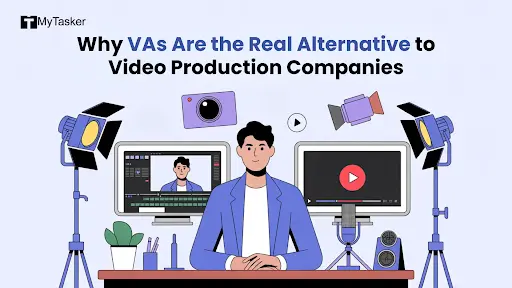
This is exactly where Virtual Assistants quietly came in to fill the gap.
A video VA doesn’t depend on slick pitch decks or complicated processes. They turn up with determination.
And the longer they keep working, the more they understand your voice, audience, and why “good enough” really is better than “perfect but late.”
That’s where the magic happens, which is not in the setup, but in the relationship.
Production companies excel at coming up with new content.
VAs excel at continuing something you’ve already started.
And honestly, that difference changes everything about how your content is kept consistent.
With a VA, you don’t have to start over with your conversation every single time.
You don’t need to explain your brand from scratch every time. You aren’t paying for additional managers or endless re-discovery.
Instead, you build real momentum effortlessly, which can be created from familiarity with your work and audience.
AI: Your VA’s companion
And now, there’s AI.
But the big idea is that AI does not eliminate the importance of VAs. It has made them even better.
AI handles everything from transcriptions to rough cuts to scene detection.
VAs bring judgment, taste, and context to the table. Together, they help you work fast without losing the human touch.
Yes, production companies can also use AI. But they still operate around projects and approvals. VAs? They function around the flow.
When you need a video production company?
That said, let’s be clear that VAs are not capable of handling everything.
If you want to produce a film with on-site shoots, complex storytelling, actors, and lighting, a production company is still the right option.
These crucial moments require structure, experience, and expertise.
But once that foundation is set, the ongoing work that includes the daily presence, the clips, the edits, the repetition, that’s where production companies struggle.
And that’s exactly where VAs succeed.
VAs are a result of a very critical evolution.
They show how content is actually made now as a continuous process, not entirely perfect, and with deliberation.
Production companies get the stage ready.
VAs ensure that the show is running.
And in a world where attention values consistency more than perfection, VAs have emerged as the real alternative.
How much does a 30-second video cost?
The cost of a 30-second video can vary broadly, and it mostly depends on who’s making it.
In the U.S., you will have to pay a video production company anywhere from $1,000 to $10,000 or more for this purpose.
That change in budget depends on factors like crew size, how complex the shoot is, and how much post-production work is involved.
But if you already have the footage and need someone for the edits? That changes everything.
Between $20 and $120, a freelance editor or a Virtual Assistant can provide a much more practical option for social media, ads, reels, or shorts.
What does the price include (equipment, talent, music licensing, etc.)?
A production company’s price usually includes quite a lot. You get access to professional cameras, lighting, and sound equipment.
A full crew handles every part of the shoot. Studio or location fees are included along with project management so that the process doesn’t lose consistency.
Multiple rounds of reviews take place.
Essentially, the cost reflects the full service and expertise that lead to the production of a perfect video.
Talent and music licensing might be included, or they could have separate charges, and sometimes those licenses come with limitations of their own.
With a VA or freelance editor, a lot of changes take place.
You’re usually paying for editing, basic color correction, captions or subtitles, royalty-free music, simple motion graphics, and platform-ready exports.
In other words, you’re paying for the work that actually matters, not for overhead or other gears.
Who owns the final video rights and copyrights?
Production companies sometimes keep partial ownership of your video or limit usage unless full rights are clearly spelled out. Some licenses even expire, which creates some problems at times.
With most VAs or freelance editors, once you’ve paid, you own the final video outright and can use it however you want.
That said, you should always confirm it in writing before any work begins.
How often should you post a video?
Consistency is more vital than perfection.
Posting two to three videos per week is the basic requirement to stay visible and engage your audience.
One short-form video per day usually is enough for steady growth, while two to three per day can really accelerate your reach.
The reality is, platforms value frequency and relevance far more than a high-budget production.
Regular efforts trump perfect efforts.
What is the process for backing up projects?
A reliable editor knows how to protect your content.
They’ll store raw footage on Google Drive or Dropbox, back up project files regularly, keep final exports separate, and give you shared access.
Files should never be deleted until you say so. And here’s an important tip: if an editor can’t explain their backups, that’s a red flag.
You want an editor who cares about your content the way you do.
What AI tools do video editors use to speed up the work?
Modern editors aren’t just cutting clips in the old-fashioned way anymore and are using AI to take care of repetitive tasks.
Some of them rely on Descript for text-based editing, Adobe Premiere Pro’s AI features for auto captions and scene detection, Runway for background removal, CapCut AI for quick short-form edits, and Topaz Video AI for improving low-quality footage.
AI generates captions, hooks, and titles, so that editors can spend more time making your content look and feel amazing.
Conclusion
So the question isn’t about whether video production companies are worth it.
They are when the moment truly requires.
An honest question at this point is: how often are you living in those moments?
Today, for most businesses, video isn’t just a campaign. It’s nothing like a grand launch. It’s not a quarterly event.
It’s the quiet, repetitive work of turning up before the audience grows. It’s clipping, posting, refining, and then repeating it tomorrow.
That’s not the environment production companies are built for.
That’s where Virtual Assistants come in.
VAs aren’t always after perfection. Rather, they maintain your momentum.
They work according to your pace instead of disrupting it.
They help create videos that are sustainable instead of stressful.
And when you pair them with AI? You work faster without losing judgment, context, or the human care your content still requires.
This has nothing to do with cutting corners.
It’s about selecting a model that functions according to reality.
Use production companies if you want to create big moments.
Use VAs to proceed with your work.
Because today, visibility doesn’t increase only for the brand which is the most polished.
It belongs to the one who keeps appearing to the audience regularly.
And that’s exactly why VAs aren’t considered just an alternative anymore.
They’re the result of a natural evolution.