Hiring a virtual project manager can help businesses lower costs, improve productivity, and access skilled talent from around the world. Because they work remotely, you can reduce expenses such as office space, equipment, utilities, and commuting support without adding a full-time employee.
More importantly, they bring structure to busy projects. They track tasks, manage deadlines, coordinate teams, organise files, follow up on approvals, and keep everyone informed. Your clients get timely updates, your team gets quick answers, and deadlines stay visible. Multiple projects can move forward without you constantly checking what has been done or what has been missed.
This means less time spent chasing people and managing emails, and more time for leadership, strategy, and growth. Think of a virtual project manager as the person standing in the middle of the traffic, keeping everything moving while you focus on where the business is going.
According to McKinsey, around 70% of organisational transformation efforts fail to achieve their goals, often because of poor execution, unclear frontline leadership, and resistance to changing established ways of working.
What Is a Virtual Project Manager?
A virtual project manager is a remote professional who plans, coordinates and monitors projects for a business.
They can work with your employees, freelancers, contractors, agencies, vendors and clients, even when everyone is working from different locations.
Their job is simple at its core:
Make sure the right work gets done by the right person at the right time.
That can involve:
-
creating project plans
-
breaking large projects into smaller tasks
-
assigning responsibilities
-
tracking progress
-
managing deadlines
-
coordinating remote teams
-
following up on dependencies
-
maintaining project documentation
-
monitoring budgets
-
communicating with stakeholders
-
identifying risks
-
preparing daily or weekly updates
This is different from simply having someone "help with admin."
A virtual project manager takes responsibility for the project management process itself.
Virtual Project Manager vs Virtual Assistant
The terms can sound interchangeable, but there is an important difference.
A virtual assistant can handle a wide range of administrative, operational or specialist tasks.
A project manager virtual assistant focuses specifically on keeping a project organised and moving forward.
An executive assistant, meanwhile, usually supports a senior person directly. They may manage calendars, inboxes, travel and personal administration.
A simple way to remember it:
Executive assistant: "How can I make your day easier?"
Virtual project manager: "How can I make sure this project gets finished?"
Of course, the roles can overlap. A business may use an executive assistant for leadership support and a project management virtual assistant for delivery and team coordination.
What Does a Virtual Project Manager Actually Do?
A good virtual project manager does not spend the day sending reminders that say, "Just checking in."
They create a system where fewer reminders are needed in the first place.
Here is what that looks like.
Task Management and Task Tracking
Big projects become much easier when they are broken into smaller pieces.
Your virtual project manager can create tasks, assign owners, set due dates and use task tracking tools to monitor what is happening.
Instead of asking, "Where are we with this?"
You can open your project dashboard and see it.
Deadline Management
Deadlines have a habit of sneaking up on teams.
A virtual project manager watches the timeline, tracks milestones and follows up when something starts falling behind.
They also look at dependencies.
If the designer cannot start until the client approves the copy, for example, that dependency needs to be visible before it delays the entire project.
Resource Allocation
Not everyone should work on everything.
A project manager helps match available people and skills to the work that needs to be done.
This becomes particularly useful when you have a distributed team working across several projects.
The goal is simple: keep work moving without overloading your best people.
Risk Management
The best project managers are often paid for the problems they prevent.
They look for warning signs such as:
-
missed approvals
-
unclear responsibilities
-
budget increases
-
unrealistic deadlines
-
unavailable team members
-
scope changes
-
communication gaps
They can then raise the issue before it becomes a crisis.
That is risk management in practice.
Budget Tracking
Projects can become expensive surprisingly quickly.
A virtual project manager can monitor planned costs against actual spending, track contractor payments and flag unexpected expenses.
For larger projects, they may also help monitor change orders, vendor costs and other financial commitments.
You get visibility before the budget becomes a surprise.
Stakeholder Communication
Clients do not always need to know every detail.
They need to know what matters.
A virtual project manager can collect updates from your team and turn them into clear progress reports for clients, managers and other stakeholders.
One person gets the information.
One person organises it.
Everyone else gets a clearer picture.
Workflow Management
If your team keeps solving the same problem every month, you probably do not have a people problem. You have a workflow problem.
A project manager can document processes, identify bottlenecks, and improve how work moves from one person to another. They can also automate repetitive tasks, streamline follow-ups and reduce manual work.
The result is simple: fewer delays, less wasted time, and lower operating costs. Your team spends less time chasing updates and repeating routine tasks, while more work gets done without increasing headcount.
According to Capterra’s software ROI and productivity analysis, automating project management workflows and routine manual tasks can reclaim 10–15 hours of work per week, helping businesses improve productivity and get better returns from their remote project infrastructure.
The Virtual Workspace Behind the Work
Virtual project management works because modern communication technology has made location much less important.
Your project team might be spread across three cities or three countries and still work from the same virtual workspace.
A typical setup might include:
-
Project management software: Trello, Asana or another platform for tasks and deadlines
-
Online collaboration tools: Google Workspace or Microsoft 365 for documents and files
-
Virtual conferencing tools: Zoom, Google Meet or Microsoft Teams for meetings
-
Instant messaging: Slack or Teams for quick conversations
-
Virtual dashboards: a simple view of progress, blockers and deadlines
-
Time-tracking tools: useful for monitoring capacity, hours and project effort
-
Cloud-based software: allowing everyone to access information without relying on one office computer
The software matters.
But the person managing the system matters more.
You can have the best project management software in the world and still have a chaotic project if nobody owns the process.
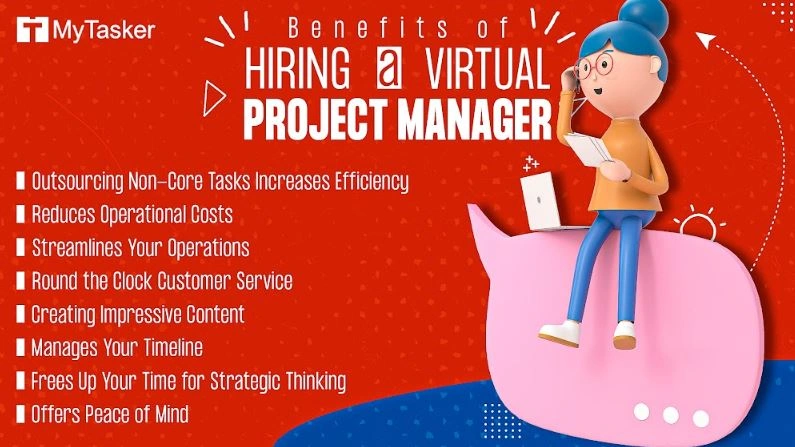
8 Benefits of Hiring a Virtual Project Manager
So, what do you actually get when you bring one into your business?
Quite a lot.
1. Your Team Gets More Productive
Every business has work that needs doing but does not need to be done by the founder, senior manager or highest-paid employee.
Think about:
-
follow-ups
-
reports
-
scheduling
-
data entry
-
research
-
task updates
-
meeting notes
-
daily logs
-
document management
-
status reports
When these jobs are organised and delegated properly, your core team gets more time for work that actually moves the business forward.
That is the real benefit of productivity.
You are not trying to squeeze more hours out of people.
You are using their hours better.
2. You Reduce Operational Costs
Hiring an in-house project manager can mean salary, office space, equipment, recruitment and other employment costs.
A virtual project manager gives you another option.
You can access professional project management support without building another permanent layer into your organisation.
For small and medium-sized businesses, that flexibility can make a significant difference.
You also gain access to a global talent pool, rather than limiting your search to people who live within commuting distance of your office.
3. Your Workflow Becomes Easier to Manage
A growing business creates more moving parts.
More clients.
More people.
More projects.
More tools.
More things that can go wrong.
A virtual project manager brings those moving parts into one system.
They can create standard processes, organise your virtual workspace, maintain project documentation and make sure everyone knows what happens next.
The result?
Less "Who is handling this?"
More "It's already being handled."
4. You Can Work Across Time Zones
Remote work has changed what a team can look like.
Your designer might be in one country. Your developer in another. Your client somewhere else.
A virtual project manager can coordinate these time zones and structure handovers between team members.
That makes remote teams, virtual teams and distributed teams much easier to manage.
With the right process, work can continue while you sleep.
Your business day does not have to end when your office closes.
5. You Get Better Visibility Into Your Projects
One of the most frustrating things about managing several projects is not knowing what is happening until something goes wrong.
A good virtual project manager changes that.
You can have:
-
live project dashboards
-
regular status reports
-
task tracking
-
deadline updates
-
budget tracking
-
risk alerts
-
documented decisions
-
clear ownership of tasks
You do not need to ask ten people for ten updates.
You get one clear picture.
6. You Get Time to Think Like a Leader
This may be the biggest benefit.
Founders often become the bottleneck without realising it.
Every decision comes to them.
Every problem comes to them.
Every approval comes to them.
Eventually, there is no time left to think.
Delegating project coordination gives you breathing room for:
-
strategy
-
leadership
-
business development
-
customer relationships
-
new opportunities
-
team development
-
long-term planning
Leadership requires space.
You cannot think strategically while spending your afternoon chasing a missing spreadsheet.
7. Projects Become Easier to Scale
A project that works with five people can become chaotic with 20.
This is particularly true for businesses managing multiple clients, capital projects, contractors or external agencies.
A virtual project manager can help establish repeatable project management frameworks so your processes do not depend entirely on one person remembering what to do.
This is useful across industries.
For example, a construction business may need to coordinate contractors, construction management software, design reviews, change orders and daily logs.
A public agency may have to manage public records requests, documentation and compliance requirements.
A marketing company may be coordinating writers, designers, developers and clients across several campaigns.
The work is different.
The coordination problem is surprisingly similar.
8. You Get Peace of Mind
There is a point where being busy stops feeling productive.
Your calendar is full.
Your inbox is full.
Your project management software is full.
And yet you still feel like something is being missed.
A virtual project manager gives you someone whose job is to watch the details.
That does not mean you stop being involved.
It means you stop having to remember everything.
And that is a very different feeling.
Who Can Benefit From a Virtual Project Manager?
You do not need to be a large enterprise to benefit from virtual project management.
It can work particularly well for:
Small and medium-sized businesses that have more projects than their internal team can comfortably manage.
Agencies coordinating multiple clients, freelancers and deliverables.
Construction and property businesses managing contractors, design reviews, documentation, change orders and field updates.
Public agencies handling complex projects, records and multiple stakeholders.
Professional services firms where specialists should be spending their time with clients rather than chasing project updates.
Remote-first businesses where employees and contractors rarely work from the same physical location.
The common thread is not industry.
It is complexity.
If several people need to work together to produce one outcome, someone needs to coordinate the work.
What About Construction and Capital Projects?
Some project management needs are more specialised than others.
Construction companies, engineering firms and public agencies may need support with capital projects, contractor coordination, daily logs, submittals, change orders, design reviews or compliance documentation.
In these environments, project management software and construction management software can become central to the workflow.
A virtual project manager can help keep information organised, follow up with contractors, maintain documentation and make sure the right people receive the right information.
They may also coordinate administrative work around contractor payments, records retention policies and project reporting.
The key is knowing where general project coordination ends and specialist knowledge begins.
For highly technical work, you need the appropriate subject-matter experts involved.
How to Choose the Right Virtual Project Manager
Not every virtual assistant is a project manager.
And not every project manager will fit your business.
Look for someone who can:
-
communicate clearly
-
manage deadlines without constant supervision
-
understand dependencies
-
organise information
-
work confidently with project management software
-
write concise updates
-
identify risks
-
ask good questions
-
work across time zones
-
communicate with different personalities
-
understand your business priorities
Do not focus only on certifications.
Communication skills and cultural intelligence matter enormously.
Your virtual project manager may communicate with your clients in the morning, your internal team at noon and an overseas contractor later that day.
They need to understand not only what people are saying, but what needs to happen next.
Where Can You Find a Virtual Project Manager?
There are several ways to hire one.
Freelance Marketplaces
Freelance marketplaces give you access to a huge pool of professionals.
The downside?
You are usually responsible for screening, testing, onboarding, managing and finding a replacement if your freelancer becomes unavailable.
Professional Networks and Referrals
Referrals can be excellent because someone else has already tested the person's work.
The problem is availability.
The person you want may not have the capacity when you need them.
Specialised Agencies
Specialised agencies can provide vetted professionals and structured support.
Companies such as Consultport, Wing Assistant, Boldly and Schedule Assist operate in this space.
This can be useful when you want a dedicated professional without handling the entire hiring process yourself.
Full-Service VA Companies
A full-service VA company gives you another advantage: access to more than one skill set.
For example, you may need a project manager today, a designer tomorrow and an administrative assistant next week.
Instead of hiring three people, you may be able to access those capabilities through one service.
That flexibility is particularly useful as your business changes.
What Project Management Tools Should You Use?
There is no single "best" project management tool.
The best tool is usually the one your team will actually use.
Popular options include:
-
Trello
-
Asana
-
Microsoft Teams
-
Google Workspace
-
Zoom
-
Slack
-
Microsoft 365
The important thing is to establish one single source of truth.
If the deadline is in one spreadsheet, the task in another platform and the latest update buried inside an email, your team will eventually get confused.
Your virtual project manager can help bring those systems together.
Some modern cloud-based platforms also offer features such as unlimited users, unlimited projects, data storage, automated updates and fast implementation.
But remember:
More features do not automatically mean better project management.
A simple system that everyone follows is usually more valuable than a complicated system nobody updates.
Why Hire a Project-Based Virtual Assistant?
Sometimes you do not need someone forever.
You need someone for the project in front of you.
A website launch.
A new marketing campaign.
A software implementation.
A client onboarding process.
An internal process redesign.
A capital project.
A major operational change.
A project-based virtual assistant can step in, create structure, coordinate the work and help get the project across the finish line.
That makes project-based support especially useful when hiring a permanent employee would be unnecessary.
How MyTasker Can Help
At MyTasker, we understand that business owners rarely need help with just one thing.
You may need a virtual project manager to coordinate a project today and a designer, writer, administrative VA or marketing specialist tomorrow.
Our virtual assistant team can support both core and non-core business functions, helping you build a more flexible virtual team without managing every individual yourself.
You get:
-
skilled remote professionals
-
project and task coordination
-
a single point of contact
-
backup support when needed
-
flexible access to different skill sets
-
help with workflow management
-
less day-to-day micromanagement
The goal is not to add another layer of management.
It is to remove the unnecessary layers already sitting on your desk.
Ready to hand over the coordination? Talk to MyTasker about finding a virtual project manager who can work with your workflow, tools, team and time zone.
Frequently Asked Questions
What does a virtual project manager do?
A virtual project manager plans, coordinates and monitors projects remotely. They can manage tasks, deadlines, resources, budgets, risks, documentation and stakeholder communication while keeping remote or distributed teams aligned.
What is the difference between a virtual project manager and an executive assistant?
An executive assistant primarily supports a person, including their calendar, inbox, travel and administrative work. A virtual project manager focuses on a project and its outcome, including timelines, tasks, resources, risks and delivery.
Is a project manager virtual assistant the same as a project manager?
Not always. A project manager virtual assistant may provide many project coordination and administrative functions, while a formally qualified project manager may have deeper responsibility for project scope, methodology, budgets and strategic delivery.
Which project management software can a virtual project manager use?
A virtual project manager can generally work with the tools your business already uses, including Trello, Asana, Microsoft Teams and other cloud-based project management software. The best system is the one your team can use consistently.
Can a virtual project manager work with remote teams?
Yes. In fact, virtual project management is particularly useful for remote teams and distributed teams because the role creates structure around communication, deadlines, handovers and task ownership.
Can a virtual project manager work across different time zones?
Yes. A project manager can structure communication around time-zone differences, establish overlap hours for important meetings and use asynchronous updates for everything else.
Can a virtual project manager manage construction projects?
They can support many administrative and coordination aspects of construction management, including documentation, contractor coordination, daily logs, change orders, submittals and project updates. Highly technical responsibilities should remain with appropriately qualified professionals.
Is virtual project management cheaper than hiring in-house?
It can be. A virtual model can reduce the costs associated with office space, equipment and full-time employment while giving businesses access to a wider talent pool. The actual cost depends on the provider, hours, responsibilities and level of expertise required.
Do I need a virtual project manager for every project?
No. If you have a small project with two people and a short deadline, you may not need one.
But when projects involve multiple people, deadlines, vendors, clients, budgets or dependencies, having someone own the coordination can save a surprising amount of time.