For many UK business owners, outsourcing used to be about one thing: saving money.
But that is changing.
Today, outsourcing can help small businesses get the skills they need, move faster, serve more customers and, most importantly, give business owners more time.
It creates a myriad of opportunities. You not only get the benefits of outsourcing for your business, such as lower costs, access to premium tools that you would otherwise have to pay for, and a wider pool of expertise, but you also get the opportunity to create a remote extension of your team.
Many entrepreneurs use outsourcing services not only to grow their own brands or handle internal tasks but also to support their client work, whether through executive assistance, project management, or other specialised services.
So, outsourcing creates opportunities on both sides. You can use outsourcing to grow your business, or you can build a business that provides outsourcing services.
Many of our UK-based clients use our virtual assistant services across various skill sets to grow their businesses. VA companies are a reliable outsourcing option.
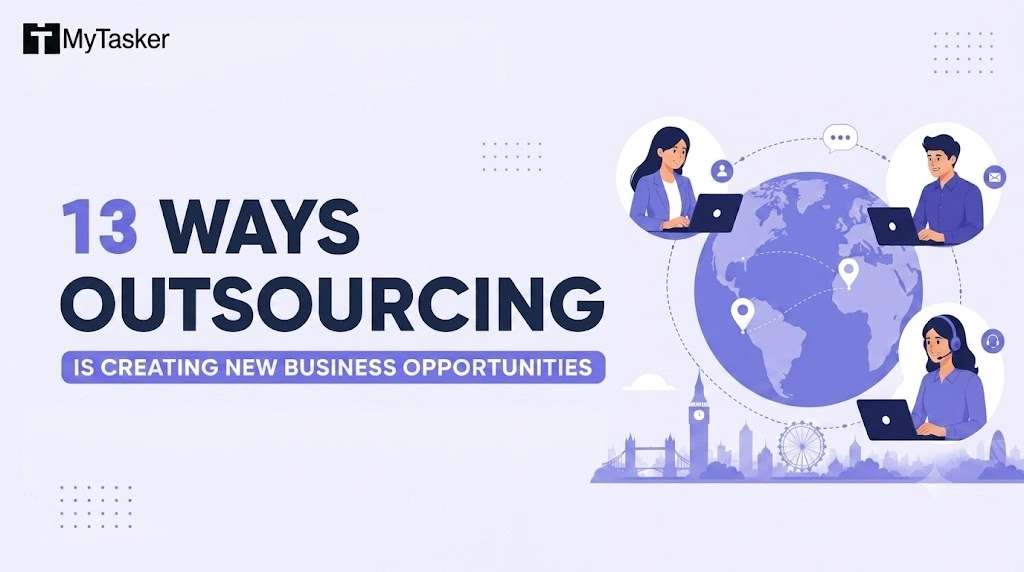
Here are 13 ways outsourcing is creating these opportunities.
1. Lower costs can mean healthier margins
Running a business in the UK is an expensive affair. Salaries are only part of the picture. Employers also have to think about National Insurance, pensions, office space, equipment, software and other overheads.
Outsourcing allows businesses to turn some of those fixed costs into more flexible operating costs.
For an SME, that can make a meaningful difference to cash flow and margins, particularly when wage and employment costs are rising.
From April 2025, UK employers faced higher National Insurance costs on lower salaries, although small businesses received some tax relief. To manage rising payroll and pension costs, many growing companies began outsourcing work to freelancers and virtual assistants.
The employer National Insurance rate rose from 13.8% to 15%, while the salary threshold fell from £9,100 to £5,000. As a result, businesses started paying National Insurance on lower-paid and part-time workers who were previously below the threshold.
The real benefit is not simply paying less. It is having more money available to invest in sales, technology, people and growth.
2. Small businesses can access specialist skills
A growing business might need a cybersecurity specialist for a few hours a week, an experienced bookkeeper during a busy period, or an AI specialist to automate a particular workflow.
Hiring each person permanently may not make financial sense.
Outsourcing changes the equation. Instead of asking, “Can we afford to hire this person full-time?”, the business can ask, “What expertise do we need, and how much of it do we actually need?”
That opens the door to skills that might otherwise be out of reach.
3. Businesses can add capacity much faster
Anyone who has tried to recruit in the UK knows that hiring can take time.
There is writing the job description, advertising the role, reviewing applications, interviewing candidates, checking references and then waiting for someone to start.
Outsourcing can be much quicker.
A business can bring in a virtual assistant, specialist agency or offshore team and start getting work done within days or weeks.
For an entrepreneur trying to launch a product, serve a new client or run a campaign, that speed matters.
Sometimes the opportunity disappears simply because the business cannot hire quickly enough to take it.
4. Growth becomes easier to manage
Not every business needs the same number of people all year round.
An e-commerce company may need additional support during Christmas. An accountant may need extra help around tax deadlines. A marketing agency may need more production capacity when several clients launch campaigns at once.
Outsourcing provides flexibility.
You can increase capacity when demand rises and reduce it when things become quieter, without making every change a permanent hiring decision.
For start-ups and growing businesses, that flexibility can make growth feel considerably less risky.
5. Founders get something money cannot easily buy: time
This may be the most valuable benefit of all.
A founder can spend hours every week answering routine emails, arranging meetings, updating spreadsheets, chasing invoices, researching information or handling basic customer enquiries.
None of these tasks are necessarily difficult.
But they consume attention.
When those responsibilities are delegated, the founder can spend more time on the things only they can do well: winning customers, developing products, building relationships, making decisions and thinking about the future.
The point of outsourcing is not to make the founder work less.
It is to help the founder spend more of their working day on work that actually moves the business forward.
6. Businesses can test ideas without betting everything
New ideas are expensive when you have to build everything in-house.
Outsourcing can reduce that initial commitment.
A company can outsource design, marketing, sales support, research, fulfilment or technical work and test whether an idea has potential before building a permanent team around it.
This gives entrepreneurs room to experiment.
Try a new market. Launch a campaign. Test a product. Explore a new service.
If it works, scale it.
If it does not, walk away without carrying a large permanent cost base.
7. SMEs can offer a bigger-company customer experience
Customers do not always care how large your company is.
They care whether their order arrives when promised, whether someone answers their question and whether problems are dealt with quickly.
That creates a challenge for smaller businesses competing with much larger companies.
Outsourced fulfilment, customer support and administrative teams can help close that gap.
A small e-commerce business does not necessarily need hundreds of employees to provide responsive support or efficient fulfilment. It needs the right systems and people behind the scenes.
Outsourcing can provide that infrastructure without requiring the business to build everything itself.
8. More outsourcing means more opportunities for providers
There is an opportunity here for entrepreneurs on the other side of the relationship.
As UK companies outsource more work, they need reliable people and businesses to deliver it.
That creates room for virtual assistant companies, specialist agencies, managed service providers, accounting firms, customer support providers and other outsourcing businesses.
The opportunity is particularly attractive for providers that understand the needs of UK SMEs rather than simply selling cheap labour.
The winning proposition is not “We are cheaper.”
It is “We can help you get important work done properly, reliably and efficiently.”
9. Niche outsourcing businesses can thrive
You do not necessarily need to build a giant outsourcing company.
There is a growing opportunity in specialising.
Think bookkeeping for property companies.
Digital marketing for dentists.
Virtual assistants for estate agents.
Cybersecurity for small professional firms.
Payroll for growing businesses.
E-commerce fulfilment for independent retailers.
The more specific the problem, the easier it can be to build a service around it.
Many business owners would rather work with someone who deeply understands their industry than with a generalist who does a little bit of everything.
10. Talent platforms can connect UK businesses with global professionals
The internet has made geography less important.
A UK entrepreneur can build a business that connects British companies with skilled professionals in countries such as India, the Philippines, Kenya, Nigeria and across Eastern Europe.
This creates opportunities for talent platforms, recruitment businesses, managed teams and Employer-of-Record services.
The strongest models do more than introduce a worker and disappear.
They handle recruitment, onboarding, payroll, compliance, management and quality control.
That creates recurring value for the client and recurring revenue for the provider.
11. AI is creating a new generation of outsourcing services
Outsourcing is not simply humans doing tasks remotely.
AI is changing what an outsourcing provider can deliver.
A modern provider might combine UK-based account management with an offshore delivery team and AI-powered tools for customer service, research, reporting, data processing or workflow automation.
The result can be a service that is faster and more capable than traditional outsourcing alone.
This creates an interesting opportunity for entrepreneurs who understand both technology and business processes.
The future may not be human versus AI.
It may be people using AI to deliver better outsourced services.
12. Higher-value knowledge work is opening up
Outsourcing is also moving beyond traditional back-office tasks.
Businesses increasingly outsource research, financial analysis, compliance support, data analysis, technology work and AI-related projects.
This is often called Knowledge Process Outsourcing, or KPO.
For entrepreneurs with specialist expertise, this creates an opportunity to turn knowledge into a repeatable service.
Instead of selling hours, they can build processes, teams and systems around a particular business problem.
That can create a much more valuable business than simply selling labour.
13. UK businesses can use outsourcing to compete globally
There is one final opportunity that is easy to overlook.
British businesses can outsource parts of their own operations while continuing to sell high-value expertise around the world.
A UK consultancy can use an offshore research team.
An accounting firm can outsource routine bookkeeping.
A marketing agency can build an international production team.
A software company can use global developers and support specialists.
This can help UK businesses remain competitive on price while keeping their most valuable expertise, relationships and decision-making close to home.
And because services represent such a large share of the UK’s international trade, the ability to deliver professional services efficiently can become a genuine competitive advantage.
The bigger opportunity
The most interesting thing about outsourcing is that it is no longer simply about reducing the wage bill.
It is about redesigning how a business operates.
A founder can buy back time.
A small company can access skills it could not afford to hire permanently.
A growing business can increase capacity without taking on a huge fixed cost.
And an entrepreneur can build an entirely new company by solving these problems for other businesses.
That is why outsourcing matters.
For the business owner using it, it can become a growth engine.
For the entrepreneur providing it, it can become the business itself.
The real question is no longer, “Should I outsource?”
It is:
“Which parts of my business should I keep, which should I delegate, and what could I build if I had access to the right people at the right time?”
Frequently Asked Questions
Is outsourcing only about reducing costs?
No. Cost reduction is one benefit, but modern outsourcing is also about accessing specialist skills, increasing capacity, improving flexibility and freeing internal teams to focus on higher-value work.
Is outsourcing suitable for small UK businesses?
Yes. In fact, smaller businesses can benefit significantly because they may not have the budget to employ specialists in every function. Outsourcing allows them to access expertise without necessarily making a full-time hire.
What can UK businesses outsource?
Almost any process that can be performed reliably outside the core business can potentially be outsourced. Common examples include administration, virtual assistance, bookkeeping, customer support, IT, marketing, research, data entry, payroll, software development and e-commerce support.
Is offshore outsourcing the same as outsourcing?
No. Outsourcing simply means using an external provider to perform work. That provider may be in the UK, overseas or somewhere in between. Offshore outsourcing is specifically when the work is delivered from another country.
Will outsourcing reduce the number of UK jobs?
It can replace some roles or change the nature of others, but it can also create new jobs and businesses. UK companies may use outsourcing to grow faster, which can lead to more demand for sales, management, specialist and customer-facing roles in the UK.
The impact depends heavily on what is outsourced and how the business uses the capacity it creates.
How can an entrepreneur start an outsourcing business?
Start with a specific problem rather than a broad promise.
Instead of offering “outsourcing services”, consider offering something much clearer, such as bookkeeping for small construction firms, customer support for e-commerce businesses or virtual assistants for estate agents.
Understand the problem deeply, build a reliable delivery process and make quality and communication part of the product.
Is AI going to replace outsourcing companies?
AI will certainly change outsourcing.
Some routine tasks will become automated. But businesses will still need people to manage processes, handle exceptions, make decisions, communicate with customers and ensure that systems actually work.
The bigger opportunity may therefore be AI-enhanced outsourcing, where people and technology work together rather than competing directly.
What is the biggest mistake businesses make when outsourcing?
Treating outsourcing as simply a way to find the cheapest labour.
Price matters, but reliability, communication, security, quality control and process knowledge matter just as much.
Cheap work that needs to be redone is not cheap.
What should a business outsource first?
Start with repetitive, time-consuming work that does not require the founder’s direct involvement.
Administrative tasks, scheduling, inbox management, data processing, bookkeeping support, research and routine customer service are often good starting points.
Once the relationship works, businesses can gradually delegate more complex processes.
Is outsourcing a growth strategy or a cost-cutting strategy?
It can be either.
But used properly, it is much more powerful as a growth strategy.
The goal is not simply to spend less. The goal is to create more capacity, access better skills, move faster and give talented people inside the business more time to do the work that matters most.