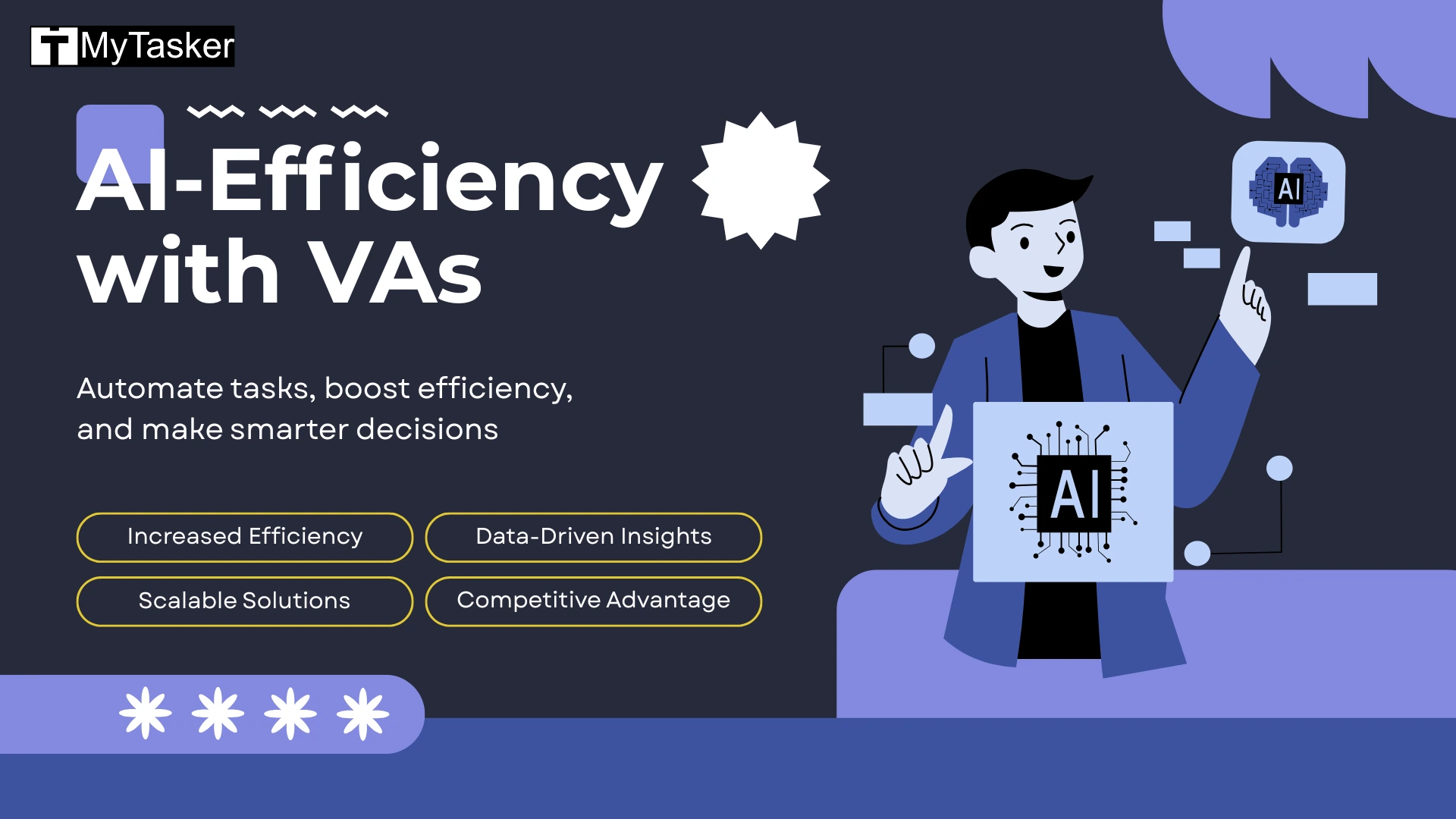
The conversation around business efficiency has fundamentally shifted.
For years, companies chased speed, scale, and automation: goals now largely fulfilled by artificial intelligence.
But as AI tools become more powerful and widespread, a new competitive edge has emerged: integrity.
AI can generate large amounts of content, process data at lightning speed, and automate workflows.
But it still fails to provide three essential human skills: scepticism, contextual judgment and cultural awareness.
This is where Human Virtual Assistants (VAs) come in - not to replace AI, but rather to be a necessary complement.
Imagine AI as the machine that drives your business forward. Human VAs are the steering system that ensures power is guided accurately, responsibly, and effectively.
The New Competitive Advantage: Integrity more than efficiency.
The first wave of AI use was concerning doing more, faster. Now, the focus has shifted to doing things right.
Even sophisticated AI systems are liable to hallucinate and confidently provide wrong or fake information.
These work by recognition of patterns, but not verification of truth. This forms an unsafe disparity between output and accuracy.
Human VAs make sure that your workflows, data, and communications are anchored in truth, logic, and context.
Devoid of this human layer, businesses stand to suffer reputation loss, loss of money and legal ramifications.
1. Research: Verification Over Volume
AI is able to summarise hundreds of web pages within a short period of time. Haste without checking is a vice.
The Issue: Artificial Noise and Roundabout Hallucinations.
More and more AI-generated content is flooding the modern internet. Blogs refer to other AI-generated blogs, which form an echo chamber of misinformation.
This results in what may be termed circular hallucinations, where false information becomes plausible merely due to its recurrence.
Even referring to the sources, AI tools do not have the sense to differentiate between research and sponsored or biased materials.
The Human Solution: Preliminary Check.
A Human VA takes a different approach to research.
They do not believe outputs, but instead, they do the following:
- Cross-check various sources of authority.
- Check the qualifications of the authors and institutions.
- Jot down biased or sponsored material.
- Refine AI and remind it to adopt tougher sourcing guidelines.
As an example, a VA can ask AI tools to only retrieve data from reputable consulting firms or certified industry reports, which will add a quality control aspect that AI can never guarantee.
The Utility: Summaries to Vetted Intelligence.
Your VA transforms scattered research into trusted intelligence, validated, organised, and ready to drive decisions.
This difference is particularly significant when the decision made has a weight, be it in long-term strategy, financial investments, or regulatory compliance.
2. Data Entry: Integrity as a Service.
Modern business systems are based on data, but what is really valuable about data is its accuracy, consistency, and usability.
The absence of them can result in false insights in even the most advanced systems.
The Issue: Rapid yet Robotic Automation.
AI-based data entry tools would be very efficient in the case of structured and repetitive data.
They have the ability to handle high volumes within a short period of time, which minimises manual work and the turnaround time.
However, their usefulness decreases greatly in the case of inconsistencies, anomalies or edge cases.
Primarily, in situations where predefined rules are included.
Some situations, for instance.
- Customers with more than one or inconsistent email formats across platforms.
- Differences in address formats (abbreviations, missing fields, or specifics to the region)
- Duplications with minor spelling or formatting differences.
- Uneven or unforeseen transaction patterns.
In these instances, AI systems have a way of going about it unflagged.
They process the data in its raw form, and this may cause small but significant errors.
This is where the Virtual Assistant can bring quantifiable value.
A VA does not simply key in data; he or she interprets it.
They identify trends, detect anomalies and exercise discretion that AI is unable to perform.
They do not allow imperfect data to flow through the system as they interfere to rectify, standardise, and verify.
As an example, a VA can:
Intelligently identify and merge duplicate records.
Standardise entries in terms of formats.
Mark suspicious transactions as such.
Compare data with the source or supporting documents.
This oversight by human beings makes data systems reliable and trustworthy. It transforms data entry as a normal process into a quality assurance role- a process that prevents the integrity of business operations.
Finally, AI is speedy, but a VA is accurate. And in data-driven worlds, precision is not a luxury, but a necessity.
The Human Solution: Cognitive Filtering.
Human VAs add context to data management. They do not merely key data; they read and comprehend.
They can:
Identify and fix discrepancies.
Detect duplication and anomalies.
Normalise formats in datasets.
Raise concern over abnormal patterns of flags.
Above all, they use common sense. When a number seems amiss, they will stop and investigate, which is not the nature of AI.
The Utility: Defending Your Object of Belief.
Clean data is not only about organisation, which is about reliability. A Human VA helps make sure that your systems are using correct, reliable information to save on downstream errors that are expensive.
In this way, VAs offer the service of Integrity as a Service, a protection of all the automated processes, which rely on your information.
3. Social Media: The Cultural Guardrail.
Social media has ceased to be a marketing channel but a live image of your brand.
The Issue: Tone-Deaf Automation.
The AI-created social media content tends to hit the wrong nail on the head. It struggles with:
Sarcasm and humor
Rapidly evolving slang
Cultural sensitivities
Contextual nuance
The result? Robotic, outdated or even inappropriate content. Contemporary users are fast to spot and dismiss fake communication- a so-called bot-blindness.
The Human Solution: Riding The Cultural Pulse.
Human VAs introduce cultural sensitivity and emotional intelligence in managing social media. They understand:
What’s trending—and why
Relevance vs. cringe: When a trend is relevant vs. cringe.
Tone adjustments to various audiences.
What to do in delicate or stressful circumstances.
They are not merely content managers, but mood-readers.
The Utility: Safeguarding Brand Equity.
One wrong move on social media will lead to a brand crisis. Human VAs serve as a cultural filter, making sure that all posts, comments and replies are in line with the voice of your brand and its target audience.
This personal touch takes your online presence beyond automated output to human interaction.
How do VAs contribute to SEO?
Search engines increasingly prioritise human-first content—material that demonstrates authenticity, expertise, and real-world relevance.
Human VAs enhance AI-generated drafts by:
-
Adding personal insights and case studies
-
Improving tone and readability
-
Ensuring factual accuracy
-
Aligning content with audience intent
This combination boosts both search rankings and user engagement.
What is a Hybrid Workflow?
The most effective modern approach is a Hybrid Workflow, where AI and humans collaborate.
-
AI handles the heavy lifting: data scraping, initial drafts, and bulk processing
-
Human VAs handle refinement: fact-checking, editing, tone adjustment, and final approval
This model maximises efficiency without sacrificing accuracy or authenticity.
The Strategic Takeaway
AI is not the enemy of human work; it’s an amplifier. But amplification without direction can lead to chaos.
Human Virtual Assistants provide that direction. They ensure that:
-
Research is accurate, not just fast
-
Data is clean, not just abundant
-
Communication is authentic, not just automated
In a world where AI generates endless output, trust becomes the real currency. Businesses that prioritise integrity will stand out, not because they produce more, but because they produce better.
The moral of the story
AI gives you power. Human VAs give you precision.
One generates momentum; the other ensures it’s heading in the right direction.
In the end, success in 2026 isn’t defined by how much you can automate, but by how well you can trust what you produce.
AI has unlocked incredible speed and scale, but without human oversight, that power can easily drift into inaccuracy, inconsistency, or disconnection from real audiences.
Human Virtual Assistants bring clarity, judgment, and authenticity: qualities that technology alone cannot replicate.
They don’t just refine outputs; they protect your brand, your data, and your decisions.
The smartest businesses aren’t choosing between AI and humans. They’re combining both.
Because while AI drives execution, it’s the human touch that ensures everything stays meaningful, reliable, and aligned with reality.