Key Takeaways
Top VA providers create a system (multi-layered quality control, including backup) for continuous efficiency.
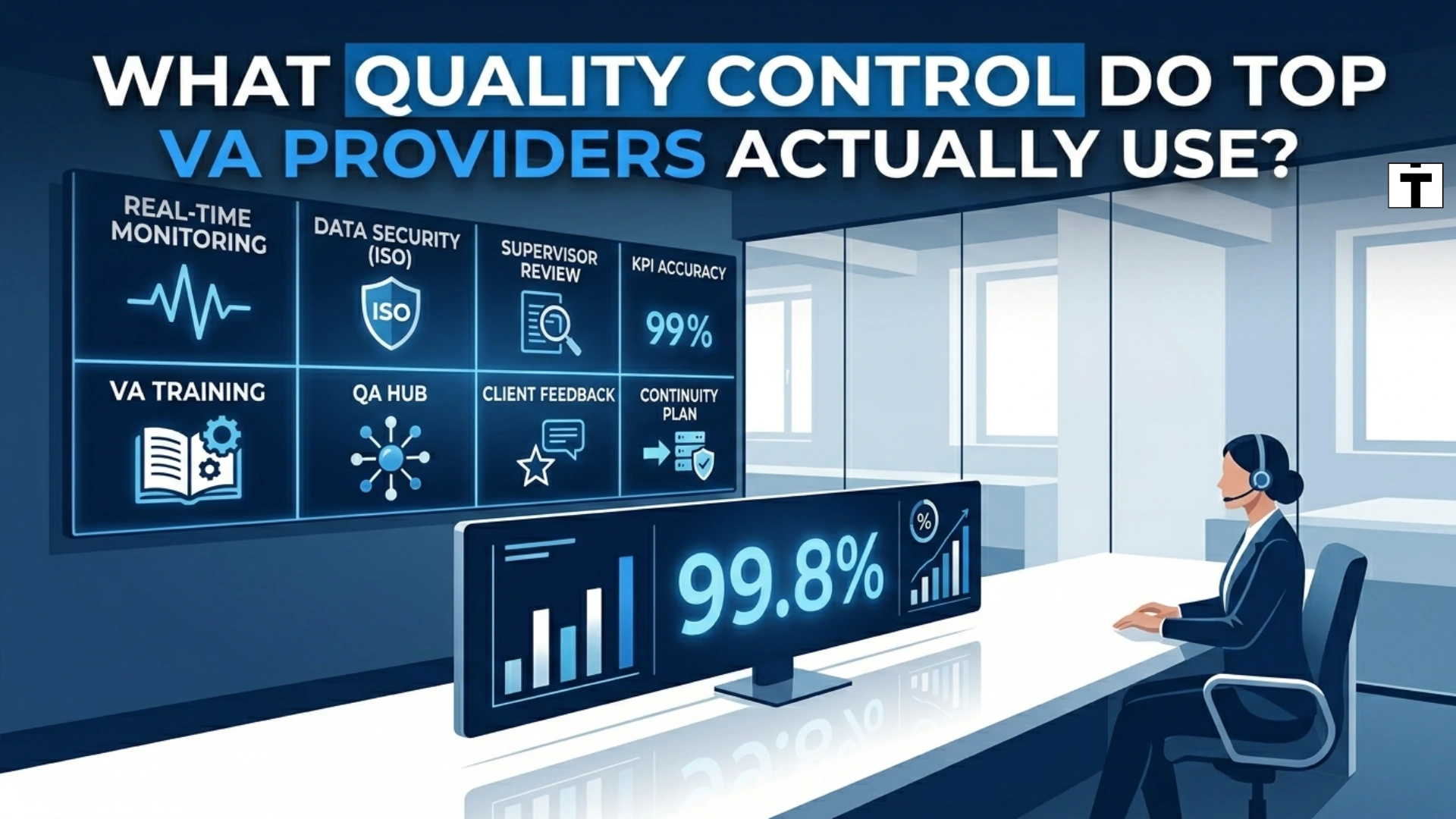
Core components: dedicated supervisor, task-level checks, real-time monitoring, KPIs, structured training, security protocols, and backup continuity.
Key takeaway: A professional VA service is often more structured and controlled than an in-house team – because behind every task is a system built for quality.
It Starts With a System, Not a Person
The most important thing to remember: Quality control in top VA companies is not random. It is multi-layered, structured, and tightly controlled.
Take a provider like MyTasker.
In summary: At the centre is a dedicated supervisor – your single point of contact. This person is responsible for:
-
Quality control
-
Workflow creation
-
Coordination across teams (Web, Graphic, Content, SEO, Accounts)
-
Backup planning
Common mistake: Hiring a VA without a supervisor means you become the quality controller. That defeats the purpose.
Key takeaway: Think of the supervisor as your project guardian – ensuring nothing slips through.
Task-Level Control – Where Quality Actually Begins
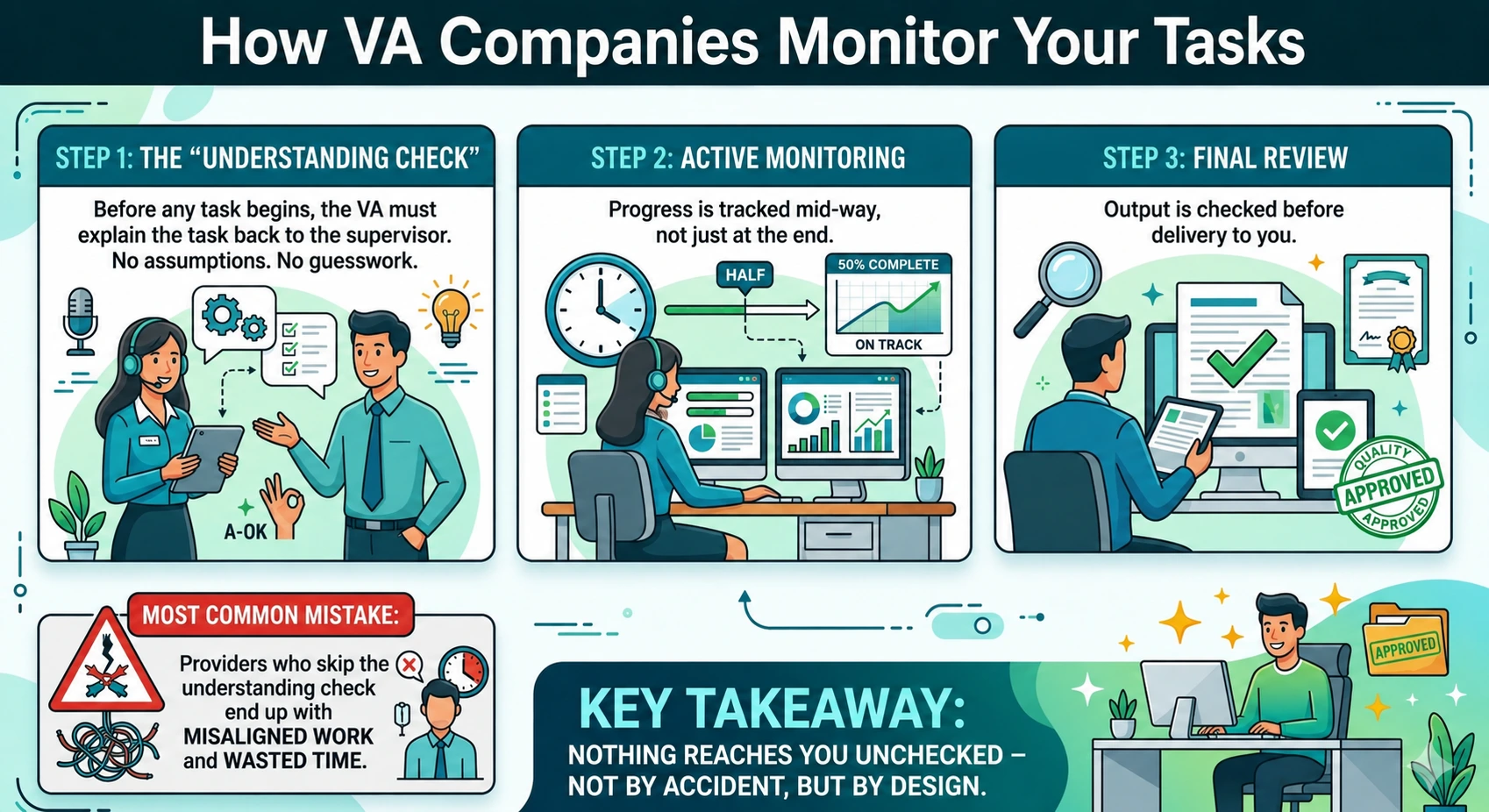
Step 1: The “understanding check” – Before any task begins, the VA must explain the task back to the supervisor. No assumptions. No guesswork.
Step 2: Active monitoring – Progress is tracked mid-way, not just at the end.
Step 3: Final review – Output is checked before delivery to you.
Most common mistake: Providers who skip the understanding check end up with misaligned work and wasted time.
Key takeaway: Nothing reaches you unchecked – not by accident, but by design.
Continuous Monitoring – No Surprises, Ever
Action: Top providers track everything in real time using:
-
Task dashboards
-
Internal CRM systems
-
Status updates
-
Live audits
Example system (MyTasker):
-
Centralised CRM to organize and prioritise work.
-
Double-layered quality control – checks at multiple levels.
-
24/7 audit team – monitors tasks to catch errors, delays, or missed steps.
To compare (without the fluff):
-
A low-quality provider relies on final delivery only, → results in surprises and missed deadlines.
-
A top provider uses real-time dashboards and audit layers, → results in predictable output and early error detection.
Common mistake: Waiting until the end to “see what happened.” That is a reaction, not control.
Key takeaway: A control room for your business operations – that is what real-time monitoring provides.
Performance Tracking – Because Quality Must Be Measured
The most important thing to remember: Quality is not a gut feeling. It is measurable.
KPIs top providers track:
-
Response time – how quickly the VA acknowledges tasks.
-
Customer satisfaction – your feedback on completed work.
-
Accuracy – error rate per task.
-
First-contact resolution – for support tasks, resolved without escalation.
Step-by-step improvement loop:
Step 1: Measure against benchmarks.
Step 2: Gather structured client feedback monthly.
Step 3: Identify gaps.
Step 4: Retrain or adjust processes.
Step 5: Repeat.
Common mistake: Collecting feedback but never acting on it. Data without action is just noise.
Key takeaway: Measure → Improve → Repeat. That loop drives consistent performance gains.
Training & Consistency – Systems Beat Talent
In summary: Great VAs are not just hired – they are trained, guided, and standardized.
What top providers build:
-
Detailed SOPs (Standard Operating Procedures)
-
Knowledge bases (searchable guides)
-
Scenario-based guidelines (what to do when X happens)
Reinforcement methods:
-
Ongoing training sessions
-
Refresher courses every quarter
-
Monthly updates on process changes
Most common mistake: Assuming a skilled VA does not need documentation. Even the best VA needs a reference.
Key takeaway: Consistency across tasks, across people, across time – that comes from systems, not heroics.
Security & Trust – The Non-Negotiable Layer
The most important thing to remember: Your data must be protected by design, not by hope.
Security layers top providers implement:
People & Agreements
-
Full-time, in-house staff (not freelancers)
-
Mandatory NDAs
-
Custom legal agreements with liability clauses
Infrastructure
-
Firewall-regulated systems
-
Server-based workstation control
-
24/7 surveillance
-
Biometric access (e.g., fingerprint entry)
Access Control
-
Restricted access based on necessity (least privilege)
-
Secure credential-sharing systems
Environment
-
VPNs or virtual desktops
-
No data stored on personal devices
Plus: Teams are trained on privacy laws and global standards, such as ISO compliance.
To compare security levels (simplified):
-
Basic providers rely only on NDAs and shared logins.
-
Top providers enforce role-based access, secured environments, and compliance training.
Common mistake: Assuming a generic NDA is enough. It is not – infrastructure and access controls matter more.
Key takeaway: Your data is not just handled – it is protected by design.
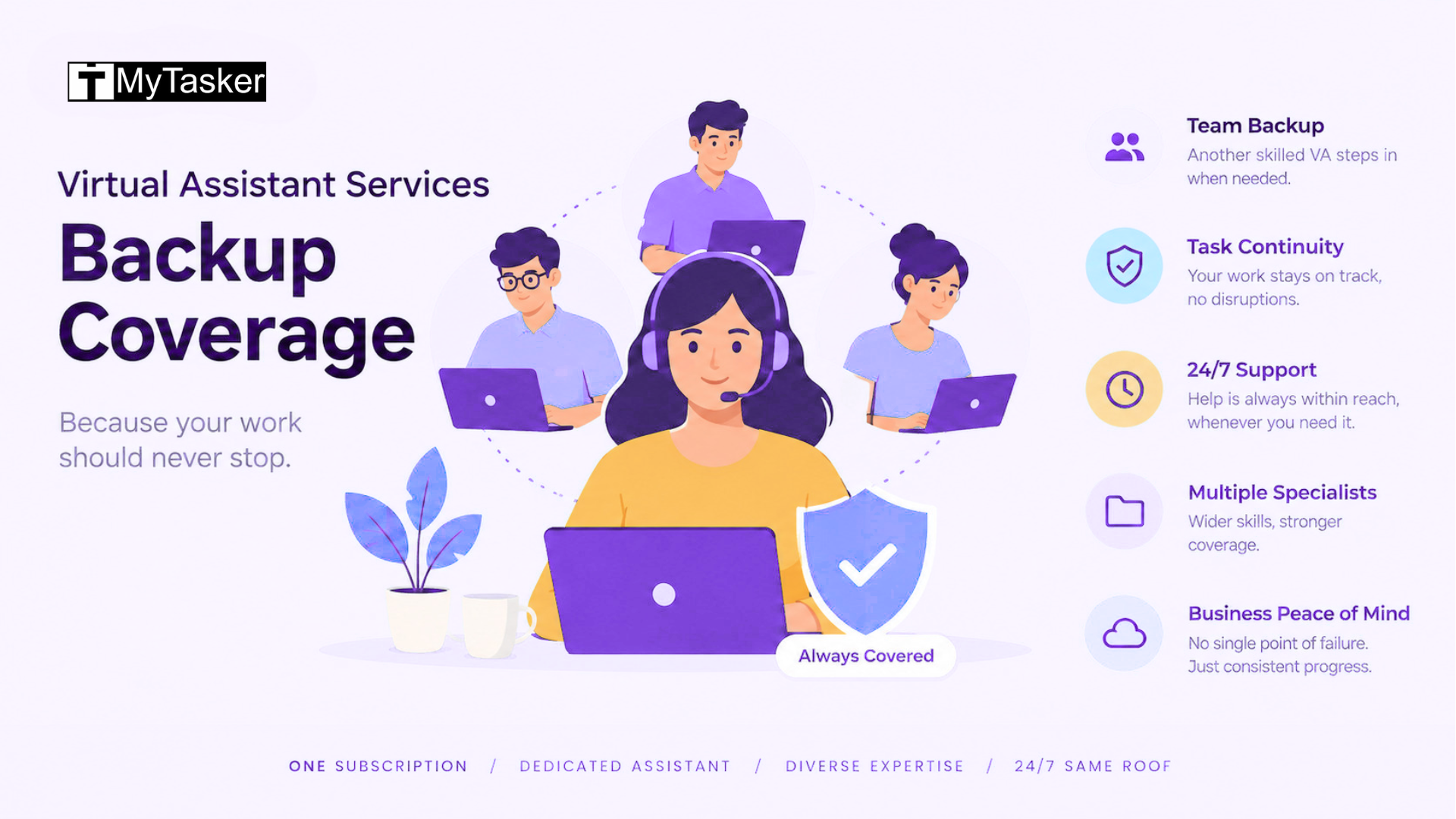
Backup & Continuity – Because Work Can’t Stop
Step 1: A backup VA is assigned from day one.
Step 2: Cross-training ensures the backup knows your workflows.
Step 3: All recurring tasks have documented SOPs.
Step 4: The supervisor manages any transition seamlessly.
What happens if your primary VA is unavailable?
-
Backup VA steps in immediately.
-
A supervisor can also step in temporarily.
-
No interruption to your operations.
Most common mistake: Hiring a solo freelancer with no backup – then panicking when they get sick or go on leave.
Key takeaway: Your operations do not pause. They continue seamlessly.
What This Really Means for You
In summary, A professional VA service is not risky. In many cases, it is actually more structured and controlled than an in-house team.
Why? Because behind every task, there is not just a person – there is a system built for quality.
Final key takeaway: When you evaluate a VA provider, do not ask:
“Can they do the work?”
Ask:
“What is their quality control system?”
Because that is where the real difference lies.
FAQ – Quality Control in VA Providers
What are the key components of a VA quality control system?
A strong QC system typically includes a dedicated supervisor, task-level checks (understanding checks), real-time monitoring through dashboards/CRM, performance tracking using KPIs, structured training systems, and backup processes for continuity.
How do top VA providers ensure task accuracy before delivery?
They follow a multi-step process:
-
Confirm task understanding upfront.
-
Monitor progress during execution.
-
Conduct supervisor-level reviews before final delivery.
Errors are caught early – not after delivery.
What KPIs are used to measure VA performance?
Most commonly tracked KPIs:
-
Response time
-
Customer satisfaction
-
Accuracy
-
First-contact resolution
These metrics are reviewed regularly to improve performance over time.
How is work monitored in real-time?
Top providers use centralized CRM systems, task dashboards, status tracking tools, and 24/7 audit teams. This allows them to track progress, flag issues, and maintain accountability.
How do VA companies maintain consistency across different assistants?
They rely on SOPs, knowledge bases, and structured training programs. Every VA follows the same process, regardless of who handles the task.
What security measures do top VA providers use?
Security typically includes NDAs, restricted system access, secure VPNs or virtual desktops, firewall-protected environments, and compliance training based on global standards like ISO.
What happens if my VA is unavailable?
Reputable providers assign a backup VA from the beginning, maintain documented workflows, and ensure supervisors manage smooth transitions – so your work continues without disruption.
Is hiring a VA riskier than hiring in-house?
Not necessarily. With proper systems in place, VA providers often offer more structured quality control than in-house teams, reducing risk and improving consistency.
Final Checklist – Evaluating a VA Provider’s Quality Control
Before signing with any VA provider, confirm:
-
Dedicated supervisor assigned (not just a ticket system).
-
“Understanding check” before tasks begin.
-
Real-time dashboards or CRM access for you.
-
Documented KPIs and monthly feedback cycles.
-
Written SOPs and a knowledge base for your workflows.
-
Security: NDAs, VPNs, role-based access, compliance training.
-
Backup VA assigned from day one.
-
Clear continuity plan for illness or time off.
Bottom line: The right provider does not just send you a VA – they send you a system. That system is what protects your time, your data, and your peace of mind.