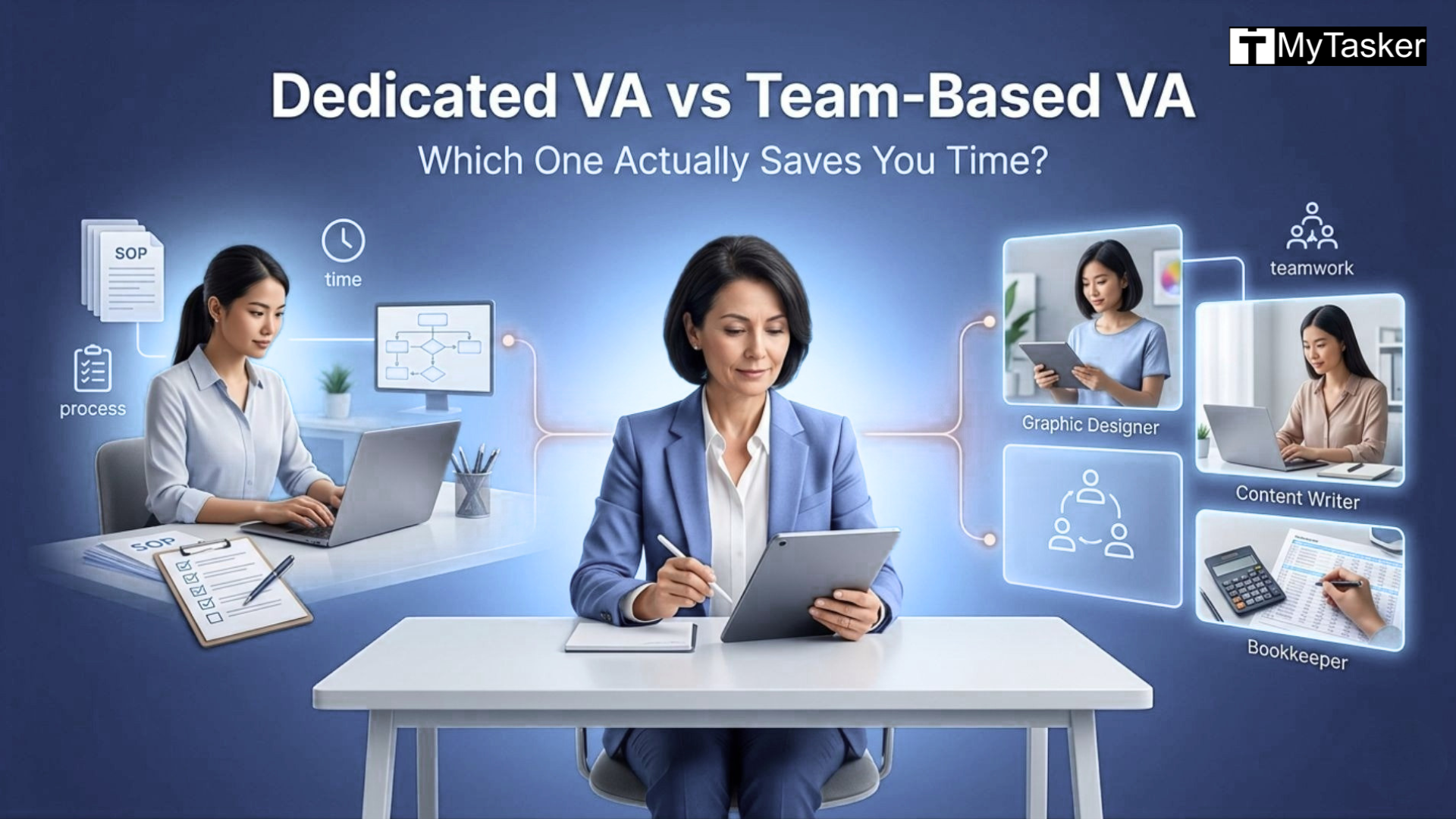
Once you've decided to hire a VA to manage your workload, the next question is whether you need a dedicated virtual assistant or a VA team.
Both deliver great advantages for your company, but how do you choose the best one?
We'll discuss these two virtual staffing models and help you select the ideal one for your business's needs.
When you see this repetitive line in most comparison-based articles, "Dedicated VAs are cost-effective”, it is nothing but an exaggeration.
That is partially correct, but the whole picture is more complicated than that.
Even though a dedicated VA is less expensive, there are real situations in which a team VA is the best option.
The team-based VA model works slightly differently.
You get a team of remote experts working together to support the operations of your business, rather than depending on a single assistant.
One person can handle your administrative tasks, another can take care of the content management, a third person can manage customer service, and the team lead can handle the overall organisation and operation.
Let's start with the basics: Which Will Save You More Time in 2026: Dedicated VA or Team-Based VA?
The 10-Second Answer for Busy Founders
If your company is stuck in an endless cycle of "reply, fix, repeat," then you are going to need a simple version to think this through:
Choose a Dedicated VA if:
-
Your business is very dependent on certain strategies and priorities that change over time.
-
You need someone who understands how you think, work, and communicate.
-
Your tasks need critical thinking, proper context, and constant teamwork.
-
You don’t mind spending time on management and training.
When you need strong support and a reliable second pair of hands that eventually becomes a part of your everyday operations, a dedicated VA works best.
Choose a Team-Based VA Model if:
-
Your business is growing fast.
-
You need to have plenty of highly specialised talents.
-
You cannot afford to have your work process paused or delayed.
-
You want a functional system and not just depend on one person.
In 2026, companies are acting much faster so they can avoid single points of failure. For several reasons, a team-based approach is a better option, as it creates stability and is flexible. If one person is unavailable, the work doesn't stop.
Choose a Hybrid Model if:
-
You want a single assistant to handle coordination as well as interaction.
-
You also want to have experts for tasks that need technological skills.
-
It would be easier for you to share without having to manage an entire remote team.
The hybrid approach is now popular as it is a flexible system with more personalised support.
Remember this before comparing pricing for nonstop three hours:
Don't count only on hourly rates to see value.
It is the amount of time, mental strain, and continuous monitoring that steals your time that you could have been spending on more important things.
What is a Dedicated Virtual Assistant?
One client, one individual. That is all. They serve you. They pick up on your business, tone, and processes. Since you're their sole employer, they appear on time. They become invested in your methods.
A competent and committed VA manages everything. They schedule email, manage your projects, provide customer service, and even do research work for you. They join you as a team. They anticipate your question before you ask it. That's worth your money.
This setup is particularly useful for:
-
Solopreneurs in need of support
-
Executives whose schedules are complicated and personal
-
Anyone whose work shifts course every week
A dedicated VA's familiarity is its biggest advantage.
They get a better understanding of your processes, expectations, and decision-making style the longer they work with you.
But people hardly ever discuss one hidden expense: The time spent managing everything.
Most of the time, you're not just hiring help. You are also taking on the roles of process manager, trainer, reviewer, and main supervisor.
That means you need to spend time explaining the tasks, reviewing them, giving feedback, fixing mistakes, and you will end up continuously improving the process together.
Another risk that businesses often ignore is:
A dedicated VA is still just one person. Your work can quickly slow down if they are unavailable, ill, on leave, or decide to move on.
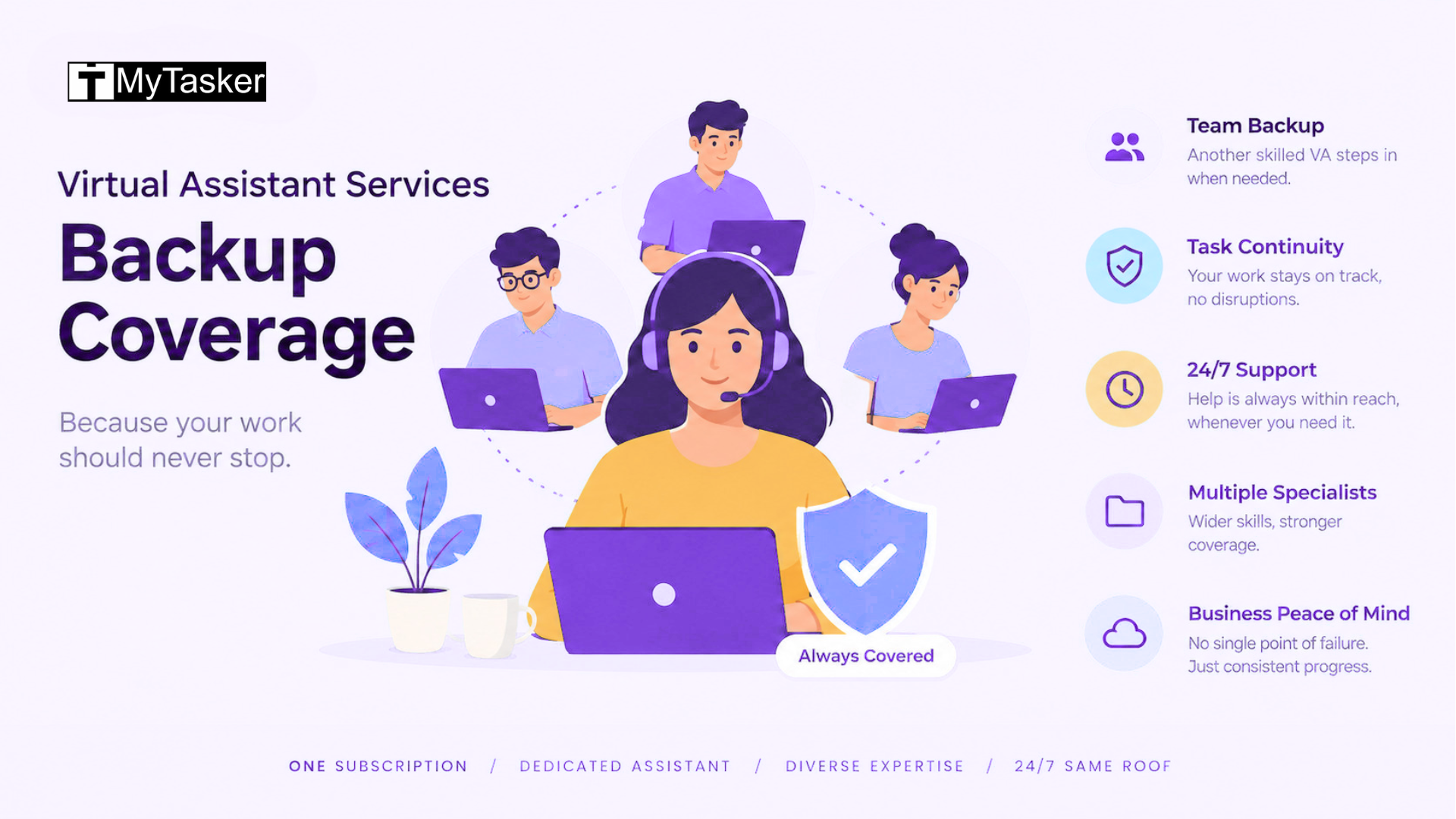
For this reason, many expanding companies eventually switch to other systems for backup support.
What is a team-based VA?
Often referred to as a "pod," a team-based VA model is essentially a remote support system in which many experts collaborate as a single functioning unit for your company.
The job is divided according to skill, compared to expecting one assistant to carry out everything. One person can handle your mailbox and administrative duties. Another can handle social media and content. Someone else can manage backend functions, customer service, and CRM updates. A team lead monitors the process, making sure everything stays organised and deadlines are met.
What's the best?
Unlike supervising several assistants alone, you typically communicate with the team head alone.
This model is particularly useful for:
-
Expanding businesses with large volumes
-
SaaS companies in need of technical support
-
Any company that cannot afford to have one point of failure
This is the section that people usually misinterpret:
In fact, hiring a single VA is typically less expensive up front than team-based setups.
But in 2026, companies are paying for more than just work fulfilment.
They are paying the bill for reduced management stress, specialist support, and stability in operations.
A team approach removes a lot of that management burden because the company already includes systems, backups, and professionals.
And this brings us to the greatest benefit of all: Continuity.
Another team member fills in if the first is unavailable. The work never stops. Deadlines don't change. Customers never notice a disturbance.
No stopping of operations. One person taking sick leave will not cause any disruption.
How Team-Based VAs Integrate Into Your Business
The purpose of hiring a team-based virtual assistant from a reputable virtual assistant company is not just about "assigning tasks."
The team is set up to work as a single unit inside your company's operations.
When they are included as part of your business team, their schedules, shift timings, and responsibilities are set up around your business needs. Instead of functioning like disconnected freelancers, they work within a coordinated system designed to support your workflow consistently.
The majority of team-based VAs work under the management of a VA company. That means the company is responsible for salaries, infrastructure, supervision, and internal coordination, even though they are dedicated to working on your business.
It makes things much easier for you.
The role of the point of contact
The VA company gives you a relationship manager and a point of contact to supervise, recruit, train, and set up backup for your procedure.
A successful VA setup is about having someone who maintains the proper functioning of the entire support system in the background.
Businesses can choose the most appropriate support structure at MyTasker.
You can create a hybrid setup that brings together both models, or you can choose a plan where a single point of contact can connect you with a group of professionals, or you can have a personal assistant who works exclusively for you.
A graphic designer, content writer, accountant, web developer, video editor, and digital marketer can all be on the professional team, supporting different parts of your company.
Each plan gives you access to all of them.
A lot of companies use dedicated part-time VAs. With this strategy, your assistant only helps other customers during their free time and gives priority to your work once tasks are assigned.
How Part-Time VAs Still Work Dedicatedly for Your Business
A common misperception about part-time VAs is that they are "less available" or split up their time between work, which slows down the support system.
If you are on a tight budget or only need help with certain activities for a few hours each week, part-time VAs are perfect.
Businesses with fluctuating schedules are best suited for a part-time VA. You will only pay for the hours you really use because you can scale them up or down as needed.
A part-time VA can give you the necessary skills without needing a commitment over time if you need someone for a particular project, like managing a short-term campaign or creating a presentation.
If you send them a task while they are working on another client's task, they will start working on your task as soon as they complete the ongoing one. If the task is urgent, ask the point of contact whether you should hire a team, a collection of experts, or a personal VA to work on it.
Alongside supervising, the point of contact participates in all meetings and feedback sessions, analyzes the SOPs, and makes sure that they learn and carry out any extra responsibilities that are shared, along with the dedicated VA
They help with continuity.
Since backup support is prepared beforehand, your projects won't stop suddenly if your dedicated VA isn't available to you. The backup methods are usually the same in team-based VA models.
There is no additional cost for it. Training is also free.
This means less dependency on a single person.
Flexibility is another advantage.
As your workload changes, you can upgrade or downgrade your subscription plan at any moment. Instead of being stuck in a rigid structure, your support system can grow, keeping up with your company's needs.
Every subscription model has advantages and benefits of its own.
Which One Saves You More Time?
Here’s the calculation that most founders ignore:
Time also has a cost.
Assume you make about $200 per hour.
Eight hours a week of training, managing, correcting, and supervising a dedicated VA is a considerable amount of high-value time spent on operations and not on growth.
Add the VA's monthly charge on top of that.
The "cheaper" choice doesn't really appear to be that cheap anymore.
A team-based approach could be more expensive initially; it often needs far less daily management from you.
You won't have to deal with every operational issue directly because of the structure.
Regardless of the plan you select, it is a win-win situation if you select an agency that can offer you a dedicated point of contact.
When Should You Switch From Dedicated to Team?
When a business is first starting, a dedicated VA can save a ton of time.
But many companies eventually reach a point where one person can fail to manage everything well because of the increasing complexity of operations.
How do you decide when it's time to move from a team-based model to a dedicated VA?
The signs are usually quite clear.
The first sign is that your VA is always overworked.
Every new task becomes like squeezing stuff into an already full bag if your assistant has been working nonstop for weeks.
There's no space for growth.
No space for new initiatives.
After a while, everything starts to slow down.
The second sign is when you try to create five departments out of a single person.
You are teaching email marketing for a week.
It's bookkeeping next week.
Next is client service.
After that, CRM management.
Your VA eventually loses productivity and ends up overwhelmed with tasks needing whole different skill sets.
The third sign is when you start panicking when they are absent.
It's usually an indication that your company has become excessively dependent on a single worker if your VA taking one sick day makes you feel as though your business might fall apart.
You're prepared for a team if any of those sound familiar.
Can You Have Both?
A lot of modern businesses end up here in 2026.
We call it the hybrid model.
You get one dedicated assistant who knows everything about daily operations and processes. Behind them is a small group of experts who work on specific tasks.
You communicate with a single point of contact while the team in the backend takes care of execution. You don't have to manage five separate people yourself.
The best features of both versions are combined in this model:
-
The assurance and trust of a dedicated VA
-
The team's capacity to grow and deliver specialised support
Many companies prefer this method since it lessens management stress without compromising flexibility or growth.
It feels like creating a tiny department for remote work around your business.
The Common Mistakes: The Part Nobody Warns You About
Success depends more on how you handle the work than on the model, whether you hire a whole team or a dedicated VA.
Even the best VA setup will be frustrating if every task is labelled as "urgent," instructions are unclear, feedback is rarely given, and you micromanage every little detail.
Before allocating anything, ask:
Is it possible to get rid of this task?
Is it possible to automate it first?
Successful organisations create systems based on clarity.
Rather than asking for your assistance if they have any questions, ask them to explain the task. Confusion can be avoided before it becomes a mistake.
Assign your work on the basis of priority, set reasonable deadlines, and divide big projects into smaller accomplishments. Most of all, set up clear limits to allow your VA or team to make decisions on their own.
If you still need to approve every little decision, that's still remote micromanagement.
Lastly, don't make your decisions just on hourly rates.
Over time, a less expensive option that saves little time frequently ends up costing more.
Better systems and freeing up your time to focus on more important things are what bring true value.
Frequently Asked Questions
Can I start with a dedicated VA and switch to a team later?
Yes, when their work list is short or uncertain, many business owners begin with a dedicated VA. As their company expands over time, they become aware of the need for more expert support. Moving from a single VA to a team is a simple process with a reliable VA agency.
Is managing a VA team more difficult than managing a single VA?
Not in every case. Managing deadlines, timetables, and communication can be difficult if you involve independent VAs on your own. But the team is already running for you when you work together with a VA agency. You receive solid delivery, clear processes, and a single point of contact. In fact, it becomes simpler than supervising a single VA who is trying to handle everything on their own.
Which VA model is best for a growing business?
A team-based or hybrid model is mostly the best option if your workload is growing and needs a variety of skill sets. It gives continuous operation, access to specialist knowledge, and the freedom to grow without depending on a single person.
What is a hybrid VA model?
A hybrid model includes access to a group of experts with a dedicated virtual assistant. While specialists take care of things like marketing, content creation, bookkeeping, web development, and customer service, you have one main point of contact who is aware of your business.
Is it more cost-effective to hire a dedicated VA?
Although hiring an independent VA can be less expensive, there might be higher risks in terms of security and reliability, plus you might need to strictly supervise all the work done.
How do I choose between an agency and an independent VA?
Think about things like your spending limit, the complicated nature and extent of the work, the need for security, and if you would rather have structured support than flexibility.