Virtual assistants and their benefits are more prominent than ever. They help you grow your business cost-effectively while breaking time barriers and reducing overhead challenges.
When you choose a virtual assistance solution, you can save significant time, increase team capability (many start with a 10-hour subscription and eventually scale to multiple VAs), and improve customer experience (with 24/7 call answering and chat support for prospects and customers).

They also help you deploy AI agents seamlessly and make full use of AI tools.
Tim considered hiring and managing virtual assistants as “training wheels” for remote management and a critical step in building a system that can eventually replace you.
To ensure this process increases your productivity rather than creating more work, you should follow these specific rules:
1. The Golden Rule of Delegation
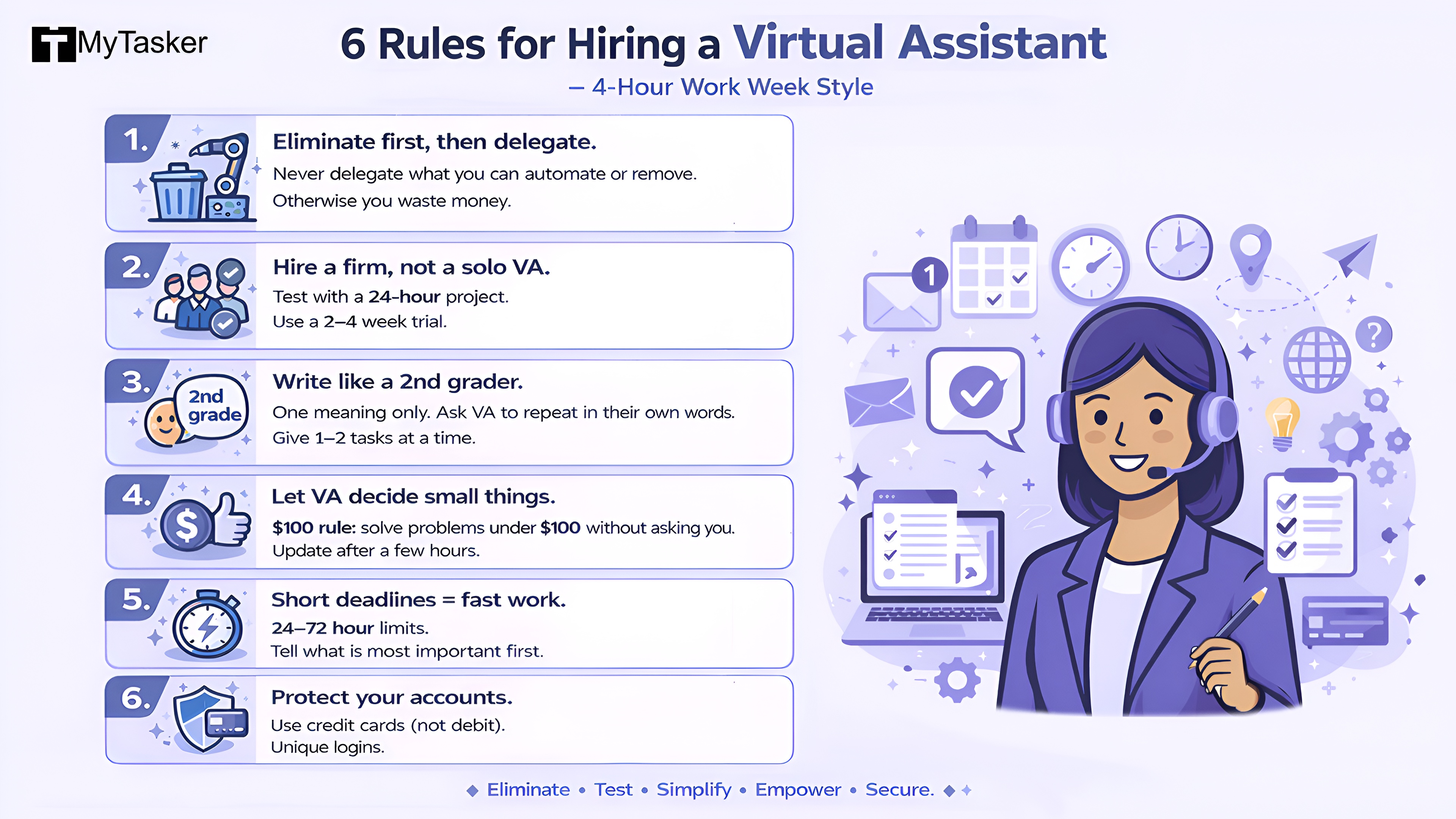
The most important rule is to eliminate before you delegate. You should never delegate a task that can be automated or eliminated altogether.
Otherwise, you are simply wasting money to multiply inefficiency. Furthermore, each task you delegate must be both time-consuming and well-defined.
This point is very true and has always played a crucial role in hiring virtual assistants.
I have often seen business owners or professionals sign up, send a list of tasks, and ask for them to be performed after purchasing an hourly subscription.
However, because they do not set which tasks require first priority, they often delegate work that is unnecessary or becomes irrelevant later. As a result, a large portion of their purchased hours gets used on low-priority or irrelevant tasks.
2. Strategic Selection and Redundancy
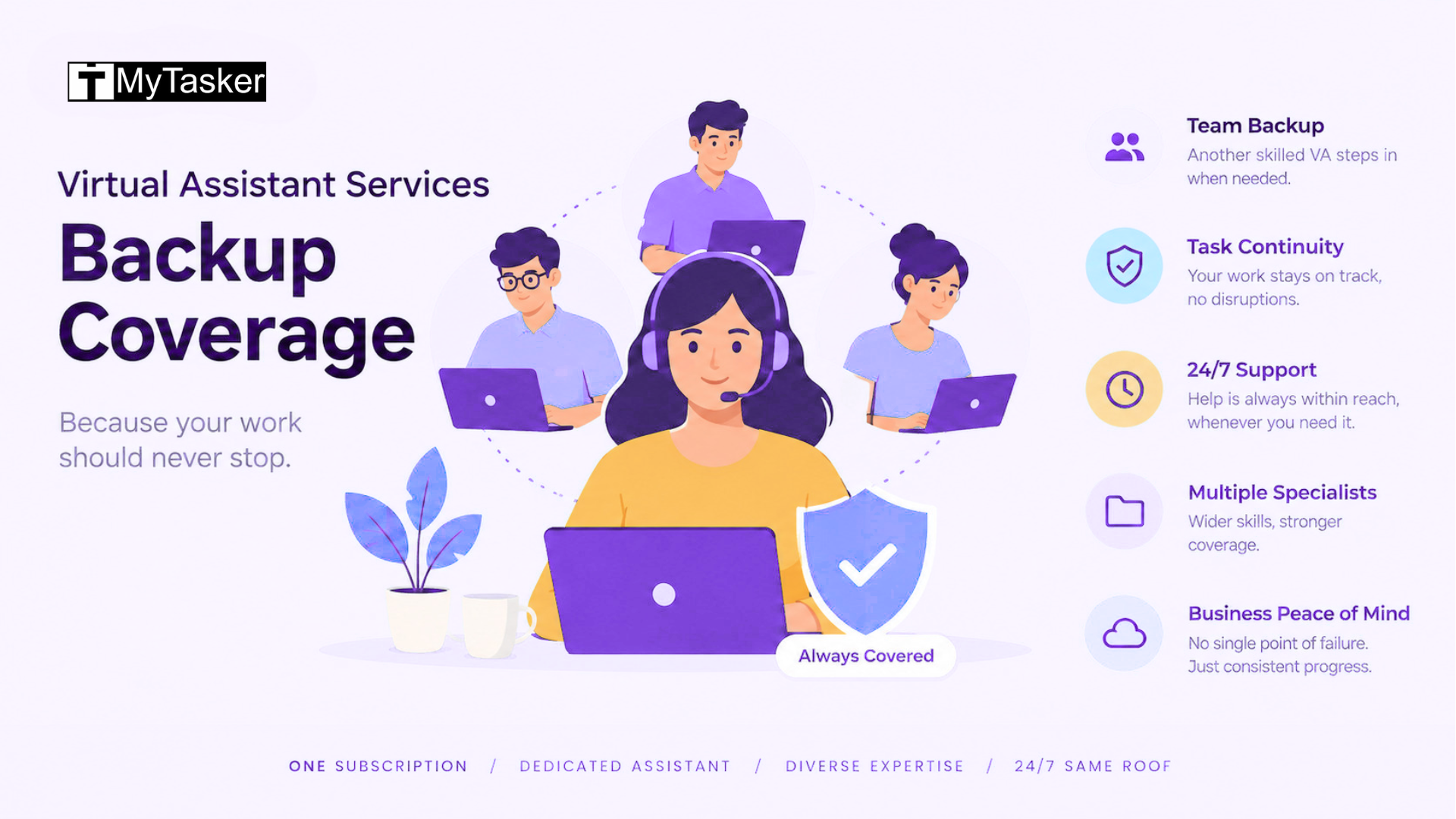
Use Firms Over Solo Operators: You should hire a VA firm or an assistant with a backup team rather than a sole operator to avoid a “single point of failure”.
If your individual assistant becomes ill or unavailable, a firm provides the backup support needed to keep your business running.
Test for Reliability: Before committing, have the top three candidates complete a small project with a tight 24-hour deadline to test for reliability and speed.
Use a Probationary Period: Implement a two-to-four-week trial period to work out communication issues before fully integrating a VA into your workflow.
3. Communication and Precision
The 2nd-Grade Rule: To avoid the language barrier and back-and-forth discussion, write instructions that have only one possible interpretation and are suitable for a 2nd-grade reading level.
Request Rephrasing: Always ask a foreign VA to rephrase the task in their own words to confirm they actually understand your requirements before they begin work.
Limit Task Volume: Assign only one or two tasks at a time. Opening too many tasks simultaneously can cause an assistant to become overtaxed and perform poorly.
4. Rules for "Undecision”
To remove yourself as a bottleneck, you must empower your assistants to make decisions without you.
The $100/$400 Rule: Give your assistants written permission to solve any problem that costs less than a specific amount (starting at $100 and moving to $400 after two months) without contacting you.
Require Status Updates: For longer projects, request a status update after only a few hours of work to ensure the task is achievable and the assistant is on the right track.
5. Efficiency and Deadlines
Apply Parkinson’s Law: Set short deadlines of 24 to 72 hours. Short deadlines help the VA focus on what matters and avoid wasting time.
Define Order of Importance: If you give multiple tasks, clearly tell which ones are most important so the VA knows what to do first.
6. Security and Risk Management
Never Use Debit Cards: Use credit cards for all transactions handled by a VA, as unauthorised charges are easier to reverse than funds withdrawn from a checking account.
Unique Logins: Create unique logins and passwords for your assistants rather than sharing your personal credentials.
When it comes to social media tasks, we often ask our clients to provide page access rather than share their social media credentials. When credentials are necessary, we request that they share them through our encrypted, firewall-protected, and IP-restricted web login section.
We also recommend that clients change their credentials periodically, especially after they pause or stop using our services. Although we sign NDAs with them, we follow these practices to maintain strong digital security and ensure best practices.
Prohibit Subcontracting: Explicitly forbid VAs from subcontracting your work to untested freelancers without your written permission.
Conclusion
Hiring a virtual assistant is not just about outsourcing tasks; it is about building a system that scales without your constant involvement. As Tim Ferriss emphasises, the goal is not to do more through others, but to do only what truly matters.
The difference between success and frustration with VAs comes down to discipline. Eliminate before you delegate. Prioritise ruthlessly. Communicate with absolute clarity. And most importantly, create guardrails that allow your assistant to operate independently without compromising quality or security.
When done right, a virtual assistant becomes more than support; they become leverage. You free up time, reduce mental load, and shift your focus to high-impact decisions that actually grow the business.
In short, virtual assistants do not just help you get things done. They help you build a business that runs without you.