AI can create content incredibly fast. Give it a topic. It gives you an article.
Give it another. You get another. And another.
Soon, you have 100 pieces of content.
Sounds productive.
But here is the problem:
100 pieces of content do not automatically make you an authority.
In fact, if those 100 pieces are not connected, they can create problems of their own.
That is why content mapping still matters.
Perhaps now more than ever.
When content becomes a problem
Imagine publishing article after article without first deciding where each one belongs.
You might write five articles about almost the same thing.
Now your own pages are competing with each other. Search engines have to figure out which one is the best answer.
That is content cannibalisation.
Or you might get the stage completely wrong.
Someone is still trying to understand a problem, and you give them a sales pitch.
Someone else is ready to buy, but you give them a basic “What is X?” article when they really want pricing, comparisons or a demo.
That is a stage-intent mismatch. Then there is something I call click vanity.
You can write an article that gets 50,000 visitors a month and still generate almost no business.
The traffic looks fantastic in your analytics. But where does the reader go next?
If there is no useful internal link, relevant CTA or logical next step, the article becomes a dead end.
Lots of clicks. Very little business value. And now AI has created another problem.
It has made publishing hundreds of pages incredibly easy.
But more pages do not automatically mean more visibility.
If your website fills up with thin, redundant or overlapping content, you can waste crawl resources and make the site harder to manage and search engines harder to process efficiently.
In simple terms:
More content can create more noise.
So before asking AI to create another article, there is a more important question to answer.
Does this content deserve to exist?
That is where content mapping comes in.
So, what is content mapping?
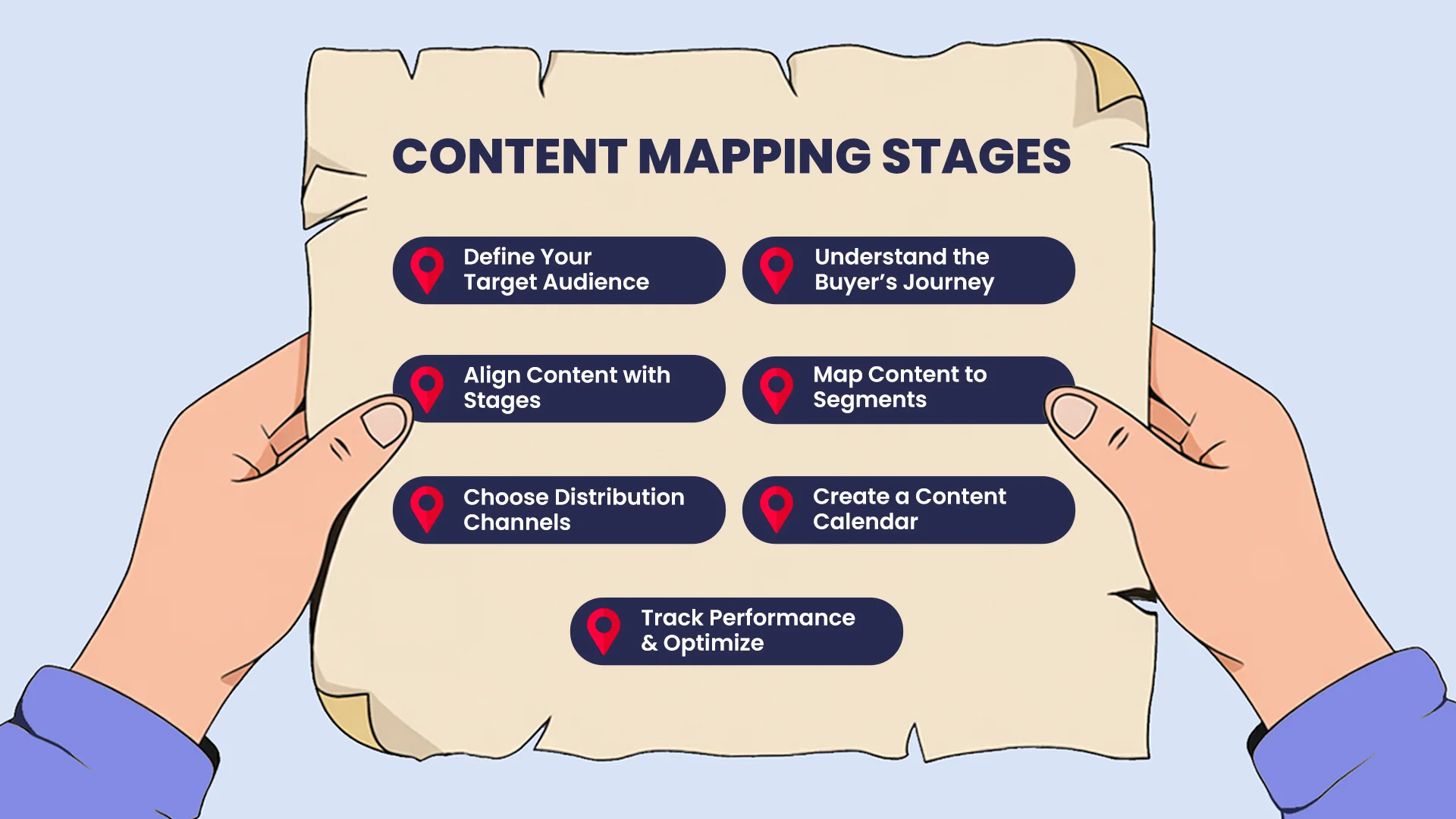
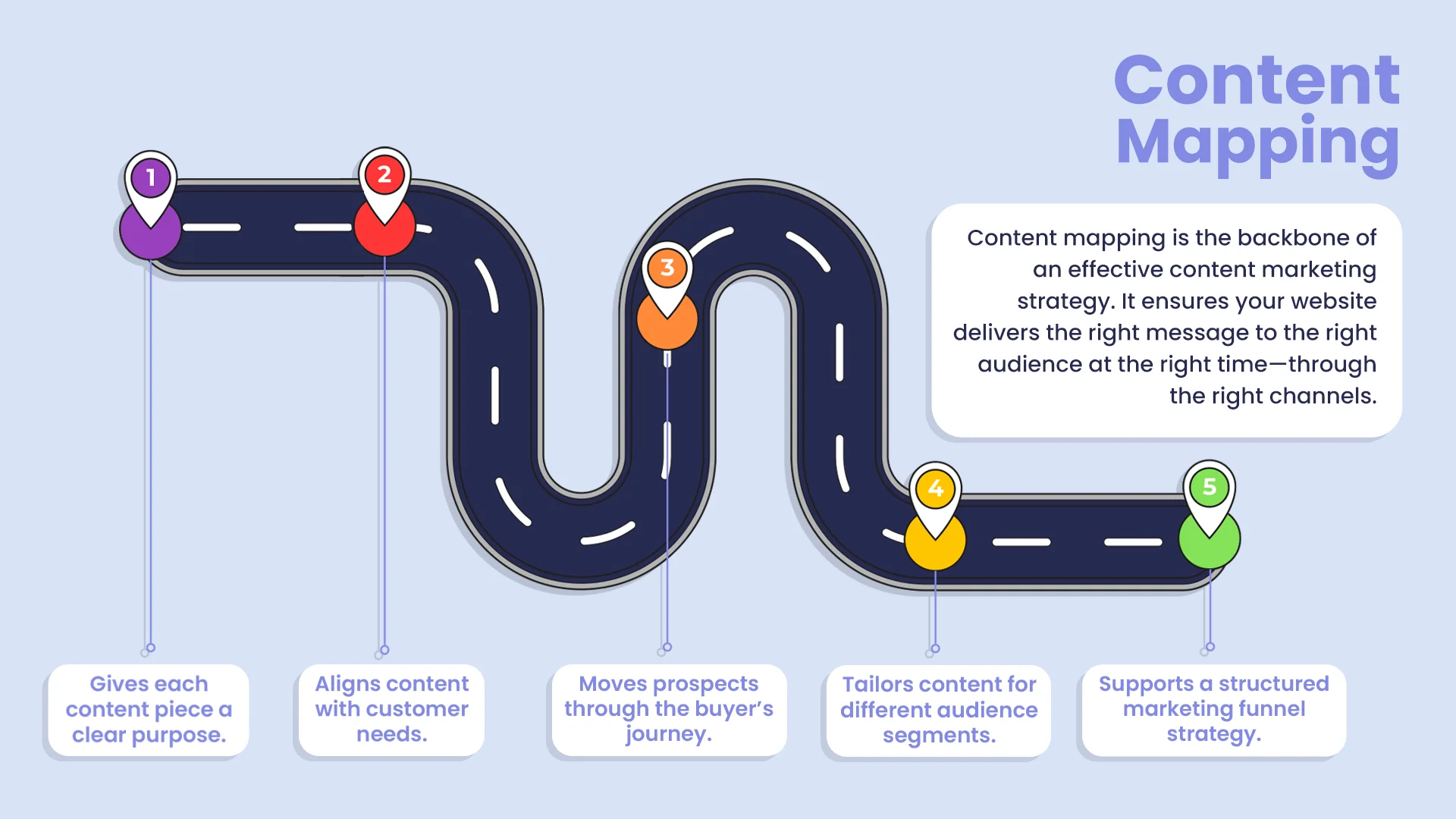
In simple terms, content mapping means putting the right content in front of the right person at the right time.
You look at two things:
Where is this person in their buying journey?
And:
What are they actually looking for?
Instead of treating every article as a standalone piece, you build a connected system where every page has a purpose.
And that changes the question from:
“What should we write next?”
to:
“What does this person need next?”
That small change can completely change your content strategy.
Start with one core topic
First, decide what your business wants to own.
Say you sell project management software for remote teams.
Your core topic might be:
Project Management Software for Remote Teams
That becomes your main hub.
Then you build supporting content around it.
The idea is simple: decide what you want your website to be known for before you start creating dozens of pages.
Then understand where the reader is
Not everyone searching for your topic is ready to buy.
Some are just trying to understand a problem.
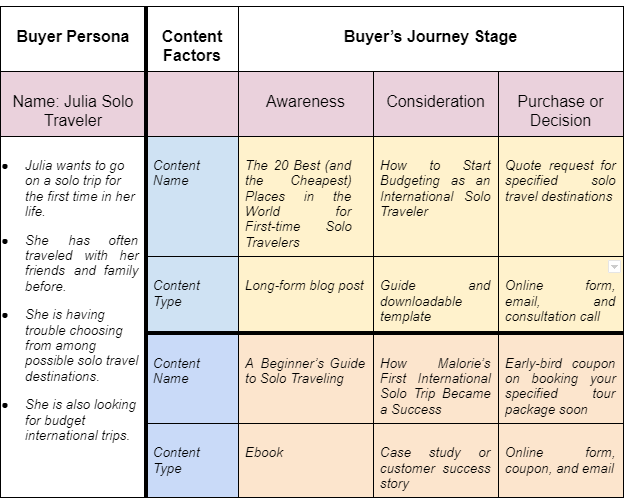
Awareness:
“Why are my projects always late?”
They need education.
Others understand the problem and are exploring solutions.
Consideration:
“Agile vs. Waterfall for remote teams”
They are comparing approaches.
And some are ready to choose a product.
Decision:
“Top 5 project management tools for remote teams under $20/month”
They want pricing, features and comparisons.
The same business can serve all three.
But the content, tone, CTA and next step should change depending on where the reader is.
That is content mapping.
Give every page a reason to exist
This is where keyword mapping becomes important.
If two articles answer essentially the same question for the same audience, you probably do not need two URLs.
For example:
-
How to Manage Remote Teams
-
Tips for Managing Remote Teams
-
Best Ways to Manage Remote Teams
Why create three pages when one genuinely useful resource could do the job?
Something like:
The Complete Guide to Remote Team Management
Then use related keyword variations naturally within it.
The principle is simple:
One intent. One primary URL.
And this changes how you use AI.
Instead of asking:
“What else can we write about this topic?”
Ask:
“Does this deserve another URL?”
That question can save you from creating a lot of unnecessary content.
Then connect the pages
A good content map does not stop at deciding what to write.
It decides what happens next.
Think of a simple journey:
Awareness → Consideration → Decision → Demo or enquiry
Someone reading “What Is API Integration?” may not be ready to book a $5,000 consulting engagement.
A more natural next step could be:
“10 API Workflows Every Operations Lead Should Know”
Later, when that person understands the problem and the possible solutions, a service page or consultation offer makes much more sense.
The goal is not to push people.
It is to guide them.
That is also how you turn traffic into something more meaningful than a number.
Stop thinking of content as a pile of articles
This is where the traditional funnel model is useful, but incomplete.
You know the model:
Awareness → Consideration → Decision
Or:
TOFU → MOFU → BOFU
It still matters.
But there is another question:
How does one piece of information connect to another?
Imagine your business is about virtual assistants.
You explain what a VA does.
Then what businesses can delegate.
Then how much a VA costs.
Then VA vs. employee.
Then how to choose one.
Then how onboarding works.
Then the common objections.
You have seven articles.
But if they are properly connected, you have something much more valuable:
A connected knowledge system.
That is the bigger idea behind modern content mapping.
The person comes before the keyword
A good content map starts with people, not search volume.
You need to understand your:
Ideal customer profile: The company you actually want, including its size, sector, budget and structure.
Buyer persona: The person inside that company, their role, pain points and responsibilities.
Target audience: The wider group you speak to across channels.
Buyer’s journey: The path from “I have a problem” to “I have chosen a supplier.”
And then there is the customer lifecycle.
What happens after the sale?
Onboarding.
Retention.
Expansion.
Most content maps stop at purchase.
That means they can miss an important part of the relationship.
This becomes even more important in B2B, where several people may research a solution before anyone contacts you.
Different stages need different content
A person discovering a problem does not necessarily need a case study.
A person comparing solutions may not need another basic explainer.
And someone ready to buy probably does not need another awareness article.
A simple guide looks like this:
Awareness: Blog posts, infographics, short videos and social content.
Consideration: Ebooks, whitepapers, webinars, comparison pages and buyer’s guides.
Decision: Landing pages, product pages, case studies, testimonials, pricing pages and ROI calculators.
The common mistake is having thirty awareness pieces and almost nothing that helps someone decide.
You end up with a funnel full of beginnings.
But no journey.
Why this matters even more in 2026
AI has changed the economics of content.
Production is no longer the biggest problem.
You can create content faster than ever.
The bigger question is whether that content adds something useful.
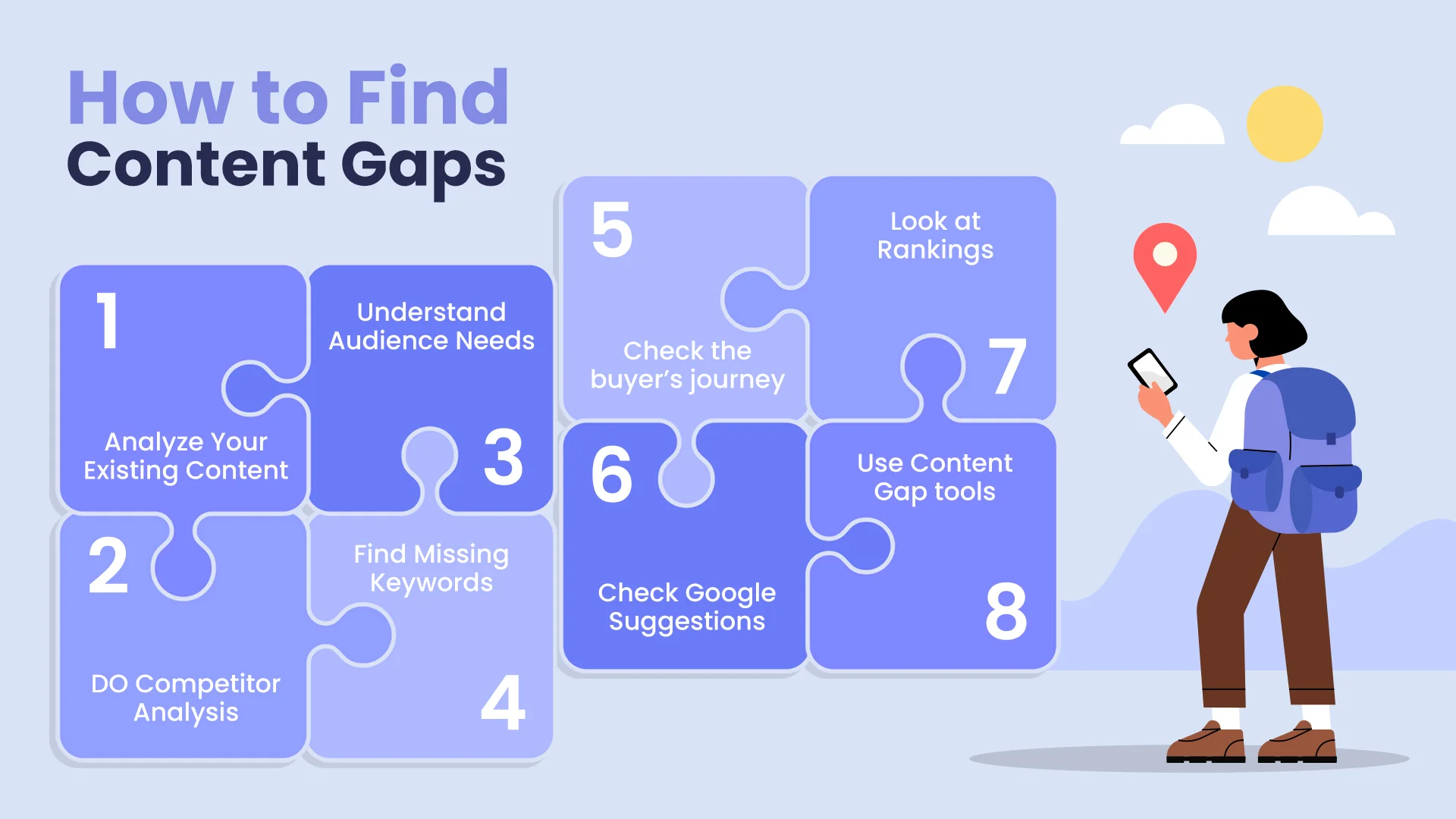
A content map helps you see what is missing.
Maybe you have 30 awareness articles but almost nothing about pricing, comparisons, implementation, risks or trust.
You have plenty of content.
But the reader still cannot make a decision.
It also helps build topical authority.
Search engines and AI systems increasingly need to understand what your website is about, what your business knows and how your ideas connect.
One article can say:
“We know this topic.”
A connected body of useful content can show it.
That matters for AI visibility too.
AI systems need information they can understand, extract and connect.
Clear explanations.
Consistent terminology.
Strong internal links.
Depth.
Structure.
A content map helps you build these deliberately.
How to actually build the map
You do not need to make this complicated.
Start by taking inventory of what you already have.
List your URLs and titles.
Then identify your audiences, their real questions and the stages of their journey.
Research the search demand, but pay close attention to search intent, not just volume.
Group related content into clusters.
If you cannot explain in one sentence why a page needs to exist, it may need to be updated, merged or removed.
Finally, turn the gaps into a prioritised content plan.
Only then should those ideas enter your content calendar.
Your map can track things such as:
URL and title, primary topic and cluster, funnel stage, search intent, audience, core question, content job, parent page, internal links, missing questions, evidence and sources, AI/GEO value, status, priority, and last updated.
Tools such as Airtable, Trello, Miro, Lucidchart, Asana or HubSpot can help.
But the tool is not the strategy.
The decisions inside the map are.
And then measure it
A content map should eventually show up in your numbers.
Are people actually engaging with the content?
Are they moving from awareness to consideration?
Which clusters generate enquiries?
Which pages assist conversions even if they do not convert directly?
Are your priority pages appearing in AI answers?
These questions tell you whether your content is simply attracting people or actually helping them move forward.
Because that is the difference between traffic and business value.
The uncomfortable truth
If your content strategy looks like this:
Find topic → ask AI to write → publish → repeat
you may be producing content. But you are not necessarily building authority.
You may simply be adding to the noise. Content mapping forces you to ask better questions:
What does this person need next?
What have we failed to explain?
Where are our knowledge gaps?
Which topics should connect?
And perhaps the biggest question:
When someone looks at everything we have published, do they see a company that truly understands the subject, or a company that has simply published a lot about it?
Those are very different things.
And in the age of AI, that difference matters more.
Conclusion
Content mapping was never the glamorous part of content marketing.
It was the quiet work underneath everything else. The planning. The connections.
The gaps. The structure.
The simple question:
“What should come next?”
But discovery is changing. People do not find information only through search results anymore.
They find it through AI systems too. And AI needs information it can understand, connect and use.
So don’t create content just because you can. Map the knowledge first.
Then create what is missing.
Connect it. Strengthen it. Keep improving it.
AI should not help you create more noise. It should help you build a better body of knowledge.
That is why content mapping still matters.
And perhaps that is the real shift in content strategy: Stop thinking about how much content you can produce. Start thinking about how much useful knowledge you can build.