We've entered the era of hyper-automation. A human personal assistant is no longer just a task manager. They’re your strategic partner.
AI optimises tasks. Humans handle context, relationships, and judgment.
They manage trust, communication, and real-world complexity. They handle things AI can’t fully understand yet.
They also act as a “human firewall,” reviewing AI outputs for tone, accuracy, and risk.
When something goes wrong or is unclear, they step in, think critically, and fix it.
They don’t just manage your schedule. They help you make better decisions and protect long-term outcomes.
AI handles execution. Humans handle meaning, trust, and responsibility.
Benefits of AI Personal Assistants
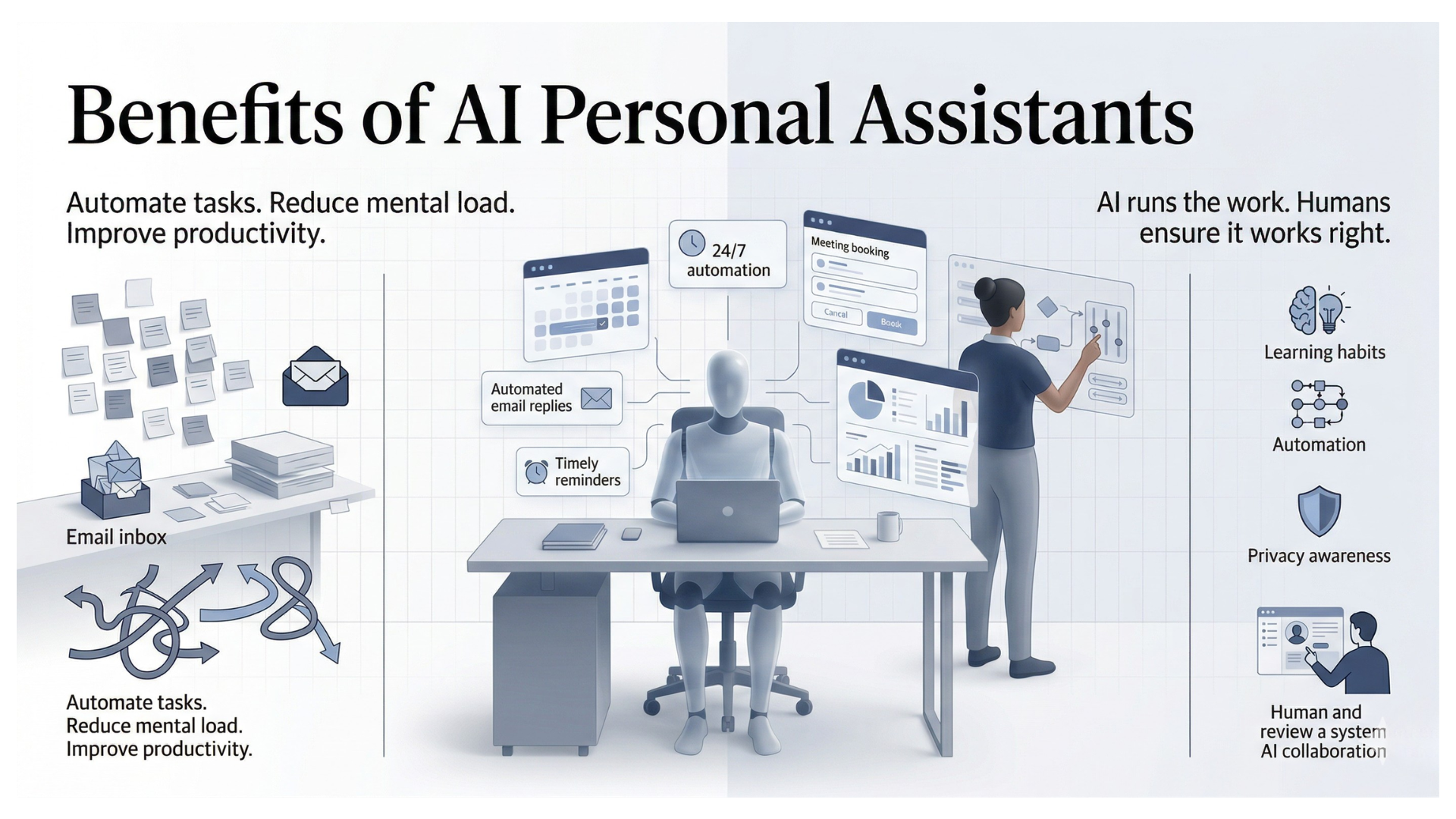
AI personal assistants act like a digital employee. They manage schedules, automate repetitive tasks, and provide real-time insights.
They learn how you work: your habits, preferences, and communication style, and improve over time.
They remove mental load by handling everyday tasks such as reminders, emails, summaries, meeting booking, and prioritisation.
Result: more focus, less stress, better productivity.
Instead of wasting time on coordination, you spend it on important work.
Modern assistants (like GPT-5.4-based tools) go beyond chat. They can take actions: send emails, update sheets, manage tasks, and connect across apps.
Just stay mindful of privacy. Review permissions and control what data you share.
However, to make it work properly, you still need a human virtual assistant.
Someone has to review workflows, question each manual task, decide what should be automated, and keep improving the system.
AI tools can fail or break. That’s common. A human steps in, fixes issues, and keeps things running.
What stands out with ChatGPT 5.4 is this: even OpenAI acknowledges the human role. You can tweak logic while it’s running, not just after.
AI runs the work. Humans make sure it works right.
Why do you need a human virtual assistant to manage AI?
A human virtual assistant acts as a human firewall: checking facts, quality, and outputs before they matter.
They optimize prompts, add context, and apply judgment. AI follows the “what”; humans understand the “why.”
They protect confidentiality and ensure sensitive data stays controlled.
They turn AI suggestions into real-world execution and keep the human touch intact.
AI can do tasks in minutes that once took hours.
But it still depends on the right input, logic, and direction. Humans make sure AI gets that right.
They also handle proofreading, refinement, and proper use: areas where AI can fall short.
AI is great at processing data, but weak at understanding human context. It works on patterns, not meaning.
Take a simple case: an angry customer.
AI may generate a polite reply. A human reads the situation, adjusts tone, shows empathy, and resolves the issue.
That difference can decide whether you lose a client or build loyalty.
The Myth That AI Is Always Cheaper
On paper, replacing human support with automated systems appears economical.
In practice, the calculation is not always so simple.
Automation can introduce hidden costs: lost deals caused by impersonal communication, hours spent correcting machine-generated errors, customers who feel ignored, and the reputational risks that arise when algorithms misbehave.
These problems rarely appear in spreadsheets but often emerge in real business operations.
The lesson is not that AI is ineffective. Quite the opposite. The lesson is that technology works best when paired with human oversight.
Many companies are still reluctant to integrate AI into their business operations.
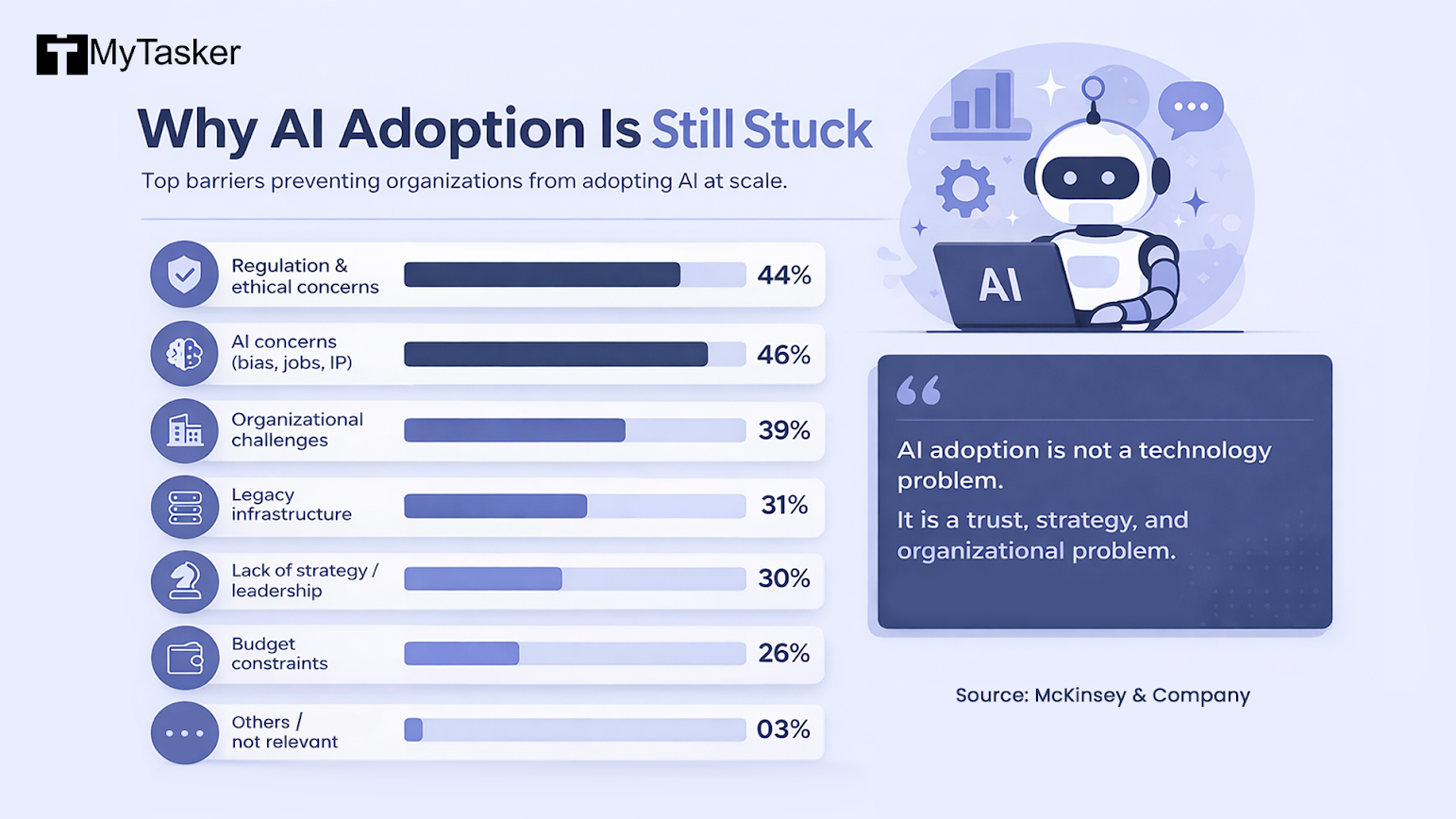
A recent report, The State of Organizations 2026, published by McKinsey & Company, says:
"AI still faces internal resistance despite its potential.
Our survey suggests that the top barrier involves concerns about AI itself, including issues of bias, intellectual property, and the potential threat it poses to jobs (46 percent).
The second top barrier addresses regulatory, ethical, or legal concerns (44 percent). These concerns are slightly higher among EU-based leaders (48 percent), especially in Germany (56 percent), than those in North America (44 percent) and Asia–Pacific (41 percent).
Third is organizational challenges, including change management and issues with breaking down silos (39 percent).
These findings raise questions about how organizations can build a “test, learn, and adapt” mindset and a culture of continuous improvement, and about how leaders redefine roles and responsibilities in a world in which machines can think, orchestrate, decide, and create."
The Evolving Role of the Personal Assistant
As AI takes over repetitive administrative work, human assistants are moving into a more strategic position.
In many organisations, they are no longer merely schedulers or gatekeepers.
Instead, they act as operational partners, managing information flows, relationships and decisions that fall outside automated systems.
Their value lies not in doing more tasks than machines, but in doing the tasks machines cannot do well.
Several areas illustrate this shift.
Emotional Intelligence
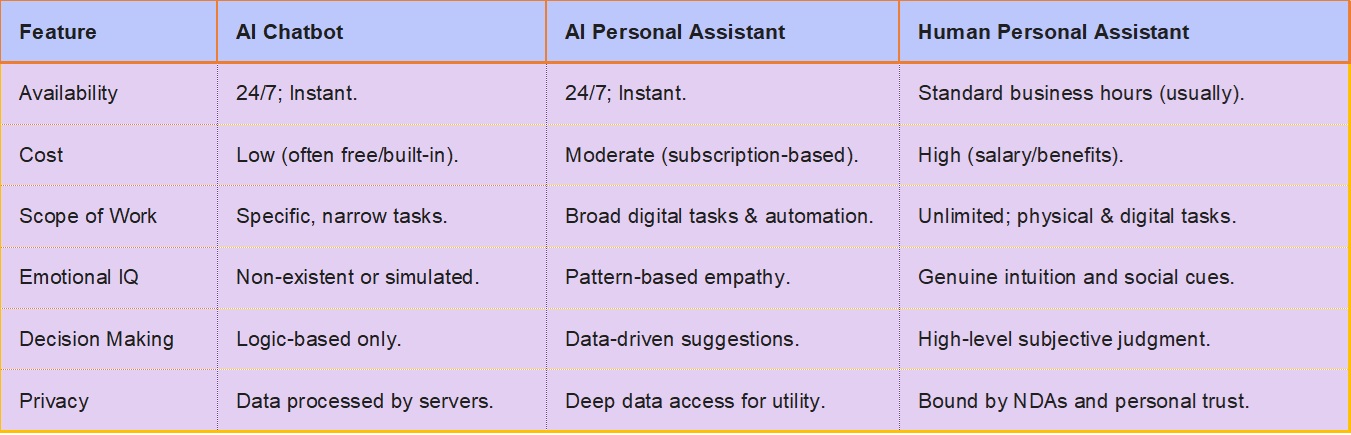
Humans detect nuance where algorithms see patterns.
A skilled assistant may notice hesitation in a client’s voice or interpret a short message that signals concern rather than approval.
Such signals are often invisible to automated systems but crucial for maintaining relationships.
Crisis Management
Computers thrive on predictable inputs. The real world rarely behaves predictably.
When unexpected events occur, a cancelled venue, a delayed shipment, a technical failure, human assistants improvise solutions, call contacts and negotiate alternatives.
Machines suggest options. Humans resolve crises.
Relationship Capital
Much of business rests on relationships rather than formal processes.
A thoughtful gesture during a client’s difficult moment or careful diplomacy with an investor can preserve partnerships worth millions. Algorithms can schedule reminders, but they cannot build trust.
Judgment Beyond the Playbook
Many decisions fall outside predefined rules.
If a supplier delays a delivery or a project deadline shifts, a human assistant can weigh trade-offs and recommend practical solutions.
AI systems may flag the problem, but they cannot always determine the best response.
Oversight of Automated Systems
AI systems are prone to occasional inaccuracies, awkward phrasing or invented information.
Human assistants provide an essential layer of quality control, reviewing automated output and ensuring communications remain accurate and appropriate.
Privacy and Accountability
Executives frequently entrust assistants with sensitive financial information, legal documents and personal schedules.
While digital platforms process enormous volumes of data, human assistants operate under confidentiality agreements and professional accountability—an important distinction in an age of increasing data concerns.
Real-World Execution
Software operates in the digital realm. Many tasks occur in the physical world.
Human assistants can inspect a property, oversee repairs, coordinate logistics or handle urgent errands.
These practical responsibilities remain firmly outside the reach of algorithms.
Work–Life Integration
Machines optimise efficiency. Humans understand priorities.
A thoughtful assistant may restructure a meeting schedule to allow an executive to attend a family event.
Such decisions require perspective rather than pure optimisation.
Strategic Partnership
Over time, experienced assistants acquire deep knowledge of a leader’s working habits, relationships and objectives.
Many evolve into trusted partners who anticipate challenges, identify inefficiencies and quietly ensure that organisations run smoothly
Final Note
The future of work is unlikely to belong exclusively to machines or to humans.
Instead, it will be shaped by collaboration between the two.
Artificial intelligence will continue to automate routine tasks and analyse vast datasets with extraordinary speed.
Human assistants will provide the judgment, empathy and contextual understanding that technology still lacks.
The organisations that thrive will be those that combine these strengths effectively.
Machines may process information faster than people ever could.
But when decisions involve trust, relationships and consequences, human judgment remains difficult to replace.