Today, the term "social media" is still shorthand for reach — but reaching people and reaching the right people have become two very different problems. If you are running a business in 2026, being well-invested in social media marketing is no longer the differentiator. Being precise about who you are talking to is.
Social platforms stopped being places we only talk to loved ones a long time ago. They are now the mainstream way new and established businesses increase engagement, acquire reach, and build brand visibility — and increasingly, they are where buying decisions actually start.
The sheer number of people on these platforms is what makes social media marketing work. According to DataReportal's April 2026 data, there are around 5.79 billion social media user identities worldwide — roughly 69.9% of the global population — growing by about 294 million in the past year. The average user is active on about 6.5 platforms a month and spends roughly 2 hours 21 minutes a day scrolling. Social media is not a trend to evaluate. It is the largest attention pool in history, and it is still growing.
But that scale cuts both ways. A bigger pool means more noise, higher ad costs, and a much steeper penalty for guessing wrong about your audience. To target the right audience on social media, you need a clear, evidence-based understanding of who that audience is. Here are the ways to build it.
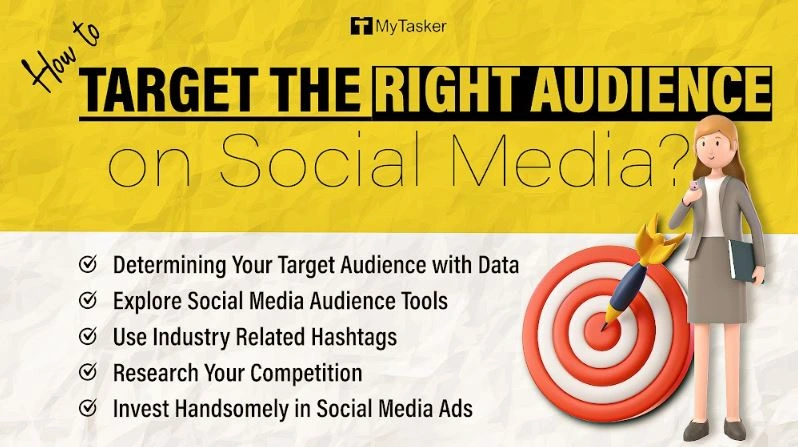
Determining Your Target Audience with Data
Knowing your audience is essential, and chasing John Does makes it very difficult to reach the people who will actually buy. A guessing game is not a wise option. You need relevant data to make informed decisions about who you are catering to. Without it, your marketing spend is just resources, time, and money burned with nothing to show at the end.
Use your own analytics instead. GA4 and your platform-native insights will tell you the demographics of the people already engaging, which channels they are most active on, and the kind of content they consume most. Turning those findings into something usable is where a content map built around your buyer's journey earns its keep — audience data is only valuable once it changes what you publish.
One important change since this article was first published: GA4 no longer reports on the same behavioural signals the old Universal Analytics did, and third-party cookies are effectively gone. GA4 is now event-based and modelled, which means it is best used for direction and pattern-spotting, not as a precise census of your audience. Pair it with:
- Server-side conversion tracking (Meta's Conversions API, Google's enhanced conversions) so the platforms still see what happened after the click
- CRM and email list data, which is now your most reliable audience signal
- Post-purchase and enquiry form questions — "how did you hear about us?" is crude, but it is first-party and it is honest
Build a First-Party Data Asset Before You Build Audiences
This is the single biggest shift since the original version of this article. Third-party cookies are gone, Apple's App Tracking Transparency has been in force for years, and privacy regulation has tightened across every major market. The businesses winning on social in 2026 are not the ones with the most data — they are the ones with the cleanest first-party data.
Social platforms have quietly become excellent first-party data sources because the signals are consent-based:
- Lead generation ad forms
- Gated content, webinars, and live events
- Newsletter and subscription sign-ups
- DM conversations and comment threads
- Saves, shares, and repeat viewers on video
Feed those signals back into your ad platforms as customer lists and conversion events. That is what powers accurate lookalike modelling now — not scraped interest categories.
Zero-party data — information customers volunteer deliberately, like a quiz answer or a stated preference — tends to signal the highest intent of all. Build a value exchange worth answering for.
Explore Social Media Audience Tools
The next part of the analysis involves the tools that surface insight: GA4 alongside native services like Meta Business Suite audience insights, Instagram Insights, LinkedIn's audience analytics, and TikTok's audience tools.
GA4 will help you see which social platforms present customers actually arrive from and what they look for when they get to your site — pricing, demos, proof, or reassurance. For the native platform tools, plug in the first-party lists you built in the previous step and develop lookalike audiences from them. This remains one of the most effective ways to define an ad audience, and it works far better from a clean customer list than from an interest stack.
Add social listening to the mix. AI-powered listening tools now surface market and consumer intelligence close to real time, which means you can anticipate a shift and adapt messaging while it is happening, instead of learning about it in a post-campaign report. If you are assembling a stack from scratch, start with the free tier of a social media scheduling and monitoring tool before paying for an enterprise suite.
Work With the Algorithm, Not Against It
The old instinct was to narrow: layer interest on interest until the audience felt exclusive. In 2026, that instinct actively hurts you on AI-driven delivery systems like Meta Advantage+ and Google Performance Max.
These systems find converters by exploring. Over-restricting the audience starves the machine learning of the room it needs to learn, and you end up paying more for a smaller, worse-performing pool.
The better approach:
- Give the algorithm strong seed data — a clean customer list, accurate conversion events, a well-configured server-side setup.
- Go broad, then guide. Use audience signals as suggestions rather than hard filters.
- Use exclusions rather than narrow inclusions. Filter out existing customers, irrelevant regions, and unqualified job titles.
- Let creative do the targeting. In an automated delivery environment, the ad itself is now your sharpest filter — the right hook attracts the right person and repels the wrong one.
Keeping up with bid strategies, campaign types, and policy changes across Meta and Google is close to a full-time job, which is why many small teams now hand the day-to-day of paid campaigns to a digital marketing virtual assistant.
One exception worth naming: LinkedIn. It is still the only major ad platform built on verified professional identity, where job title, company size, industry, and seniority are self-reported and kept current. For B2B, precise targeting still earns its keep there — though CPCs run high enough that the offer needs a clear route to ROI.
Use Industry-Related Hashtags — and Social Search Keywords
The last decade saw an explosion of hashtags across every platform, and they remain an easy way to track trending topics, questions, and events in your industry. Anyone searching a particular hashtag can view the related content, and a well-chosen one still helps a brand gain exposure.
Narrow them down. The more specific the hashtag, the better it performs, because it reaches a smaller audience that genuinely matches your niche.
That said, the weight has shifted. Platforms now read the spoken words, on-screen text, and captions in your content, not just the tags attached to it. And a large share of users — particularly under 30 — now begin product research inside TikTok, Instagram, and YouTube rather than a search engine. We covered that behaviour in detail in our guide to social media as a search engine for Gen Z. Increasingly, AI assistants are a discovery layer of their own.
Practically, that means writing for search inside social:
- Say your keyword out loud in the first few seconds of a video
- Put it in on-screen text and in the caption's opening line
- Write descriptive, question-shaped captions ("how do small businesses handle back-office admin?")
- Keep hashtags to a focused handful rather than a wall of them
Mining your audience's own language — the questions they ask, the tags they follow — is one of the most reliable sources of new content ideas you have.
Research Your Competition
Keep a tab on how your competitors are faring across all social platforms. Can you categorise their target audience or persona? What kinds of content are they using, and what is working in their favour?
This method — competitor research — is designed to offer inspiration and insight. It gives you the time and space to understand why and when competitors perform well, and it reliably sparks ideas of your own.
In 2026, add two things to that review. First, check their ad activity directly in the Meta Ad Library, TikTok Creative Center, and LinkedIn's ad transparency tab — you can see the actual creative running and infer who it is aimed at. Second, note which creators and employees are posting on their behalf. Creator partnerships and employee advocacy have become a core distribution channel, and audience alignment matters more than follower counts.
When you spot a gap, resist the urge to copy post-for-post. Slot the insight into a content pyramid so one strong idea produces a video, a carousel, and a long-form piece rather than a single reactive post.
Invest Handsomely in Social Media Ads
Invest in ads on the right platforms. Spending where your target audience is not present is money set on fire. Advertise only on channels where your customers are active and spend time.
Fuel those ads with organic content that has already proved itself. People are frustrated with advertising, but if you present them with the kind of content they are already choosing to spend time on, your click-through odds improve substantially. Promoting a post that performed organically is still the most dependable way to lower cost per result.
Two additions for 2026. Social commerce now accounts for a meaningful share of online sales, and in-app checkout means the distance between attention and purchase is shorter than it has ever been — factor that into how you measure a campaign. And with attribution weakened by privacy changes, incrementality tests and geo holdouts are worth more than last-click dashboards when you are deciding where the next rupee or dollar goes.
If the volume of creative and reporting this demands is more than your team can produce, there is a strong case for outsourcing social media management rather than stretching one overloaded marketer across five platforms.
The Part Most Businesses Underestimate: Consistency
Precise targeting fails without steady execution. Audience research goes stale, creative fatigues in weeks rather than months, comments and DMs pile up unanswered, and reporting slips because there is always something more urgent.
This is exactly the work a social media virtual assistant absorbs — content scheduling, community management, competitor and hashtag research, engagement monitoring, and monthly performance reporting — so the strategy you built actually runs, week after week. UK businesses in particular tend to hit this wall early; we broke the arrangement down in our guide to hiring a VA for social media in the UK.
Targeting the right audience is fundamental to kicking off a successful and sustainable social media marketing campaign. This blog has given you an insight into how to reach that audience in 2026 — with cleaner data, broader-but-better-guided ad delivery, and content written to be found. If you are still struggling to hit the mark, or you simply do not have the hours to run it consistently, talk to the specialists behind MyTasker's digital marketing services. You can start with our $1 Exclusive Trial — no time limit, no lock-in — and watch your business soar.
FAQs
How do I find my target audience on social media?
Start with data you already own: GA4, your CRM, your email list, and platform-native audience insights. Identify the demographics, locations, and platforms of people who already convert, then use that list as the seed for lookalike audiences. Guessing from assumed interests is the most common and most expensive mistake.
How many social media users are there in 2026?
DataReportal's April 2026 figures put it at roughly 5.79 billion social media user identities globally — about 69.9% of the world's population — growing by around 294 million year on year. Note that these are identities, not unique people; the average user holds accounts on about 6.5 platforms.
Do hashtags still work in 2026?
They still help with niche discovery, but they matter less than they did. Platforms now index captions, on-screen text, and spoken audio, so keyword-rich captions and clear spoken hooks generally outperform long hashtag lists. Use a focused handful of specific, niche hashtags rather than broad ones.
Should I use narrow or broad targeting for social media ads?
On AI-driven systems like Meta Advantage+ and Google Performance Max, broad targeting with strong first-party seed data and tight exclusions usually beats heavily layered narrow targeting. LinkedIn is the main exception, where verified professional data makes precise B2B targeting worthwhile.
How has the loss of third-party cookies changed social media targeting?
Behavioural tracking across sites has largely stopped working, so platforms rely more on modelling and on data you supply directly. The practical response is to build first-party data — lead forms, subscriptions, CRM records, server-side conversion tracking — and feed it back to the platforms as your targeting foundation.
Can a virtual assistant manage social media targeting?
Yes. A digital marketing virtual assistant can handle audience and competitor research, content scheduling, hashtag and keyword research, community management, and performance reporting. Strategy usually stays with you or a specialist; the recurring execution is what a VA takes off your plate.