Summary:
-
With more than 34 million active users in Canada, Facebook remains the country’s largest social platform and one of the most cost-effective advertising channels for businesses.
-
Meta’s AI-powered ecosystem — including GEM, MetaLattice, Advantage+, and CAPI — has become essential infrastructure for profitable customer acquisition in 2026.
-
The best-performing campaigns now combine broad AI-driven targeting with highly specific creative, clean first-party data, and strong post-click experiences.
-
For Canadian businesses, Meta Ads consistently outperform many traditional channels on cost efficiency, with average CPCs often ranging from $0.50 to $2.00 compared to $3 to $8 on Google Search.
-
Success on Meta no longer comes from constant tweaking. It comes from patience, structured testing, conversion tracking, and human oversight.
Why Meta Is Still the Most Important Advertising Platform in Canada
Despite growing competition from TikTok, YouTube Shorts, and X, Facebook continues to dominate the Canadian social media landscape.
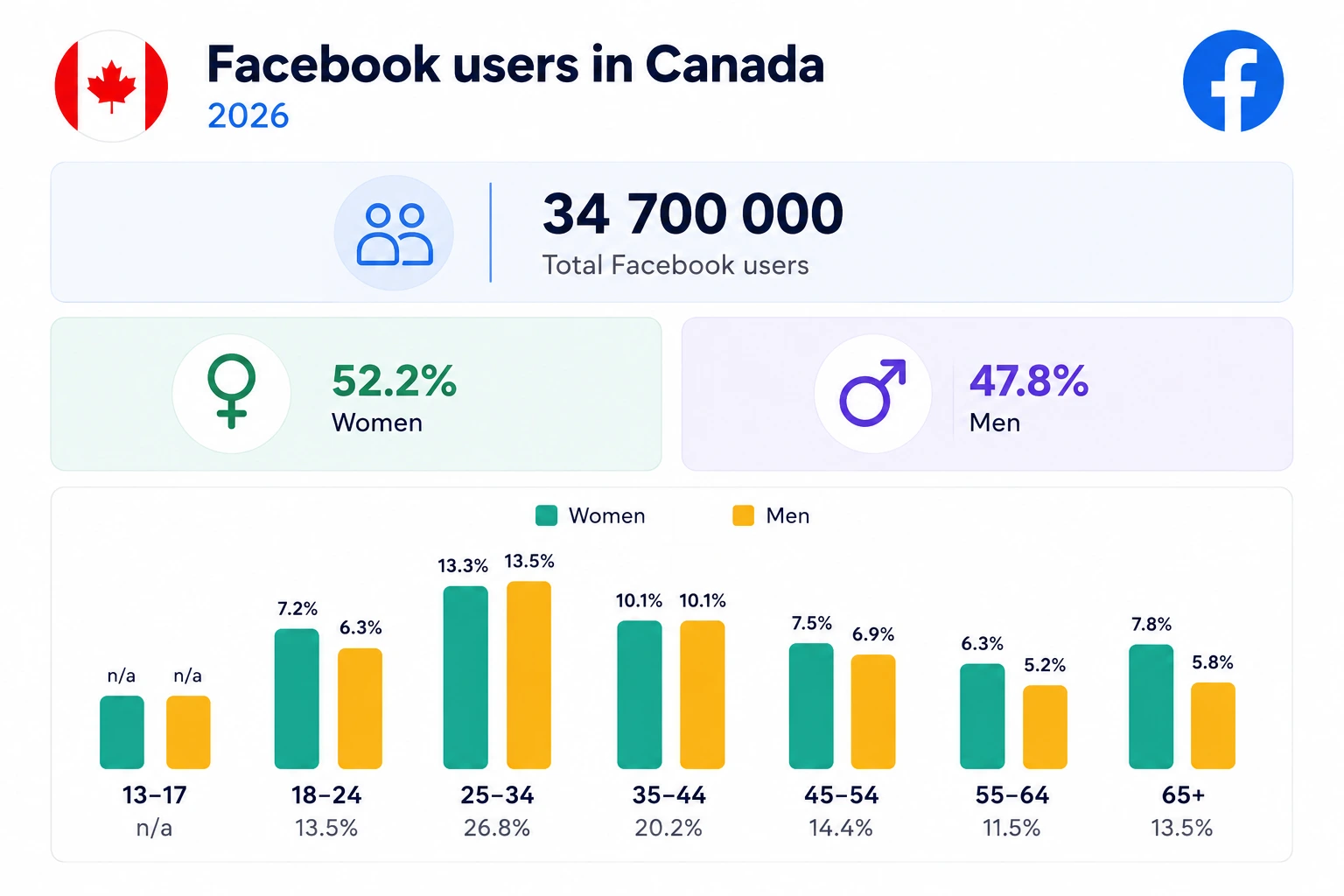
More than 34 million Canadians actively use Facebook, making it the single largest social platform in the country. For businesses, that scale matters. Meta’s ecosystem gives advertisers access not only to Facebook, but also Instagram, Messenger, Reels, Stories, and Audience Network placements from a single advertising platform.
For most Canadian businesses, Meta Ads remain one of the fastest and most scalable ways to generate leads, drive local traffic, and increase online sales.
The economics are also compelling.
While Google Search often captures high-intent demand at CPCs ranging from $3 to $8 or higher, Meta frequently generates clicks between $0.50 and $2.00 in many industries. That lower entry cost allows businesses to test creative, audiences, and offers at a much faster pace.
However, Meta advertising in 2026 is no longer simple.
The platform has evolved into a sophisticated AI-driven acquisition engine powered by predictive modelling, behavioural analysis, and generative creative systems. Businesses still relying on outdated strategies — manual targeting, static creative, and browser-only tracking — are increasingly losing efficiency.
The companies winning today are those treating Meta not as a “social media platform,” but as a customer acquisition operating system.
Who Should Use Meta Ads?
Meta Ads work across almost every major business model because the platform supports both demand generation and conversion-focused campaigns.
Content creators use Meta to grow audiences, monetise video content, and expand reach through Reels and in-stream ads.
Event organisers use radius targeting and event response campaigns to increase attendance and sell tickets locally.
Nonprofits use Meta for awareness campaigns, donor acquisition, and volunteer recruitment.
Local businesses generate calls, bookings, appointments, and foot traffic from nearby customers using hyperlocal targeting.
Established brands use Meta to remain visible across multiple demographics while reinforcing brand recall through consistent exposure.
For Canadian SMBs, Meta’s flexibility is one of its greatest strengths. Businesses can run image ads, video ads, carousel ads, collection campaigns, Lead Ads, Click-to-WhatsApp campaigns, Instant Experience ads, Reels placements, and interactive poll formats from a single platform.
Why Meta Ads Continue to Work So Well in Canada
Massive Reach Across Prime Buying Demographics
Facebook’s largest Canadian user segment falls within the 25–34 age group, one of the strongest purchasing demographics across retail, real estate, automotive, SaaS, hospitality, and financial services.
The platform also reaches older audiences exceptionally well, making it one of the few digital ecosystems capable of serving both younger mobile-first consumers and older decision-makers simultaneously.
Advanced Targeting Capabilities
Meta’s targeting infrastructure remains one of the most sophisticated in digital advertising.
Businesses can target users based on:
-
Postal code
-
Interests
-
Purchase behaviour
-
Device type
-
Relationship status
-
Life events
-
Website engagement
-
CRM customer lists
-
Lookalike modelling
However, advertisers must understand that certain industries fall under Meta’s Special Ad Categories policies.
Housing, employment, and credit advertisers face restrictions on age, gender, and detailed geographic targeting due to anti-discrimination regulations.
This has become particularly important in Canada as privacy regulations and platform accountability continue tightening.
Cross-Platform Advertising From One Dashboard
Meta’s biggest structural advantage is ecosystem integration.
A single campaign can simultaneously serve ads across Facebook, Instagram, Messenger, Stories, Reels, and Audience Network placements.
That creates multiple touchpoints throughout the customer journey without requiring advertisers to manage separate systems.
For Canadian businesses trying to maintain visibility across fragmented attention spans, this cross-platform delivery remains incredibly valuable.
Mobile-First Ad Infrastructure
Most Canadian users browse Meta platforms primarily through mobile devices.
Meta’s ad formats are designed specifically for mobile consumption, with fast-loading vertical creative, instant lead forms, swipeable carousels, and immersive in-app experiences.
This is one reason Lead Ads and Click-to-Message campaigns continue outperforming many traditional landing-page funnels.
Reducing friction increases conversions.
Trust and Social Proof
A strong Facebook Page still influences purchasing behaviour in Canada.
Reviews, comments, engagement, user-generated content, and visible community interaction create social proof that static websites alone often cannot replicate.
In many local industries, trust is the conversion mechanism.
What Most Businesses Still Do Not Understand About Meta Ads
The majority of advertisers continue focusing on demographics and audience size.
In reality, Meta advertising in 2026 is driven far more by data quality, creative specificity, and behavioural modelling.
The “Ghost Conversion” Problem
One of the largest structural shifts in digital advertising is attribution loss.
Privacy changes, browser restrictions, and tracking limitations have created what many advertisers now call the “ghost conversion gap.”
Meta Ads Manager and CRM systems often differ by 40–60% in reported conversions.
This is normal.
Businesses still relying solely on the Meta Pixel are operating with incomplete data.
That is why Conversions API (CAPI) has become essential.
CAPI sends server-side conversion events directly from your CRM or backend systems into Meta, recovering large portions of attribution data lost through browser restrictions.
Without CAPI, Meta’s AI receives weaker optimisation signals.
Weaker signals produce weaker performance.
Creative Is the New Targeting
Perhaps the biggest change in Meta advertising is this:
Creative now influences targeting itself.
Meta’s AI analyses your visuals, headlines, hooks, voiceovers, captions, and engagement patterns to determine which audience segments should receive your ads.
Broad targeting often outperforms narrow targeting today — but only when the creative is highly specific.
A generic ad saying:
“We offer home renovation services. Contact us today.”
will almost always underperform compared to:
“Watch how we transformed a 20-year-old Toronto kitchen in three days for under $15K.”
Specificity gives Meta’s AI clearer contextual signals.
That improves both delivery quality and conversion efficiency.
The Learning Phase Trap
Many campaigns fail not because the strategy is wrong, but because advertisers interfere too early.
Meta’s algorithm typically needs around 50 optimisation events per week per ad set before stabilising performance.
The system also needs time.
Frequent edits reset learning and destabilise delivery.
This is one of the biggest reasons Canadian SMBs abandon campaigns prematurely.
Strong campaigns often require seven to ten days before meaningful optimisation patterns emerge.
Patience is now a competitive advantage.
Creative Similarity Penalties
Many advertisers think they are testing creatives when they are really testing minor cosmetic variations.
Meta’s systems increasingly identify similarity between ads.
Running nearly identical creatives reduces testing quality and limits algorithmic learning.
Effective testing requires genuinely different concepts, angles, hooks, and storytelling structures.
Testing three headlines on the same visual is not enough anymore.
Post-Click Friction Is Killing Conversions
A slow website destroys campaign efficiency.
Every additional second of loading time reduces conversion probability.
That is why in-app experiences often outperform traditional landing-page funnels.
Lead Ads, Click-to-WhatsApp campaigns, Messenger campaigns, and Instant Experience formats reduce friction by keeping users inside Meta’s ecosystem.
The fewer barriers users encounter, the higher the conversion rate.
Real Estate: Hyperlocal Intent Targeting
One of the clearest demonstrations of Meta’s AI evolution is hyperlocal real estate advertising.
A user in Toronto watches a long-form video about Leslieville cafés, schools, and neighbourhood culture.
They never search “homes for sale.”
Yet Meta’s systems identify emerging behavioural patterns suggesting residential interest.
Hours later, that user sees a townhouse ad specifically tailored to Leslieville first-time buyers.
This is powered by Meta’s Generative Ads Recommendation Model (GEM), which analyses behavioural signals, content consumption patterns, location context, and engagement sequences to predict future purchase intent.
Traditional real estate advertising waited for users to search.
Meta’s AI increasingly predicts demand before the search happens.
Retail: Advantage+ Shopping Campaigns
For e-commerce businesses, Advantage+ has become foundational infrastructure.
A Canadian outdoor retailer launching winter gear no longer needs weeks of manual audience testing.
Advantage+ Shopping campaigns automatically identify high-performing audience clusters, allocate budget dynamically, and personalise creative delivery.
A skier in Quebec may see technical performance messaging, while an urban commuter in Ontario sees convenience-focused positioning.
This is powered by MetaLattice, Meta’s sequence-learning system that models customer journeys instead of isolated clicks.
The platform is no longer simply placing ads.
It is assembling personalised experiences in real time.
Automotive: Predictive Lead Scoring
Automotive advertising has also evolved dramatically.
Meta’s systems now combine dealership site behaviour, financing page engagement, EV incentive research, and prior interactions to predict test-drive probability.
When integrated with CAPI, the platform can aggressively bid only on high-intent users instead of wasting spend on casual browsers.
For dealerships, this means lower cost per sale, faster lead routing, and higher-quality opportunities.
Understanding the Technical Engine
Generative Ads Recommendation Model (GEM)
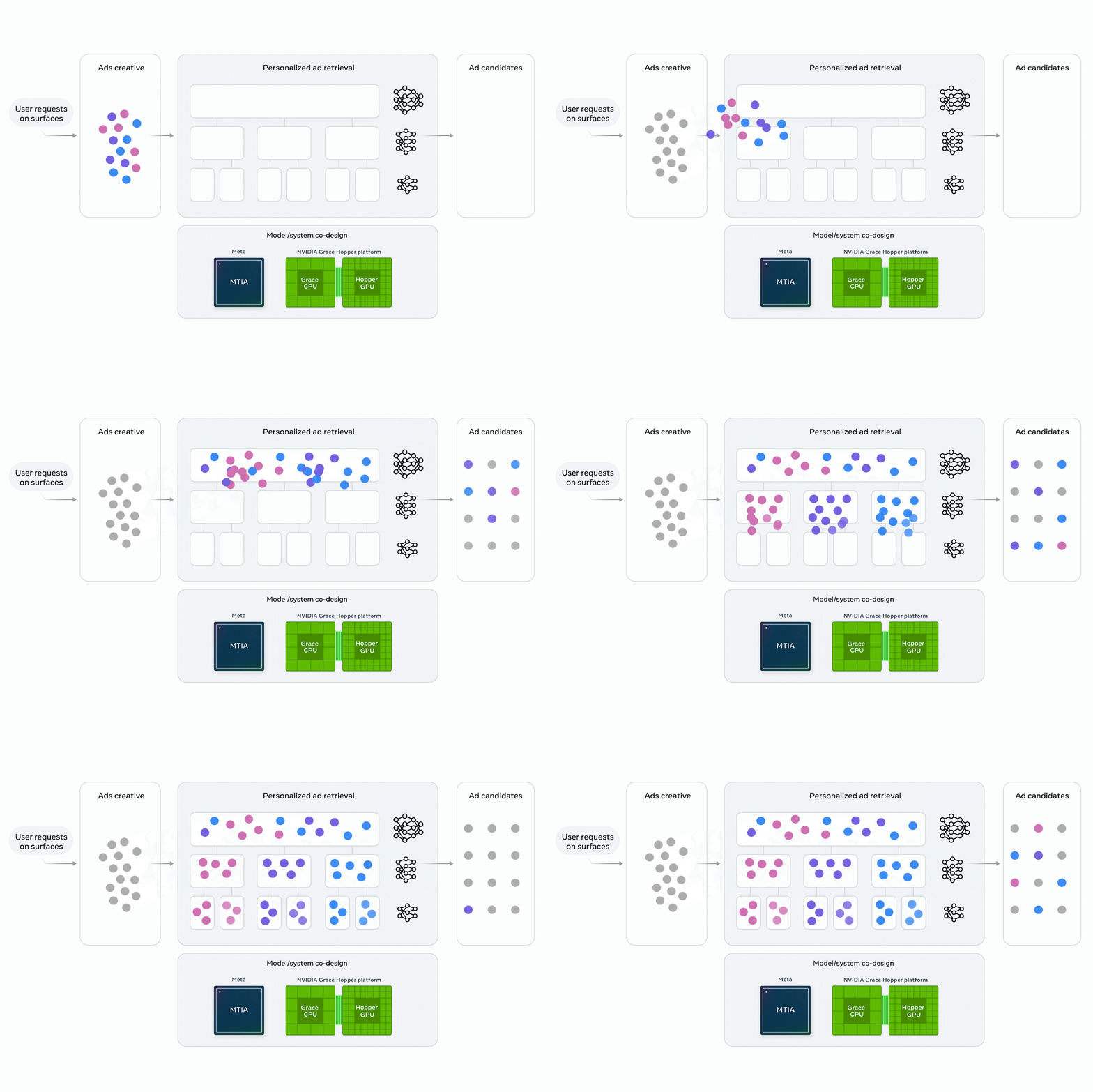
GEM is Meta’s AI-powered creative generation system.
It generates headlines, descriptions, image variations, and ad copy based on product feeds, landing pages, and behavioural data.
For Canadian businesses, GEM’s localisation capabilities are especially valuable.
Ads can adapt messaging regionally, such as highlighting free Quebec shipping or tax-specific messaging in Alberta.
However, human oversight remains critical.
AI-generated copy still requires validation for accuracy, compliance, and brand consistency.
MetaLattice
MetaLattice is Meta’s sequence-learning architecture.
Rather than evaluating single clicks, it models the order of behavioural actions:
Video watched → post engaged → site visited → product viewed → form submitted.
This allows Meta to predict future conversion likelihood far more accurately.
For industries with long buying cycles, this is extremely valuable.
Advantage+ Infrastructure
Advantage+ Shopping automates audience targeting, creative assembly, placements, and budget allocation.
Advantage+ Audience expands beyond seed audiences using predictive modelling while maintaining relevance controls.
For businesses spending meaningful budgets on Meta, these systems are no longer optional.
Why Meta Is Becoming Stronger for B2B
Meta increasingly outperforms LinkedIn in many B2B environments because of lower acquisition costs and stronger behavioural data modelling.
The major unlock is Conversions API.
By sending CRM events server-to-server, businesses can optimise for qualified leads, booked demos, closed deals, and contract renewals — even if those conversions occur months later.
This allows Meta to optimise for actual revenue instead of low-quality form submissions.
For Canadian SaaS firms, consultants, agencies, and enterprise providers, this has become one of the most important structural advantages in modern digital advertising.
AI Localisation for English and French Canada
Canada’s bilingual market creates enormous opportunities for AI-assisted localisation.
Meta’s AI Sandbox tools now support AI dubbing, lip-sync alignment, and multilingual video adaptation.
Businesses can create English and French Canadian campaigns from a single source video, dramatically reducing production costs while increasing regional relevance.
In Quebec, especially, localised creative consistently outperforms generic English campaigns.
Trust increases when prospects hear messaging in their preferred language.
Costs, Taxes, and Budget Expectations in Canada
Meta advertising costs vary significantly by industry.
Typical Canadian benchmarks include:
-
CPC: approximately $0.50 to $3.50
-
CPM: approximately $5 to $15
Competitive sectors such as finance, insurance, legal services, and real estate often exceed these ranges.
For most SMBs, a testing budget of $20 to $50 per day per ad set produces far more reliable learning than ultra-low budgets.
While $5 daily budgets can technically run, optimisation speed becomes extremely limited.
Meta’s algorithm needs sufficient conversion volume to stabilise effectively.
Canadian advertisers must also understand tax obligations.
Since 2021, Meta generally charges GST, HST, or PST on Canadian advertising accounts unless a valid tax number is added under Business Settings billing information.
Businesses should still consult their accountant regarding reporting obligations and self-assessment requirements.
Practical Strategies for Toronto and Ontario Markets
Hyperlocal campaigns continue performing exceptionally well in major Canadian urban centres.
Strong local strategies include:
-
Using a 5–10 kilometre radius targeting
-
Featuring recognisable Toronto landmarks or neighbourhood references
-
Running short-form vertical video content
-
Retargeting website visitors and Instagram engagers from the past 90 days
-
Building lookalike audiences from existing buyers
-
Following up on leads within five minutes whenever possible
Fast follow-up remains one of the largest differentiators between average and high-performing businesses.
Ads generate opportunity.
Sales processes convert it.
Meta Ads vs Google Ads in Canada
Meta and Google serve different functions.
Google captures active intent.
Meta creates and amplifies intent.
Google excels when users already know what they want.
Meta excels at storytelling, awareness, retargeting, and demand generation.
The strongest Canadian growth strategies combine both:
-
Meta for awareness, education, retargeting, and nurture
-
Google for high-intent search capture
Together, they create a full-funnel acquisition system.
Can Canadian Businesses Monetise Directly on Facebook?
Yes.
Canadian creators and businesses can monetise through:
-
In-stream video ads
-
Facebook Shops
-
Branded content partnerships
-
Paid collaborations
-
Affiliate commerce integrations
For many creators, Meta’s ecosystem still remains one of the easiest ways to scale audience-driven monetisation.
Do Meta Ads Still Work for Small Businesses?
Absolutely.
Small businesses often perform extremely well on Meta because local targeting reduces waste.
A business spending as little as $15 to $25 daily can still generate qualified leads if the campaign structure, creative, and follow-up systems are strong.
The biggest factor is not budget size.
It is operational consistency.
Final Takeaway
Meta advertising in Canada has entered a completely different era.
The platform is no longer driven primarily by manual targeting or demographic segmentation. It is now powered by AI systems that analyse behaviour, predict intent, personalise creative, and optimise toward profitable outcomes.
Businesses succeeding in 2026 are combining:
-
First-party data
-
Conversions API
-
Strong creative specificity
-
Patience during optimisation
-
Human oversight
-
Fast lead follow-up
-
Localised messaging
Despite rising competition from newer platforms, Facebook’s massive Canadian user base, deep targeting infrastructure, cross-platform integration, and AI-driven optimisation capabilities still make it one of the strongest growth channels available.
The AI is already capable.
The real advantage now comes from how intelligently businesses guide it.