A practical, down-to-earth look at how virtual assistance can take extra workload off your plate and help your business thrive.
The real value of a VA lies not simply in lower expenses. It is creating capacity without automatically adding another permanent role, desk, or extra overhead.
Running a small business means playing a variety of job roles. You may start the morning talking to a customer and end up spending the afternoon managing emails, updating a spreadsheet, following up a lead, or trying to sort your calendar. None of those jobs is too complicated. The problem is that they all take time away from the work only you can do.
Small businesses should hire virtual assistants because they reduce operating costs, save physical office space, free up time for core business activities by taking over repetitive administrative tasks, and charge only for productive hours, with no payment for idle time, lunch breaks, or rework.
Virtual Assistants help to prevent entrepreneur burnout, offer the flexibility to increase or decrease support as per client requirements, avoid recruitment costs associated with traditional hiring, and require little to no onboarding infrastructure because they have professional skill sets, experience and often have their own specialised tools and software.
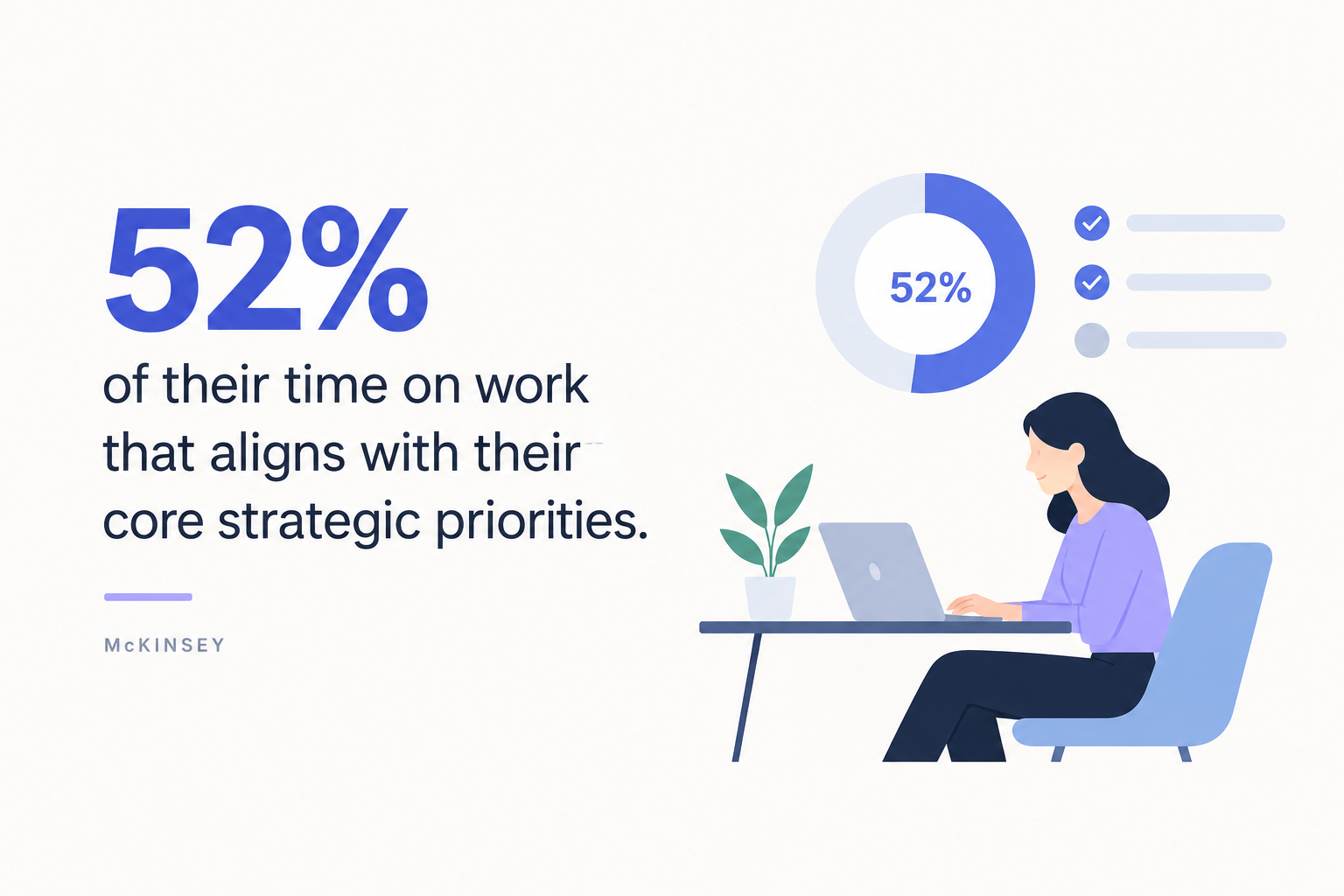
McKinsey has found that leaders spend only about 52% of their time on work that directly supports their core strategic priorities. Only 9% say they are satisfied with how their time is being used.
Virtual assistant services also provide immediate access to specialised skills, ensure 24/7 business coverage, improve customer response times, boost daily productivity, maintain organised digital systems through consistent management of your inbox, calendar, and CRM, strengthen your social media presence, and reduce the cost of bad hires since you can replace a VA when needed.
Through a remote professional, a small business gets access to people with the requisite skills and productive hours without requiring another desk, office, full-time salary, or lengthy recruitment process.
Reduce operating costs without adding another employee
Traditional hiring comes with costs beyond salary. You need to spend time screening people, pay for office equipment, software, employee benefits, training, and other overheads. And nowadays, even to screen a VA, you may need a paid subscription to job-posting sites.
With outsourcing, much of the infrastructure is already in place. You have the option to pay for the hours of support you need rather than hiring and paying for a full-time position when the workload doesn’t justify it.
This freedom can significantly impact operating costs, making virtual assistance a cost-effective strategy for businesses that need additional capacity without adding permanent overhead.
VA Services are more than admin for Businesses
Virtual assistants are indeed a great support for cost-effectiveness, especially when reducing costs and getting rid of repetitive work is a priority. But virtual assistants are not limited to admin work.
You might be surprised to know that skilled graphic designers, developers, app developers, video editors, and content writers work as remote professionals with virtual assistant companies and assist customers without the customer having to pay separately for premium tools.
We even assist marketing companies. One of our customers, who is an Executive Assistant at a Marketing firm, shared a highly positive experience using virtual assistant services for over two years. She describes the service as an “absolute lifesaver,” with the team handling social media graphic design, video editing, reel creation, and converting transcripts into blog posts.
So, virtual assistants can become an integral part of a marketing firm, company, or creative business as well. It goes well beyond admin work, which is a very common misconception.
Go through the service page of a virtual assistant company, and you may be surprised by the range of services they provide.
Pay for productive work
One practical advantage of a virtual assistant is the ability to structure support around productive hours and defined tasks.
Depending on the provider, you may have an hourly rate, pay-as-you-go arrangement, or monthly subscription rates. The work might include email management, calendar management, data entry, invoicing, expense tracking and bookkeeping.
The objective is straightforward: more of your spending goes towards work that actually needs to get done.
Free yourself from repetitive work
Small business owners often end up doing work simply because nobody else is available to do it.
Checking emails. Scheduling meetings. Updating customer records. Preparing reports. Finding prospects. Posting content. Following up with leads.
These administrative tasks may consume a considerable amount of the business owner's time.
A dedicated virtual assistant can take over these routine tasks, allowing the owner and core team to focus their time and energy on customers, sales, strategy, product development, and business growth.
Avoid expensive recruitment cycles
Recruiting a full-time employee takes time.
You need to advertise the position, review applications, conduct interviews, select a candidate, complete paperwork, and handle onboarding and training.
A professional VA provider may already have a vetting process, background checks, and candidate pre-selection in place. This can reduce the time a small business spends searching for the right person.
Get specialised skills when you need them
A small business may need SEO this month, video editing next month, market research the following week, and bookkeeping throughout the year.
Hiring a separate full-time specialist for every requirement is rarely practical.
Virtual assistant services can give you access to different skills without requiring a permanent hire for each one.
Support can include:
-
Administrative support
-
Customer support
-
Customer service
-
Social media management
-
Marketing support
-
Lead generation
-
Bookkeeping
-
Invoicing
-
Data entry
-
CRM updates
-
Project management
-
Market research
-
Appointment scheduling
-
Expense tracking
If a task requires expertise outside your primary VA’s skill set, a broader team can bring in a specialist.
Scale support with your workload
Business workload is rarely constant.
You may need more support during a product launch, busy season, marketing campaign, or period of rapid growth and less support during quieter months.
This is where scalability becomes useful. A business can increase or decrease support according to its workload rather than committing to a permanent headcount for every change in demand.
Virtual Assistance Providers may offer flexible work hours, monthly plans, or pay-as-you-go arrangements, which can be particularly cost-effective for small businesses instead of hiring another full-time employee.
Improve customer response times
Customers may not always contact your business at your convenient time. An inquiry unanswered for a long time, a follow-up that gets forgotten, or an appointment that gets delayed can cost your business an opportunity to grow.
A VA can help you with routine customer support, appointment scheduling, prospect follow-ups, and keeping customer details up to date. Virtual Assistant services offering 24x7 support are really helpful for businesses serving people in different time zones.
Keep your digital systems organised
Digital clutter builds up quietly. One unanswered email becomes ten. A CRM record gets out of date. The calendar fills with overlapping commitments. A file is saved somewhere nobody can remember. Then someone spends half an hour trying to find it.
A VA can keep these systems under control through regular email management, calendar management, CRM updates, file organisation, reporting, and follow-up.
Also, you don't need to change your operational setup. Your VA can often work inside the systems your business already uses, including HubSpot, QuickBooks, Google Workspace, or Microsoft 365.
Strengthen marketing and lead generation
Marketing for a small business often falls behind due to lack of proper support. A VA can take care of prospect research, lead generation, updating the CRM, social media management, content scheduling, competitor research, and other areas of marketing.
For customers speaking more than one language, a bilingual virtual assistant can also make day-to-day communication easier.
Businesses may look for several criteria while selecting a VA.
A VA team in Latin America may be suitable for a US-based business that wants closer time-zone overlap. Another business may care more about cost, specialist skills, availability, or language. There is no single setup that works for everyone.
Reduce entrepreneur burnout
There comes a point when one person is simply doing too many jobs. The owner is the salesperson, administrator, customer service representative, researcher, marketer, scheduler, and project manager—all before lunch.
Handing off work that does not need the owner’s direct involvement can create some much-needed breathing room. More than anything, it gives the owner a chance to focus on productivity, work-life balance, customers, and decisions that actually move the business forward.
Move projects faster
Not all projects are derailed due to big decisions. Some lag due to the smaller jobs related to big decisions not being completed by those not involved, including research, gathering, coordination, documentation, scheduling, and follow-up.
A VA can manage those supporting roles to allow a project owner or the main team to concentrate on decisions that need their experience, maintaining project momentum instead of getting it bogged down in a mass of small tasks.
The result can be faster and more organised project management.
What About Security and Accountability?
Can you trust an external party with your business? Yes, but it has to be with proper safeguards, and the responsibility is shared between the client and the VA.
A professional relationship will set out essential parameters to consider, including confidentiality, communication, timekeeping, and contingencies, so these must be negotiated before beginning work and not when something goes wrong.
How is sensitive data protected?
Avoid sharing passwords where possible, and only give the VA access to the systems necessary to fulfil their role. Equally important are good data security practices, including appropriate encryption, data privacy, data protection, and system access control, which should be in place for the VA, just as they would be for any other employee. If the company works with regulated information, ask how the VA is compliant with the necessary standards of confidentiality.
Will the VA sign an NDA?
If the work requires access to confidential or sensitive information, a Non-Disclosure Agreement can be used to set out parameters for what the VA can and cannot do with the information provided.
How is remote work secured?
Remote work can be perfectly secure if the right precautions are in place. The VA must be able to work from a secure, password-protected environment and have the correct protections in place, such as antivirus and, if needed, a Virtual Private Network (VPN). Working from a public Wi-Fi network is never advisable for any kind of business task.
How do you know what you are paying for?
Time tracking is the most reliable way for a pay-as-you-go or hourly VA. This establishes a transparent working relationship in which the client knows precisely what they are paying for in terms of work done. A clear accounting of hours worked will help everyone understand the value for money.
What happens if the VA is sick or takes a holiday?
That’s a good question; it’s surprising how quickly things can fall apart when the main VA is unavailable and no contingency planning has been done. The best VAs will often have backup support in place, and some companies offer account management to help plan and manage the working relationship, ensuring there is always someone available to help.
What if the VA does not have the right skill?
No one is perfect, and it’s part of the job description to be aware of one’s limitations and know when to ask for help. If a specific skill is required that the VA doesn’t have, such as a higher level of SEO expertise, video editing, design work, or bookkeeping, the provider should have someone on hand who can provide the additional support required.
What if the VA is not the right fit?
A working relationship can break down for any number of reasons, including communication style, availability, skills, or the way a person works.
A good VA service should have a clear replacement process.
Some providers also offer a trial to allow a business to assess the working relationship before entering into a longer-term arrangement.
Are you locked into a long-term contract?
This depends on the provider.
Before engaging a VA, it is also advisable to review the contract, minimum hours, notice, set-up fees, cancellation and whether any unused hours can be carried forward.
Having flexibility can be important for a small business to be able to scale its support, in line with its requirements.
What About AI Virtual Assistants?
Over the last 12 months, artificial intelligence has evolved significantly. Simple chatbots have advanced into autonomous AI agents – capable of taking entire end-to-end multistep business processes from initiation through to completion. They can identify performance issues, maintain a single source of truth, and trigger appropriate conversations to the relevant executives. Most importantly, they can free up human time. Core processes can take 35-40% less time, with some seeing improvements of over 70%.
AI has also radically changed the virtual assistance market.
An AI Virtual Assistant can complete certain repetitive processes via the use of artificial intelligence, machine learning, natural language processing, a chatbot or an AI agent.
Tools such as ChatGPT and Copilot Chat can be used for drafting, research, summarisation, information processing and other processes. However, there are still some processes in which humans excel over AI.
A human VA can interpret context, communicate with customers, make judgment calls, follow up with people, manage exceptions and take ownership of processes that require human interaction.
For many businesses, the issue is not one of humans versus AI, but where they can bring automation and AI into a process and have a remote professional managing the more judgment-heavy aspects of the same topic.
What About VA Companies?
There are a number of different VA providers across the market. Examples include MyTasker, BELAY, Fancy Hands, Time Etc and Virtual Assist USA.
Some providers operate a US-focused service, whereas others may have international or specialism-focused services. A business based in Atlanta, Georgia, for example, may need to have US time zone coverage and will have different requirements than a business that wants to reduce costs, or that requires specific skills or languages.
The important thing in choosing a VA service is to be able to look at the actual services offered, and not be put off by the name or price.
Why Hiring a Virtual Assistant Is About Flexibility, Not Just Costs
The benefits of a VA are not just about being cheaper than employing a full-time assistant.
The key is about flexibility.
A small business can scale its support without immediately creating a larger permanent overhead. They can offload repetitive administrative processes, gain access to specialist skills, provide continued customer service, generate leads, keep digital systems tidy and give their core team more time to spend on core processes. The issue for many small businesses is not whether they can afford a VA, but how much time and capacity they are currently spending on something that could be passed to a virtual assistant.